Tocbál incailich iarnalándiurug quando canitur oblata isforaithmet gene Crist insin tre airde aindocbale [cor.: insin áindocbale tre airde] et [=ocus] firto · Quando canitur accipit Iesus panem · Tanaurnat insacart fathri duaithrigi dia pecthaib atnopuir deo [not in MS: ocus canaid in salmso Miserere mei deus] & slechthith inpopul & nitaet guth isson arnatarmasca insacardd ar issed athechte arnarascra amenme contra deum céne canas inliachtso isde ispericulosa oratio á nomen · Na · iii · chemmen ciṅges infergraith foracúlu & tociṅg afrithisi ised atrede inimruimdethar cachduine id est himbrethir hicocell hiṅgnim & ised ·iii· tresanaith nuigther iterum & trisatoscigther dochorp Crist :~
Tocbal in cailich iarn a landiurug, quando canitur Oblata, is foraithmet gene Crist insin [ocus] tre airde a indocbale (/ a indocbale tre airde) ocus firto.
Quando canitur: Accepit Iesus panem, tanaurnat in sacart fat(h)ri du aithrigi dia pecthaib; atnopuir Deo; ocus slecthith in popul: ocus ni taet guth isson, ar na tar masca in sacardd; ar issed a thechta ar na rascra a menme contra Deum, cene canas in liachtso. Is de is Periculosa Oratio a nomen.
Na tri chemmen cinges in fergraith for a culu, ocus tocing afrithisi, ised a trede in imruimdethar cach duine, idon, himbrethir, hi cocell, hingnim; ocus ised trede tressanaithnuigther iterum, ocus trisatoseigther do Chorp Crist.
The elevation of the chalice, after the full uncovering thereof, quando canitur Oblata (when Oblata is chanted), that is a memorial of the birth of Christ and of His exaltation through signs and miracles.
Quando canitur: Accepit Iesus panem (When is chanted: 'Jesus took bread'), the priest bows himself down thrice to repent of his sins. He offers them [i.e. the bread and chalice] to God, and the people prostrates: and there comes not a sound then, that it disturb not the priest, for it is his duty that his mind separate not contra Deum ('against', i.e. from, God) whist he chants this Lection. It is from this that Periculosa Oratio (the Most Dangerous Prayer) is its nomen (name).
The three steps which the ordained man stepps backwards and which he steps in return, that is the triad wherein sins any person, to wit, in word, in thought, in deed; and that is the triad through which he is renewed iterum (again) and by which he is moved to the Body of Christ.

Showing posts with label Rites. Show all posts
Showing posts with label Rites. Show all posts
Monday, July 9, 2012
Treatise on the Mass (from the Stowe Missal), Part 02


Thursday, May 26, 2011
Treatise on the Mass (from the Stowe Missal), Part 01
According to Wikipedia:
The Stowe Missal is a missal written in Latin and Gaelic which was transcribed at Lorrha Monastery in the ninth century. Also known as the Lorrha Missal, it is known as the 'Stowe' Missal due to its acquisition by one of the Dukes of Buckingham for the Stowe manuscripts collection. Stowe House was sold in 1849 to the Earl of Ashburnham. In 1883 the missal was purchased by the British Government and deposited in the Royal Irish Academy.Here we are going to look upon a tract on the Mass (folios 65-67) written in Old Irish. I would first provide the original Gaelic and Latin text (as it appears in the Missal), a more 'tidied up' version (with proper spacings and punctuations), and an English translation.
The form of the liturgy and the services of baptism and unction reflect a Celtic usage dating from before 650 AD. Whether this is the usage brought by St. Patrick in the early fifth century, or a later revision is not certain. Used during an era in which Christianity was neither universal nor fully understood, it asserts in detail the redemptive nature of Jesus Christ's birth, death and resurrection. The writer(s) assumes that those participating in the Eucharist must have every detail repeated clearly.
Thursday, May 5, 2011
From Youtube: Ambrosian Rite Mass at Rome's Santa Maria Sopra Minerva
A little something I just wanted to introduce.
The video shows the chanting of the Gospel. Note the Ambrosian form of the thurible (no top cover), the manner of censing (clockwise), and the cappino worn by the priest around the neck (derived from the apparelled amice).
The video shows the chanting of the Gospel. Note the Ambrosian form of the thurible (no top cover), the manner of censing (clockwise), and the cappino worn by the priest around the neck (derived from the apparelled amice).
Saturday, August 21, 2010
The Mass in Gaul, Part 3 (from The Mass of the Western Rites)
 |
| Christ in Majesty (c. AD 1100), Chapelle des Moines, Berzé-la-Ville |
the words accompanying it in many liturgies, the sole meaning of this rite is to show to the faithful, before Communion, that it is the very Body and Blood of Christ which they are about to receive; and that their separation under the different species of bread and wine is only apparent. Although at this epoch Communion under both kinds was almost universal, the doctrine that Christ was present, whole and entire, under both species, was none the less of equally universal acceptance. The rites of "Commixtion" or "Immixtion," which are attached to this part of the Mass, seem, in our opinion, to favor this interpretation (see "Immixtion" in DACL).
Thursday, August 19, 2010
The Mass in Gaul, Part 2 (from The Mass of the Western Rites)
THE MASS OF THE FAITHFUL
 |
| The paten from Gourdon. |
But since then it has disappeared, as it has at Rome, and we find in the Gallican liturgy only diaconal litanies, imitated from those in the Byzantine liturgy.
Wednesday, August 18, 2010
The Mass in Gaul, Part 1 (from The Mass of the Western Rites)
THE MASS IN GAUL
The Mass of the Catechumens. -The Mass of the Faithful.
In the volume on "Books of the Latin Liturgy" (Sands & Co., London), pp. 96-103, we have mentioned the different documents by the aid of which the Gallican Mass may be reconstituted and the origins of this liturgy established. On this subject we have also stated that for the description of the Gallican Mass no reliance can be placed on the pretended letters of St. Germain of Paris, though this has been done too often. These letters are not a document of the middle of the sixth century, but an anonymous treatise written a century later (ibid., p. 99). We must therefore, like Mabillon and, more recently, Dom Wilmart (DACL, "Germain, Lettres de St."), keep solely to the other documents which we possess on this subject, and to the texts of contemporary authors, the most valuable of which is that of Gregory of Tours. A very complete bibliography of all these documents will be found in the article ("Gallicanes Liturgies)" of Dom Leclercq, DACL.
Tuesday, August 17, 2010
From the Gallican Rites...
According to the Catholic Encyclopedia:
The Reichenau Fragments (Carlsruhe, 253) are described (no. 8) in Delisle's "Memoire sur d'anciens Sacramentaires." -- These were discovered by Mone in 1850 in a palimpsest manuscript from the Abbey of Reichenau, in the library of Carlsruhe. The manuscript, which is late seventh century, had belonged to John II, Bishop of Constance (760-81). It contains eleven Masses of purely Gallican type, one of which is in honour of St. Germanus of Auxerre, but the others do not specify any festival. One Mass, except the post Post-Pridie which is in prose, is entirely in hexameter verse. Mone published them with a facsimile in his "Lateinische und Griechische Menssen aus dem zweiten bis sechsten Jahrhundert" (Frankfort 1850). They were reprinted in Migne's "Patrologia Latina" (Vol. CXXXVIII), and by Neale and Forbes in "The Ancient Liturgy of the Gallican Church" (Burntisland, 1855–67).
The Reichenau Fragments (Carlsruhe, 253) are described (no. 8) in Delisle's "Memoire sur d'anciens Sacramentaires." -- These were discovered by Mone in 1850 in a palimpsest manuscript from the Abbey of Reichenau, in the library of Carlsruhe. The manuscript, which is late seventh century, had belonged to John II, Bishop of Constance (760-81). It contains eleven Masses of purely Gallican type, one of which is in honour of St. Germanus of Auxerre, but the others do not specify any festival. One Mass, except the post Post-Pridie which is in prose, is entirely in hexameter verse. Mone published them with a facsimile in his "Lateinische und Griechische Menssen aus dem zweiten bis sechsten Jahrhundert" (Frankfort 1850). They were reprinted in Migne's "Patrologia Latina" (Vol. CXXXVIII), and by Neale and Forbes in "The Ancient Liturgy of the Gallican Church" (Burntisland, 1855–67).
MISSA II(collectio.) Deum fidelium saluatorem, conseruatoremque credentium. deum aeterne. inmortalitatis auctorem. fratres dilectissimi. unianimiter dominum depraecemur. ut nobis pietatis suae dono spiritali misericordiam indeficienter inperciat p. d.
(collectio ante nomina.) Deus qui pro magnitudinem tuam per uniuersa deffunderis et ubi tamen totus adsistis. discriteus omnium uoluntatis qualitatebus locis temporibus adque personis. uotorum omnium capax. propiciatus exaudi. dum ad cunctus adspices foues omnebus misereris. p. d.
(post nomina.) Recitata nomina dominus benedieat et accepta sit domino uti huius oblatio. nostrisque praecebus intercessio suffragetur. spiritibus quoque karorum nostrorum laetis sedibus conquiiscant. et primi resurrectionis gaudia consequantur. p. d. nm.
(ad pacem.) Exaudi nos deus salutares noster. et in consortio nos diuinorum sacrificiorum dignanter admitte. hac pacem tuam benignus largire. p. d.
(contestatio.) Dignum et iustum est equum et iustum est ut te sancte pater omnipotens aeterne deus. omnibus locis. omnibusque temporibus. per omnia momenta ueneremur. tibi supplices simus. tibi deferamus praecis, te totis stodiis et effectibus adoremus. deus qui ultra omnibus uirtutis. ultra omnis es potestatis. deux uniuersorum arbiter. judex secretorum. quem caeli et terra. quem angeli et archangeli. quem throni et dominationis. quem cherubin. et serafin. incessabili uoce proclamant dicentes. SS. SCS. SS.
(contestatio.) Dignum et iustum est. nos tibi gratias agere domine deus per Xpm Jhm filium tuum. qui cum deus esset aeternus. homo fieri pro nostra salute dignatus est. unice singulare. et multiplex saluatoris nostri mysterium. nam unus idemque et deus summus et homo perfectus, et pontifex maximus. et sacrificii sacratissimum. secundum diuinam potentiam creauit omnia. secundum humanam conditionem liberabit hominem. secundum uim sacrificii expiauit conmaculatus. secundum jus sacerdocii reconciliauit offensus. O unice redemptionis. mysterium singulare. in quo uetusta ilia uulnera. noua domino medicina sanauit. et primi hominis praeiudicia. salutares nostri praeuiligia resciderunt. ille concupiscientiae exagitatus stimolis. hic oboedientiae, confixus est clauis. ille ad arborem manus incontinenter extendit. iste ad crucem pacienter abtauit. ille uoluptate inlecitus gustus explebit. iste cruciatu indebite dolores afflictus est. ideo merito poena innocentiae facta est absolutio debetores jure. etenim obnoxii demittuntur debita quae pro eis ille qui nihil
habebat absoluit. quod singulare mystirium. non solum homines in terris. uerum etiam. angeli uenerantur in caelis. cui me[rito].
(post sanctus.) Uere sanctus. uere benedictus dominus noster Jhs Xps filius tuus. Qui pridie.
(post mysterium.) Domini ac dei nostri sempeterni gloriam depraecemur. orantis uti hoc sacrificium tua benedictione. benedicas et sancti spiritus tui rore perfundas. ut accipientibus uniuersis. legitima sit eucharestia per Jhm Xpm filium tuum deum ac dominum conseruatoremque nostrum, cui est aput te domine cum spiritum sanctum regnum sempiternum perpettia diuinitas in secula seculorum amen.

Tuesday, June 29, 2010
June 29: The Feasts of Saints Peter and Paul
- The Inlatio of the Feast, from the Missale Mixtum (Mozarabic Rite)DIGNUM et justum est: omnipotens Pater nos tibi ingentes agere gratias: pro multiplici Apostolorum Petri et Pauli gloria: quam eis per diversas munerum distributiones larga satis pietate donasti. Quos et unigeniti tui discipulos: et fecisti esse magistros. Qui ob Evangelii predicationem cum celorum preficiantur in regnis: carcerum clauduntur angustiis. Potestatem accipiunt solvendi: et ferri vinculis alligantur. Sanitatem donant: et egritudines portant. Demonibus imperant: et ab hominibus flagellantur. Mortes fugant: et fugiunt persequentes. Super mare ambulant: et labore desudant. Montes verbo transferrant: et propriis victum manibus querunt. Judicaturi Angelos: in questionem mittuntur. Cum Deo vivunt: in mundo periclitantur. Postremo Christus eis serviens pedes lavat: el facies eorum blasfemantium manus alapis collapbizat. Nihil sustinentibus pene defuit ad tolerantiam: nihil superantibus victorie non adfuit ad coronam. Si recurramus: quot ad testificandam fidei veritatem erumnarum pertulerint in tormentis frequenter suis: superfuere Martyribus. Si in mirabilibus: hoc per Christum fecere: quod Christus. Si in passionibus: hoc sustinuerunt illi necessitate mortali: quod ille voluntate moriendi. Isti ejus viribus: ille suis. Probantes doctrine auctoritatem similitudine: non equalitate doctoris. Implevit Petrus suo tempore: quod promiserat ante tempus. Posuit animam suam pro illo: quem se non crediderat negaturum. Quia ad ardue sponsionis celeritatem nimia charitate preventus non intellexit servum pro Domino
dare non posse: quod pro servo ante Dominus non dedisset. Similiter non renuit crucifigi: sed equaliter non presumpsit appendi. Obiit ille rectus: iste subjectus. Ille ut majestatem ascendentis sublimitate proferret: iste ut fragilitatem descendentis humilitate monstraret.
Nec Paulus affectu minor meminit: quemsibi arrogaverat dicens: Mihi vivere Christus est: et mori lucrum. Gaudet insanientis ictibus percussoris: domitas jugo Christo offerre cervices: et pro corporis sui capite: dare corporis sui caput. Diviserunt sibi passionis Dominice vestimentum duo milites Dei: unus in patibulo: alter in gladio. Petrus in transfixione: Paulus in sanguine. His igitur dispari mortis genere: non dispari moriendi amore perfunctis. Exultet in eorum doctrinis Ecclesia Catholica: in exis religiositas universa: in memoriis Urbs Romana: in patrociniis omnis anima christiana. Неc autem omnia tu Domine operaris: qui a Prophetis demonstraris: ab Angelis adoraris: et in omni seculo Apostolorum lumine declararis. Cui merito omnes Angeli et Archangeli non cessant clamare quotidie ita dicentes:
Sanctus, Sanctus, Sanctus
Dominus Deus Sabaoth:
Pleni sunt celi et terra gloria majestatis tue:
Osanna filio David.
Benedictus qui venit in nomine Domini:
Osanna in excelsis.
Agyos, Agyos, Agyos, Kyrie o Theos.


Saturday, June 19, 2010
Crédimus in unum Deum...

Fidem, quam corde crédimus, ore autem dicámus:Crédimus in unum Deum Patrem omnipoténtem, factórem caeli et terrae, visibílium ómnium et invisibílium Conditórem.Thus is the Creed in the Mozarabic Rite of Spain. One interesting thing that you'll notice first here is that the Mozarabic Creed was, and is recited in the first-person plural (Crédimus...confitémur...expectamus, 'We believe...we confess...we await') as was the case with the Coptic, Ethiopian, Chaldean, and Armenian liturgies. This is in contrast to other Eastern and Western rites where the pronoun is changed to the singular (Credo...confiteor...expecto). In this respect this version preserves the form adopted by the First Councils of Nicaea and Constantinople, which was in the plural.
Et in unum Dóminum nostrum Jesum Christum, Fílium Dei Unigénitum, et ex Patre natum ante ómnia sæcula; Deum ex Deo, Lumen ex Lúmine. Deum verum ex Deo vero; natum non factum, Omoúsion Patri, hoc est, ejúsdem cum Patre substántiae; per quem ómnia facta sunt, quae in caelo, et quae in terra.
Qui propter nos hómines, et propter nostram salútem, descendit de caelis, et incarnátus est de Spíritu Sancto ex María Vírgine, et homo factus est. Passus sub Póntio Piláto, sepúltus, tértia die resurréxit, ascéndit ad caelos, sedet ad déxteram Dei Patris omnipoténtis. Inde ventúrus est judicáre vivos et mórtuos, cujus regni non erit finis.
Et in Spíritum Sanctum, Dóminum vivificatórem, et ex Patre et Fílio procedéntem. Cum Patre et Fílio adorándum et conglorificándum; qui locútus est per prophétas.
Et unam, sanctam, Cathólicam et Apostólicam Ecclésiam.
Confitémur unum baptísma in remissiónem peccatórum.
Expectámus resurrectiónem mortuórum, et vitam ventúri saeculi.
Amen.
Now this, of course predated ICEL's changing of the Roman version from the singular to the plural during translation of the text. ;)
The Triduum as it was in the Church of Rome: Holy Thursday from the Gelasian Sacramentary, Part 2
(Part 1 here)
RECONCILIATIO POENITENTIS AD MORTEM.
Deus misericors, Deus clemens, qui secundum multitudinem miserationum tuarum peccata poenitentium deles, et praeteritorum criminum culpas venia remissionis evacuas, respice super hunc famulum tuum et remissionem sibi omnium peccatorum tota cordis confessione poscentem deprecatus exaudi. Renova in eo, piissime Pater, quicquid terrena fragilitate corruptum est vel quicquid diabolica fraude violatum est: in unitatem corporis ecclesiae tuae membrum, perfecta remissione restitue: miserere, Domine gemituum, miserere lacrimarum, et non habentem fiduciam, nisi in tua misericordia, ad sacramentum reconciliationis admitte: Per.
Maiestatem tuam, Domine, supplices deprecamur, ut huic famulo tuo, longo squalore poenitentiae macerato, miserationis tuae veniam largire digneris, ut nuptiale veste recepta, ad regalem mensam unde eiectus fuerat mereatur intrare. Per.
RECONCILIATIO POENITENTIS AD MORTEM.
Deus misericors, Deus clemens, qui secundum multitudinem miserationum tuarum peccata poenitentium deles, et praeteritorum criminum culpas venia remissionis evacuas, respice super hunc famulum tuum et remissionem sibi omnium peccatorum tota cordis confessione poscentem deprecatus exaudi. Renova in eo, piissime Pater, quicquid terrena fragilitate corruptum est vel quicquid diabolica fraude violatum est: in unitatem corporis ecclesiae tuae membrum, perfecta remissione restitue: miserere, Domine gemituum, miserere lacrimarum, et non habentem fiduciam, nisi in tua misericordia, ad sacramentum reconciliationis admitte: Per.
Maiestatem tuam, Domine, supplices deprecamur, ut huic famulo tuo, longo squalore poenitentiae macerato, miserationis tuae veniam largire digneris, ut nuptiale veste recepta, ad regalem mensam unde eiectus fuerat mereatur intrare. Per.
Tuesday, April 6, 2010
The Triduum as it was in the Church of Rome: Holy Thursday from the Gelasian Sacramentary, Part 1
 At Rome during the 4th to 6th century, Holy Thursday was a day for the reconciliation of the penitents. In the 7th century, there were two Masses in churches celebrated by priests: one in the morning to close out Lent, and the other in the evening to commemorate the institution of the Eucharist. But during noon, a Mass was celebrated by the Pope (=Bishop of Rome) and consecrated the chrism and blessing the oils. The ministers were also instructed to reserve a portion of the "sacrifice" consecrated in this Mass for the next day: reservant de ipso sacrificio in crastinum unde communicent, as the Gelasian notes in its rubrics.
The Sacramentary contains the propers for three Masses: one for the closing of Lent, another for the chrism, and yet another for the Last Supper.
Tuesday, January 12, 2010
And Now...
Two random articles from E.G. Atchley's Ordo Romanus Primus that might be of some interest:
ii. Lights.
The basilicas and churches were illuminated when need was with lamps and candles, of which we have very frequent mention in the Liber Pontificalis and elsewhere. The numerous gifts, for example, recorded in the Life of St. Silvester, which although probably of later date than the time of Constantine yet belong to an early period, include large lamps in which scented oils burned, heavy silver candelabra for the nave of the Lateran Basilica, and seven bronze candlesticks before the altar in the same; and in the time of Innocent I there was said to be twenty brazen candelabra in the nave of the church of SS. Gervase and Protase, each weighing forty pounds. Later on, Pope Leo III ordained that on Sundays and festivals lights should be set on either side of the lectern during the reading of the lessons.
Prudentius makes the Prefect of the City inquire of St. Laurence for the silver scyphi in which the sacred blood was held, and for the golden candlesticks in which the tapers were set at their nocturnal meetings. Paulinus of Nola (θ 431) describes the lights in his basilica of St. Felix at the festival in the following lines:'Now the golden doors are adorned with curtains all snow-white,So, in another poem on the same subject, he mentions tapers fixed to the pillars of the church, giving forth scented odours, and lamps hanging by brazen chains in the spaces between them. These he compares to a tree full of branches, bearing little glass vessels at the end like fruit in which the lights burn: the whole candelabrum, when lit, rivalling the crowd of stars with its numerous flames.
Thickly crowned with lamps the altars are brilliantly shining:
Lights are burning, and give forth the scent of the waxen papyrus,
Night and day they shine: thus night with the splendour of daylight
Blazes, and day itself, made bright with heavenly beauty,
Shines yet brighter, its light by lamps innumerable doubled.'
We have got beyond mere lighting for necessity here, for the lamps were lit by day as well as by night at the festival of St. Felix: the lights are become signs of rejoicing, a common practice amongst most nations of antiquity. The well-known lines of Juvenal will suffice to recall the custom of pagan Rome:'All things are gay: my doorway now is decked with tall branches,
And is keeping the feast with lanterns lit in the morning.'St. Paulinus also mentions lamps (lychni) hanging by brazen
chains in the basilica of St. Felix. And in the Life of Pope Hilarus we read of four golden lamps burning before the Confession in the Oratory of the Holy Cross, and ten silver candelabra hanging before the altar of the Lateran Basilica. Belisarius is recorded, in the Life of Pope Vigilius, to have offered of the spoils of the Vandals two large silver-gilt candlesticks, which stood (at the time when the biographer wrote) before the body of blessed Peter in the Vatican Basilica. There was also a branched candelabrum hanging by golden chains in the covered space (pergula) before the same Confession, given in the time of Leo III; this pope also ordained that two lamps should burn every night before the altar in the same Basilica. Pope Paschal caused them to burn by day as well as by night.
iii. Incense.
From lights to incense is but a step. The list of gifts recorded in the Liber Pontificalis under St. Silvester mentions Donum aromaticum ante altaria, after the censers. As the latter weighed thirty pounds, the passage may mean that the aromatics were burned in censers hung before the altar of the Lateran Basilica. Boniface I (418-422) is said to have ordained that no woman or man, save only a minister, should burn incense (incensum poneret). We do not meet with censers in the Liber Pontificalis before the time of Sixtus III (432-440), except in the Life of Silvester; and these latter, as was mentioned before, seem to belong rather to the time of Hilarus.
In the church of SS. Marcellinus and Peter aromatics were burned before the relics of the patron saints who were buried therein, according to the compiler of the Life of St. Silvester. Later on, Pope Sergius (687-701) hung a golden censer, with columns and a cover, before the images of St. Peter in the Vatican Basilica, 'in which incense and the odour of sweetness were put while mass was being celebrated, on festivals.' We find a similar practice at Cremona in 666, and in England under Theodore (668-690). Leo III (795-816) set up a golden censer before the vestibule of the altar in the same basilica, which weighed seventeen pounds. In the Life of Leo IV (847-855) we are told of a censer with a hanging cup (canthara) at the basilica of the Four Crowned Martyrs.
We have already dealt with the ceremonial use of incense in the pope's procession to the altar, and the deacon's procession to the ambo to read the gospel. Ordo I also mentions that the sexton and the assistant presbyter of the
stational church welcomed the pope with incense on his arrival there.
Incense was only used in the Roman rite at these two liturgical moments, save the occasional use in some basilicas of a hanging censer, burning all through the service, before some altar or image. When Amalar of Metz went to Rome for the furtherance of his liturgical studies, he found that the Ordo Romanus, by which he had set such store, had misled him in several particulars, which he recorded in the second preface to his book on the Ecclesiastical Offices. There he tells us that the Romans did not offer incense at the altar after the gospel; and there is no reference to any such practice in Ordo I, although the Gallicanized Ordo II directs it to be done.


Thursday, October 8, 2009
The 'Missa Graeca'
Recently, I came across something little-known, yet interesting.
It is a well-known fact that for the early centuries of Christianity, Koine Greek was the predominant language among believers, reflecting its status in the Empire as a lingua franca and the hold it has on the eastern areas (where Christianity originated). The same held true for the city of Rome itself (initially to the large number of Greek slaves in Roman households).
However, by the 4th century AD, Greek no longer held such dominance over Latin in the western Church, arts and sciences as it had previously, resulting to a great extent from the growth of the western provinces. As centuries went on, popular knowledge of Greek disappeared, save for the scraps which the liturgies of the West preserved (one of which is the familiar Kyrie Eleison). "Latin was enough of a problem by itself: it was no longer anyone's native language, but it was nevertheless indispensable as the language of the liturgy, political administration, scholarship, and most arts, and almost all energy expended on language learning was concentrated on Latin. Greek could at best be one's "second foreign language"-and thus only a very few medieval Westerners acquired the ability to understand a Greek text with unfamiliar content." (Walter Berschin, "Valuation and Knowledge of Greek")
Due to the scholarly interest in Greek, there circulated a fad of using the Greek language for the ordinary as well as the propers of the Mass at high feasts in a number of places during the Carolingian period (ca. 9th-11th centuries AD), which in turn survived in a few locales such as the Royal Abbey of Saint-Denis (which retained this tradition well into the French Revolution). These texts - usually showing the Greek in transliterated Latin characters - are collectively known as the Missa Graeca, the "Greek Mass". For example, three out of many variants of transliterating the Agnus Dei (along with the actual Greek version):
 Here, meanwhile is the Sanctus and the Gloria from an 9th-century missal from St. Denis (BN lat. 2290):
It is a well-known fact that for the early centuries of Christianity, Koine Greek was the predominant language among believers, reflecting its status in the Empire as a lingua franca and the hold it has on the eastern areas (where Christianity originated). The same held true for the city of Rome itself (initially to the large number of Greek slaves in Roman households).
However, by the 4th century AD, Greek no longer held such dominance over Latin in the western Church, arts and sciences as it had previously, resulting to a great extent from the growth of the western provinces. As centuries went on, popular knowledge of Greek disappeared, save for the scraps which the liturgies of the West preserved (one of which is the familiar Kyrie Eleison). "Latin was enough of a problem by itself: it was no longer anyone's native language, but it was nevertheless indispensable as the language of the liturgy, political administration, scholarship, and most arts, and almost all energy expended on language learning was concentrated on Latin. Greek could at best be one's "second foreign language"-and thus only a very few medieval Westerners acquired the ability to understand a Greek text with unfamiliar content." (Walter Berschin, "Valuation and Knowledge of Greek")
Due to the scholarly interest in Greek, there circulated a fad of using the Greek language for the ordinary as well as the propers of the Mass at high feasts in a number of places during the Carolingian period (ca. 9th-11th centuries AD), which in turn survived in a few locales such as the Royal Abbey of Saint-Denis (which retained this tradition well into the French Revolution). These texts - usually showing the Greek in transliterated Latin characters - are collectively known as the Missa Graeca, the "Greek Mass". For example, three out of many variants of transliterating the Agnus Dei (along with the actual Greek version):
1: O Amnos tutheu, o eronthas amarthias tuchosmu, eleyson imas.
2: Ao amnos tutheu, oerronan tin amartias tu cosmu, eleison imas.
3: Oamnos tu theu, oerontas amartias tu kosmu, eleison imas.
ὁ ἀμνὸς τοῦ Θεοῦ, ὁ αἴρων τὰς ἁμαρτίας τοῦ κόσμου, ἐλέησον ἡμᾶς.
(O amnos tou Theou, o airon tas amartias tou kosmou, eleison imas).
 Here, meanwhile is the Sanctus and the Gloria from an 9th-century missal from St. Denis (BN lat. 2290):
Doxa en ypsistis Theo ke epi gis irini en antropis eudokia enumen se eulogumen se proskunumen se doxologumen se eucharistumen se dia tin megalin su doxan Kyrrie basileu ep uranie thee Pater pentocrator kyrrie yie monogeni Iisu Christe ke Agion Pneuma. Kyrrie o Theos o amnos tutheu o yios tu Patros o eron tin amartian tu kosmu eleison imas oerontas amartias tu kosmu pros de ke tin deisin imon kathimenos en dexia tu Patros eleison imas oti sy i monos agios sy iomonos Kyrrios sy i monos ypsistos Iisus Christos syn Agion Pneumati is doxan Theu Patrosa. Amin.
Agios Agios Agios Kyrios pliris
ouranos ke igitis doxis
osanna entys ypsistys
eulogemenos o ercomenos
en onomati Kyrriu
osanna entys ypsistis.
Tuesday, February 3, 2009
The Mass in Köln (the Use of Köln, Germany), part 6

Hic accipit corpus in manibus dicat. Panem coelestem accipiam, et nomen Domini invocabo.
Hic ter tundat pectus suum. Domine, non sum dignus, ut intres sub tectum meum: sed tantum dic verbo, et sanabitur anima mea.
Sumat corpus et dicat. Corpus Domini nostri Jesu Christi custodiat animam meam in vitam aeternam. Amen.
Inclinatus dicat. Quid retribuam Domino pro omnibus quae retribuit mihi? Hic accipit in manus calicem dicens Calicem salutaris accipiam, et nomen Domini invocabo. Laudans + invocabo Dominum, et ab inimicis meis salvus ero.
Hic sumat Sanguinem dicens. Sanguis Domini nostri Jesu Christi custodiat animam meam in vitam aeternam. Amen.
Post perceptionem. Corpus tuum, Dómine, quod sumpsi, et Sanguis, quem potávi, adhaereat viscéribus meis: et praesta, ut in me non remáneat scélerum mácula, quem pura et sancta refecérunt Sacraménta: Qui vivis et regnas in saecula sæculórum.
Quod ore sumpsimus, Domine, pura mente capiamus: et de munere temporali fiat nobis remedium sempiternum. Per Christum Dóminum nostrum. Amen.
Deinde Communio et postea.
V. Dóminus vobíscum. R. Et cum Spíritu tuo.
Oremus. sequitur Complenda quam finitam respondetur Amen. deinde benedicens populum.
V. Dóminus vobíscum. R. Et cum Spíritu tuo.
Quando Gloria dicatur Ite Missa est, quando non dicitur Benedicámus Dómino. R. Deo grátias.
Benedícat vos omnípotens Deus, Pater, et Fílius, + et Spíritus Sanctus. R. Amen.
Finita Missa inclinet se dicens. Placeat tibi, sancta Trinitas, obsequium servitutis meae: et praesta, ut sacrificium quod oculis tuae majestatis indignus obtuli, tibi sit acceptabile, mihique, et omnibus, proquibus illud obtuli, sit te miserante propitiabile. Per Christum Dominum nostrum. Amen.
Osculando Altare dicit: Méritis et intercessiónibus istórum et ómnium Sanctórum suórum miseriátur nostri omnípotens Deus per Christum Dóminum nostrum. Amen.
deinde in cornu Evangelii
V. Dóminus vobíscum. R. Et cum Spíritu tuo.
Prosequitur. + Inítium sancti Evangelii secundum Joánnem.
In principio erat Verbum et Verbum erat apud Deum, et Deus erat Verbum. Hoc erat in principio apud Deum. Omnia per ipsum facta sunt, et sine ipso factum est nihil quod factum est; in ipso vita erat, et vita erat lux hominum; et lux in tenebris lucet, et tenebrae eam non comprehenderunt. Fuit homo missus a Deo cui nomen erat Joannes. Hic venit in testimonium, ut testimonium perhiberet de lumine, ut omnes crederent per illum. Non erat ille lux, sed ut testimonium perhiberet de lumine. Erat lux vera quae illuminat omnem hominem venientem in hunc mundum. In mundo erat, et mundus per ipsum factus est et mundus eum non cognovit. In propria venit, et sui eum non receperunt. Quotquot autem receperunt eum, dedit eis potestatem filios Dei fieri; his qui credunt in nomine eius, qui non ex sanquinibus, neque ex voluntate carnis, neque ex voluntate viri, sed ex Deo nati sunt. Et verbum caro factum est et habitavit in nobis; et vidimus gloriam eius gloriam quasi unigenti a Patre, plenum gratiae et veritatis.
=============================
Here he shall take the Body in his hands and say: I will take the Bread of heaven, and call upon the name of the Lord.
Here he shall beat his breast three times: Lord, I am not worthy that You should enter under my roof; but only say the word, and my soul shall be healed.
He shall receive the Body and say: May the Body of our Lord Jesus Christ preserve my soul unto life everlasting. Amen.
He shall bow and say: What return shall I make to the Lord for all He has given to me? Here he shall take the chalice in his hands and say: I will take the Chalice of salvation, and call upon the name of the Lord. Praising + I will call upon the Lord, and I shall be saved from my enemies.
Here he shall receive the Blood, saying: May the Blood of our Lord Jesus Christ keep my soul unto life everlasting, Amen.
After partaking: May your Body, O Lord, which I have received, and your Blood which I have drunk, cleave to my bowels; and grant that no stain of sin may remain in me, whom your pure and holy sacraments have refreshed; who lives and reigns forever and ever. Amen.
Grant, Lord, that what we have taken with our mouth we may receive with a pure mind; and that from a temporal gift it may become for us an eternal remedy.
Then the Communion follows; and afterwards:
V. The Lord be with you. R. And with your spirit.
Let us pray. Then follows the Post-Communion, when it is ended is said Amen. Then the blessing of the people.
V. The Lord be with you. R. And with your spirit.
When the Gloria is said: Go, the dismissal is made (the Mass is ended), when it is not said: Let us bless the Lord. R. Thanks be to God.
May the almighty God bless you: Father, Son, + and Holy Spirit. R. Amen.
When Mass is ended, he bows and says: May the homage of my service be pleasing to you, O holy Trinity; and grant that the sacrifice which I, though unworthy, have offered in the sight of your majesty, may be acceptable to your: and through your mercy win forgiveness for me and for all those for whom I have offered it. Through Christ our Lord. Amen.
Kissing the Altar, he says: Through their merits and intercession, and of all His saints, almighty God have mercy on us; through Christ our Lord. Amen.
Then on the Gospel side (of the Altar):
V. The Lord be with you. R. And with your spirit.
Then follows: + The beginning of the Holy Gospel according to John.
In the beginning was the Word, and the Word was with God, and the Word was God. He was in the beginning with God. All things were made by Him: and without Him was made nothing that was made. In Him was life, and the life was the light of men. And the Light shines in the darkness, and the darkness did not comprehend it.
Hic ter tundat pectus suum. Domine, non sum dignus, ut intres sub tectum meum: sed tantum dic verbo, et sanabitur anima mea.
Sumat corpus et dicat. Corpus Domini nostri Jesu Christi custodiat animam meam in vitam aeternam. Amen.
Inclinatus dicat. Quid retribuam Domino pro omnibus quae retribuit mihi? Hic accipit in manus calicem dicens Calicem salutaris accipiam, et nomen Domini invocabo. Laudans + invocabo Dominum, et ab inimicis meis salvus ero.
Hic sumat Sanguinem dicens. Sanguis Domini nostri Jesu Christi custodiat animam meam in vitam aeternam. Amen.
Post perceptionem. Corpus tuum, Dómine, quod sumpsi, et Sanguis, quem potávi, adhaereat viscéribus meis: et praesta, ut in me non remáneat scélerum mácula, quem pura et sancta refecérunt Sacraménta: Qui vivis et regnas in saecula sæculórum.
Quod ore sumpsimus, Domine, pura mente capiamus: et de munere temporali fiat nobis remedium sempiternum. Per Christum Dóminum nostrum. Amen.
Deinde Communio et postea.
V. Dóminus vobíscum. R. Et cum Spíritu tuo.
Oremus. sequitur Complenda quam finitam respondetur Amen. deinde benedicens populum.
V. Dóminus vobíscum. R. Et cum Spíritu tuo.
Quando Gloria dicatur Ite Missa est, quando non dicitur Benedicámus Dómino. R. Deo grátias.
Benedícat vos omnípotens Deus, Pater, et Fílius, + et Spíritus Sanctus. R. Amen.
Finita Missa inclinet se dicens. Placeat tibi, sancta Trinitas, obsequium servitutis meae: et praesta, ut sacrificium quod oculis tuae majestatis indignus obtuli, tibi sit acceptabile, mihique, et omnibus, proquibus illud obtuli, sit te miserante propitiabile. Per Christum Dominum nostrum. Amen.
Osculando Altare dicit: Méritis et intercessiónibus istórum et ómnium Sanctórum suórum miseriátur nostri omnípotens Deus per Christum Dóminum nostrum. Amen.
deinde in cornu Evangelii
V. Dóminus vobíscum. R. Et cum Spíritu tuo.
Prosequitur. + Inítium sancti Evangelii secundum Joánnem.
In principio erat Verbum et Verbum erat apud Deum, et Deus erat Verbum. Hoc erat in principio apud Deum. Omnia per ipsum facta sunt, et sine ipso factum est nihil quod factum est; in ipso vita erat, et vita erat lux hominum; et lux in tenebris lucet, et tenebrae eam non comprehenderunt. Fuit homo missus a Deo cui nomen erat Joannes. Hic venit in testimonium, ut testimonium perhiberet de lumine, ut omnes crederent per illum. Non erat ille lux, sed ut testimonium perhiberet de lumine. Erat lux vera quae illuminat omnem hominem venientem in hunc mundum. In mundo erat, et mundus per ipsum factus est et mundus eum non cognovit. In propria venit, et sui eum non receperunt. Quotquot autem receperunt eum, dedit eis potestatem filios Dei fieri; his qui credunt in nomine eius, qui non ex sanquinibus, neque ex voluntate carnis, neque ex voluntate viri, sed ex Deo nati sunt. Et verbum caro factum est et habitavit in nobis; et vidimus gloriam eius gloriam quasi unigenti a Patre, plenum gratiae et veritatis.
=============================
Here he shall take the Body in his hands and say: I will take the Bread of heaven, and call upon the name of the Lord.
Here he shall beat his breast three times: Lord, I am not worthy that You should enter under my roof; but only say the word, and my soul shall be healed.
He shall receive the Body and say: May the Body of our Lord Jesus Christ preserve my soul unto life everlasting. Amen.
He shall bow and say: What return shall I make to the Lord for all He has given to me? Here he shall take the chalice in his hands and say: I will take the Chalice of salvation, and call upon the name of the Lord. Praising + I will call upon the Lord, and I shall be saved from my enemies.
Here he shall receive the Blood, saying: May the Blood of our Lord Jesus Christ keep my soul unto life everlasting, Amen.
After partaking: May your Body, O Lord, which I have received, and your Blood which I have drunk, cleave to my bowels; and grant that no stain of sin may remain in me, whom your pure and holy sacraments have refreshed; who lives and reigns forever and ever. Amen.
Grant, Lord, that what we have taken with our mouth we may receive with a pure mind; and that from a temporal gift it may become for us an eternal remedy.
Then the Communion follows; and afterwards:
V. The Lord be with you. R. And with your spirit.
Let us pray. Then follows the Post-Communion, when it is ended is said Amen. Then the blessing of the people.
V. The Lord be with you. R. And with your spirit.
When the Gloria is said: Go, the dismissal is made (the Mass is ended), when it is not said: Let us bless the Lord. R. Thanks be to God.
May the almighty God bless you: Father, Son, + and Holy Spirit. R. Amen.
When Mass is ended, he bows and says: May the homage of my service be pleasing to you, O holy Trinity; and grant that the sacrifice which I, though unworthy, have offered in the sight of your majesty, may be acceptable to your: and through your mercy win forgiveness for me and for all those for whom I have offered it. Through Christ our Lord. Amen.
Kissing the Altar, he says: Through their merits and intercession, and of all His saints, almighty God have mercy on us; through Christ our Lord. Amen.
Then on the Gospel side (of the Altar):
V. The Lord be with you. R. And with your spirit.
Then follows: + The beginning of the Holy Gospel according to John.
In the beginning was the Word, and the Word was with God, and the Word was God. He was in the beginning with God. All things were made by Him: and without Him was made nothing that was made. In Him was life, and the life was the light of men. And the Light shines in the darkness, and the darkness did not comprehend it.
There was a man sent from God whose name was John. This man came for a witness to give testimony of the light, that all men might believe through him. He was not the Light, but was to give testimony of the Light. That was the true Light, which enlightens every man that comes into this world. He was in the world, and the world was made by Him, and the world knew Him not. He came to His own, and His own received Him not. But as many as received Him, He gave them power to be made the sons of God, to them that believe in His name: who are born, not of bloods, nor of the will of the flesh, nor of the will of man, but of God. And the Word was made flesh, and dwelt among us, and we saw His glory, the glory as it were of the only begotten of the Father, full of grace and truth.
Friday, October 31, 2008
The Mass in Köln (the Use of Köln, Germany), part 5
 A statue of St. Christopher from the Cathedral of Köln, created ca. 1470 by Tilman van der Burch.
Oremus. Praeceptis salutaribus moniti, et divina institutione formati, audemus dicere:
Pater noster, qui es in coelis: sanctificetur nomen tuum: adveniat regnum tuum: fiat voluntas tua, sicut in coelo, et in terra. Panem nostrum quotidianum da nobis hodie, et dimitte nobis debita nostra, sicut et nos dimittimus debitoribus nostris. Et ne nos inducas in tentationem.
R. Sed libera nos a malo. Amen.
Hic elevet patenam sub silentio dicens.
Libera nos, quaesumus, Domine, ab omnibus malis præteritis, praesentibus, et futuris: et intercedente beata et gloriosa semper Virgine Dei Genitrice Maria, cum beatis Apostolis tuis Petro et Paulo, atque Andrea, et omnibus Sanctis, da propitius pacem in diebus nostris: Hic osculetur patenam faciendum cruxem ut ope miseri+cordiae tuae adjuti, et a peccato simus semper liberi, signet secum patenam in fronte et ab omni perturbatione securi. Hic dividat hostiam per medium. Per eumdem Dominum nostrum Jesum Christum Filium tuum, dividat alteram partem qui tecum vivit et regnat in unitate Spiritus Sancti Deus. Levet calicem dicens Per omnia saecula saeculorum. Amen.
Hic faciat crucem cum tertia parte hostiae super calicem
Pax + Domini sit + semper vobis+cum.
R. Et cum spiritu tuo.
Hic elevet patenam sup silentio dicens.
Fiat haec commixtio et consecratio Corporis et Sanguinis Domini nostri Jesu Christi ómnibus nobis suméntibus salus mentis et córporis in vitam aetérnam. Amen.
Deinde
Agnus Dei, qui tollis peccata mundi: miserere nobis.
Agnus Dei, qui tollis peccata mundi: miserere nobis.
Agnus Dei, qui tollis peccata mundi: dona nobis pacem.
Domine Jesu Christe, qui dixisti Apostolis tuis: Pacem relinquo vobis, pacem meam do vobis: ne respicias peccata mea, sed fidem Ecclesiae tuae: hic osculatur Altare eamque secundum voluntatem tuam, pacificare deinde Librum et coadunare digneris: qui vivis et regnas Deus, per omnia saecula saeculorum. Amen.
Deinde osculando corporale et det pacis dicens.
Pax tibi et Ecclésiæ Dei abúndet in córdibus nostris.
Deinde osculato pacis osculo dicat super Ministrum Pax tecum.
Deinde Habéte vínculum pacis et caritátis: ut apti sitis sacrosánctis mystériis Christi. Amen.
Antequam comunicet, inclinat dicens. Domine Jesu Christe, Fili Dei vivi, qui ex voluntate Patris, cooperante Spiritu Sancto, per mortem tuam mundum vivificasti: libera me per hoc sacrosanctum Corpus et Sanguinem tuum ab omnibus iniquitatibus meis, et universis malis: et fac me tuis semper inhaerere mandatis, et a te numquam separari permittas. Qui cum eodem Deo Patre et Spiritu Sancto vivis et regnas Deus in saecula saeculorum.
Deinde.
Perceptio Corporis tui, Domine Jesu Christe, quod ego indignus sumere praesumo, non mihi proveniat in judicium et condemnationem: sed pro tua pietate prosit mihi ad tutamentum mentis et corporis, et ad medelam percipiendam: qui vivis et regnas cum Deo Patre in unitate Spiritus Sancti Deus, per omnia saecula saeculorum.
=============================
Let us pray. Taught by the precepts of salvation, and following the Divine commandment, we dare to say:
Our Father, who art in heaven, hallowed be Thy name: Thy kingdom come; Thy will be done on Earth as it is in Heaven.
Give us this day our daily bread, and forgive us our trespasses, as we forgive them that trespass against us. And lead us not into temptation.
R: But deliver us from evil. Amen.
Here he shall elevate the paten while saying silently:
Deliver us, we beg You, O Lord, from every evil, past, present, and to come; and by the intercession of the blessed and glorious ever-Virgin, Mother of God, Mary, and of the Blessed Apostles Peter and Paul, of Andrew, and all Saints. Grant of Your goodness, peace in our days: Here he shall kiss the paten, making a cross that aided by the riches of Your mer+cy, we may be always free from sin Here he shall sign the paten at the front and safe from all disturbance. Here he shall break up the Host in the middle. Through the same Jesus Christ, Your Son, our Lord, He shall break one portion who lives and reigns with You, in the unity of the Holy Spirit, God, forever and ever. Amen.
Here he shall make a cross over the chalice with the three pieces of the Host
The peace + of the Lord + be with you + always.
R. And with your spirit.
Then:
Lamb of God, who takes away the sins of the world; have mercy on us.
Lamb of God, who takes away the sins of the world; have mercy on us.
Lamb of God, who takes away the sins of the world; grant us peace.
O Lord Jesus Christ, who said to Your apostles, Peace I leave with you, my peace I give to you; look not upon my sins, but upon the faith of Your Church; and deign to her that peace and unity which is agreeable to Your will; who lives and reigns; God, forever and ever. Amen.
He shall kiss the corporal and give the Peace, saying:
Peace be to you and the Church of God; may it abound in our hearts.
He shall then kiss the Kiss of Peace and say over the Ministers Peace to you.
Then Receive the bond of peace and love, that you may be meet for the most holy mysteries of Christ. Amen.
Before communicating, he shall bow and say: O Lord Jesus Christ, Son of the living God, who, according to the will of Your Father, through the cooperation of the Holy Spirit, had by Your death given life to the world, deliver me by this, Your most holy Body and Blood, from all my iniquities and from every evil; and make me always cleave to Your commandments, and never let me to be separated from You; who with the same God the Father and Holy Ghost lives and reigns; God, forever and ever.
Then: Let not the partaking of Your Body, O Lord Jesus Christ, which I, though unworthy, presume to receive, turn to my judgment and condemnation; but through Your loving kindness may it be to me a safeguard and remedy for soul and body; Who, with God the Father, in the unity of the Holy Spirit, lives and reigns; God, forever and ever. Amen.
Pater noster, qui es in coelis: sanctificetur nomen tuum: adveniat regnum tuum: fiat voluntas tua, sicut in coelo, et in terra. Panem nostrum quotidianum da nobis hodie, et dimitte nobis debita nostra, sicut et nos dimittimus debitoribus nostris. Et ne nos inducas in tentationem.
R. Sed libera nos a malo. Amen.
Hic elevet patenam sub silentio dicens.
Libera nos, quaesumus, Domine, ab omnibus malis præteritis, praesentibus, et futuris: et intercedente beata et gloriosa semper Virgine Dei Genitrice Maria, cum beatis Apostolis tuis Petro et Paulo, atque Andrea, et omnibus Sanctis, da propitius pacem in diebus nostris: Hic osculetur patenam faciendum cruxem ut ope miseri+cordiae tuae adjuti, et a peccato simus semper liberi, signet secum patenam in fronte et ab omni perturbatione securi. Hic dividat hostiam per medium. Per eumdem Dominum nostrum Jesum Christum Filium tuum, dividat alteram partem qui tecum vivit et regnat in unitate Spiritus Sancti Deus. Levet calicem dicens Per omnia saecula saeculorum. Amen.
Hic faciat crucem cum tertia parte hostiae super calicem
Pax + Domini sit + semper vobis+cum.
R. Et cum spiritu tuo.
Hic elevet patenam sup silentio dicens.
Fiat haec commixtio et consecratio Corporis et Sanguinis Domini nostri Jesu Christi ómnibus nobis suméntibus salus mentis et córporis in vitam aetérnam. Amen.
Deinde
Agnus Dei, qui tollis peccata mundi: miserere nobis.
Agnus Dei, qui tollis peccata mundi: miserere nobis.
Agnus Dei, qui tollis peccata mundi: dona nobis pacem.
Domine Jesu Christe, qui dixisti Apostolis tuis: Pacem relinquo vobis, pacem meam do vobis: ne respicias peccata mea, sed fidem Ecclesiae tuae: hic osculatur Altare eamque secundum voluntatem tuam, pacificare deinde Librum et coadunare digneris: qui vivis et regnas Deus, per omnia saecula saeculorum. Amen.
Deinde osculando corporale et det pacis dicens.
Pax tibi et Ecclésiæ Dei abúndet in córdibus nostris.
Deinde osculato pacis osculo dicat super Ministrum Pax tecum.
Deinde Habéte vínculum pacis et caritátis: ut apti sitis sacrosánctis mystériis Christi. Amen.
Antequam comunicet, inclinat dicens. Domine Jesu Christe, Fili Dei vivi, qui ex voluntate Patris, cooperante Spiritu Sancto, per mortem tuam mundum vivificasti: libera me per hoc sacrosanctum Corpus et Sanguinem tuum ab omnibus iniquitatibus meis, et universis malis: et fac me tuis semper inhaerere mandatis, et a te numquam separari permittas. Qui cum eodem Deo Patre et Spiritu Sancto vivis et regnas Deus in saecula saeculorum.
Deinde.
Perceptio Corporis tui, Domine Jesu Christe, quod ego indignus sumere praesumo, non mihi proveniat in judicium et condemnationem: sed pro tua pietate prosit mihi ad tutamentum mentis et corporis, et ad medelam percipiendam: qui vivis et regnas cum Deo Patre in unitate Spiritus Sancti Deus, per omnia saecula saeculorum.
=============================
Let us pray. Taught by the precepts of salvation, and following the Divine commandment, we dare to say:
Our Father, who art in heaven, hallowed be Thy name: Thy kingdom come; Thy will be done on Earth as it is in Heaven.
Give us this day our daily bread, and forgive us our trespasses, as we forgive them that trespass against us. And lead us not into temptation.
R: But deliver us from evil. Amen.
Here he shall elevate the paten while saying silently:
Deliver us, we beg You, O Lord, from every evil, past, present, and to come; and by the intercession of the blessed and glorious ever-Virgin, Mother of God, Mary, and of the Blessed Apostles Peter and Paul, of Andrew, and all Saints. Grant of Your goodness, peace in our days: Here he shall kiss the paten, making a cross that aided by the riches of Your mer+cy, we may be always free from sin Here he shall sign the paten at the front and safe from all disturbance. Here he shall break up the Host in the middle. Through the same Jesus Christ, Your Son, our Lord, He shall break one portion who lives and reigns with You, in the unity of the Holy Spirit, God, forever and ever. Amen.
Here he shall make a cross over the chalice with the three pieces of the Host
The peace + of the Lord + be with you + always.
R. And with your spirit.
Then:
Lamb of God, who takes away the sins of the world; have mercy on us.
Lamb of God, who takes away the sins of the world; have mercy on us.
Lamb of God, who takes away the sins of the world; grant us peace.
O Lord Jesus Christ, who said to Your apostles, Peace I leave with you, my peace I give to you; look not upon my sins, but upon the faith of Your Church; and deign to her that peace and unity which is agreeable to Your will; who lives and reigns; God, forever and ever. Amen.
He shall kiss the corporal and give the Peace, saying:
Peace be to you and the Church of God; may it abound in our hearts.
He shall then kiss the Kiss of Peace and say over the Ministers Peace to you.
Then Receive the bond of peace and love, that you may be meet for the most holy mysteries of Christ. Amen.
Before communicating, he shall bow and say: O Lord Jesus Christ, Son of the living God, who, according to the will of Your Father, through the cooperation of the Holy Spirit, had by Your death given life to the world, deliver me by this, Your most holy Body and Blood, from all my iniquities and from every evil; and make me always cleave to Your commandments, and never let me to be separated from You; who with the same God the Father and Holy Ghost lives and reigns; God, forever and ever.
Then: Let not the partaking of Your Body, O Lord Jesus Christ, which I, though unworthy, presume to receive, turn to my judgment and condemnation; but through Your loving kindness may it be to me a safeguard and remedy for soul and body; Who, with God the Father, in the unity of the Holy Spirit, lives and reigns; God, forever and ever. Amen.
Friday, October 24, 2008
The Mass in Köln (the Use of Köln, Germany), part 4
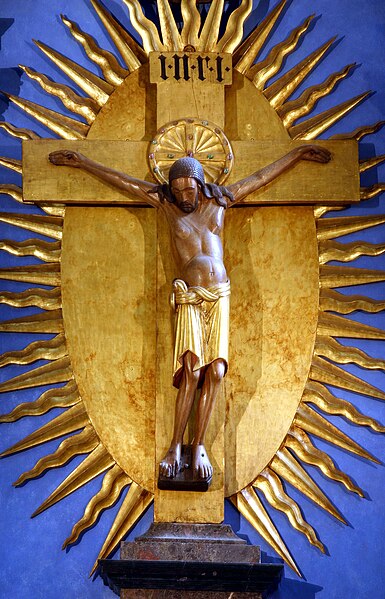 The Gero Crucifix (Gerokreuz in German), commissioned by Archbishop Gero of Cologne and created somewhere around 965-970, is the oldest large sculpture of the crucified Christ north of the Alps, and has always been displayed in Cologne Cathedral in Germany.
Ad ablutionem digitorum hic nihil est dicendum. Sed statim digitis lotis et extensis signat se signo sanctae Crucis. Deinde osculatur altare super corporale, postea crucem sub crucifixio. Deinde aspiciendo devote coelum ac manus conjugendo inclinat se, dicens:
Te igitur, clementissime Pater, per Jesum Christum Filium tuum, Dominum nostrum, supplices rogamus ac petimus, hic erigat se dicendo uti accepta habeas, et benedicas haec + dona, haec + munera, haec + sancta sacrificia illibata; in primis quae tibi offerimus pro Ecclesia tua sancta catholica; quam pacificare, custodire, adunare, et regere digneris toto orbe terrarum: una cum famulo tuo Papa nostro N.,et Antistite nostro N., et Rege nostro N., et omnibus orthodoxis, atque catholicae et apostolicae fidei cultoribus.
Deinde: Memento, Domine, famulorum famularumque tuarum N. Hic recitet nomina vivorum eorum maxime pro quibus orare tenetur et omnium circumadstantium, quorum tibi fides cognita est, et nota devotio, pro quibus tibi offerimus, vel qui tibi offerunt hoc sacrificium laudis, pro se suisque omnibus, pro redemptione animarum suarum, pro spe salutis, et incolumitis suae: tibique reddunt vota sua aeterno Deo, vivo et vero.
Deinde. Communicantes, et memoriam venerantes, in primis gloriosae semper Virginis Mariae, Genitricis Dei et Domini nostri Jesu Christi: sed et beatorum Apostolorum ac Martyrum tuorum, Petri et Pauli, Andreae, Jacobi, Joannis, Thomae, Jacobi, Philippi, Bartholomaei, Matthaei, Simonis, et Thaddaei: Lini, Cleti, Clementis, Xysti, Cornelii, Cypriani, Laurentii, Chrysogoni, Joannis et Pauli, Cosmae et Damiani, et omnium Sanctorum tuorum; quorum meritis precibusque concedas, ut in omnibus protectionis tuae muniamur auxilio. Per eundem Christum Dominum nostrum.
Hic inclinet se Sacerdos dicendo. Hanc igitur oblationem servitutis nostrae, sed et cunctae familiae tuae quaesumus, Domine, ut placatus accipias: diesque nostros in tua pace disponas, atque ab aeterna damnatione nos eripi, et in electorum tuorum jubeas grege numerari. Per Christum Dominum nostrum.
Hic erigat se Sacerdos dicendo. Quam oblationem tu, Deus, in omnibus, quaesumus, bene+dictam, adscrip+tam, ra+tam, rationabilem, acceptabilemque facere digneris,. ut nobis Cor+pus, et San+guis fiat dilectissimi Filii tui Domini nostri Jesu Christi.
Hic purget digitos et accipiat hostiam dicendo. Qui pridie quam pateretur, accepit panem in sanctas ac venerabiles manus suas, et elevatis oculis in coelum ad te Deum Patrem suum omnipotentem, tibi gratias agens, bene+dixit, fregit, diditque discipulis suis, dicens: Accipite, et manducate ex hoc omnes:
HOC EST ENIM CORPUS MEUM.
Elevet corpus Domini: quo reposito accipiat calicem dicendo. Simili modo postquam coenatum est, accipiens et hunc praeclarum Calicem in sanctas ac venerabiles manus suas: item tibi gratias agens, bene+dixit, deditque discipulis suis, dicens: Accepite, et bibite ex eo omnes:
HIC EST ENIM CALIX SANGUINIS MEI,
NOVI ET AETERNI TESTAMENTI:
MYSTERIUM FIDEI:
QUI PRO VOBIS ET PRO MULTIS EFFUNDETUR
IN REMISSIONEM PECCATORUM.
Hic elevet calicem dicendo: Haec quotiescumque feceritis, in mei memoriam facietis.
Extendat brachia in modum Crucis: Unde et memores, Domine, nos servi tui, sed et plebs tua sancta, ejusdem Christi Filii tui Domini nostri tam beatae Passionis, nec non et ab inferis Resurrectionis, sed et in coelos gloriosae Ascensionis: offerimus praeclarae majestati tuae de tuis donis ac datis, hostiam + puram, hostiam + sanctam, hostiam + immaculatam, Panem + sanctum vitae aeternae, et calicem salutis perpetuae.
Ponat manibus junctas super utrumque: Supra quae propitio ac sereno vultu respicere digneris, et accepta habere, sicuti accepta habere dignatus es munera pueri tui justi Abel, et sacrificium patriarchae nostri Abrahae, et quod tibi obtulit summus sacerdos tuus Melchisedech, sanctum sacrificium, immaculatam hostiam.
Cancellatis manibus se inclinet. Supplices te rogamus, omnipotens Deus, jube haec perferri per manus sancti Angeli tui in sublime altare tuum, in conspectu dininae majertatis tuae: ut quoquot ex hac altaris participatione, sacrocanctum Filii tui Cor+pus, et San+guinem sumpserimus, hic signet seipsum signo crucis dicendo: omni benedi+ctione coelesti et gratia repleamur. Per eumdem Christum Dominum nostrum. Amen.
Deinde. Memento etiam, Domine, famulorum famularumque tuarum qui nos praecesserunt cum signo fidei, et dormiunt in somno pacis N. Hic recitet nomina defunctorum.
Ipsis, Domine, et omnibus in Christo quiescentibus, locum refrigerii, lucis et pacis, ut indulgeas, deprecamur. Per eumdem Christum Dominum nostrum. Amen.
Tundat pectus et exaltet vocem. Nobis quoque peccatoribus famulis tuis, de multitudine miserationum tuarum sperantibus, partem aliquam, et societatem donare digneris, cum tuis sanctis Apostolis et Martyribus, cum Joanne, Stephano, Matthia, Barnaba, Ignatio, Alexandro, Marcellino, Petro, Felicitate, Perpetua, Agatha, Lucia, Agnete, Caecilia, Anastasis, et omnibus Sanctis tuis: intra quorum nos consortium, non aestimator meritim sed veniae, quaesumus, largitor admitte. Per Christum Dominum nostrum.
Per quem haec omnia Domine, semper bona creas, Hic signet utrumque. sancti+ficas, vivi+ficas, bene+dicis, et praestas nobis.
Hic faciat quattuor cruces super calicem cum hostia: et quintam crucem in labra calicis dicendo. Per ip+sum, et cum ip+so, et in ip+so, est tibi Deo Patri + omnipotenti, in unitate Spiritus + Sancti, omnis honor et gloria. Hic tangat calicem cum hostia: et mutet vocem. Per omnia saecula saeculorum.
Amen.
=============================
Te igitur, clementissime Pater, per Jesum Christum Filium tuum, Dominum nostrum, supplices rogamus ac petimus, hic erigat se dicendo uti accepta habeas, et benedicas haec + dona, haec + munera, haec + sancta sacrificia illibata; in primis quae tibi offerimus pro Ecclesia tua sancta catholica; quam pacificare, custodire, adunare, et regere digneris toto orbe terrarum: una cum famulo tuo Papa nostro N.,et Antistite nostro N., et Rege nostro N., et omnibus orthodoxis, atque catholicae et apostolicae fidei cultoribus.
Deinde: Memento, Domine, famulorum famularumque tuarum N. Hic recitet nomina vivorum eorum maxime pro quibus orare tenetur et omnium circumadstantium, quorum tibi fides cognita est, et nota devotio, pro quibus tibi offerimus, vel qui tibi offerunt hoc sacrificium laudis, pro se suisque omnibus, pro redemptione animarum suarum, pro spe salutis, et incolumitis suae: tibique reddunt vota sua aeterno Deo, vivo et vero.
Deinde. Communicantes, et memoriam venerantes, in primis gloriosae semper Virginis Mariae, Genitricis Dei et Domini nostri Jesu Christi: sed et beatorum Apostolorum ac Martyrum tuorum, Petri et Pauli, Andreae, Jacobi, Joannis, Thomae, Jacobi, Philippi, Bartholomaei, Matthaei, Simonis, et Thaddaei: Lini, Cleti, Clementis, Xysti, Cornelii, Cypriani, Laurentii, Chrysogoni, Joannis et Pauli, Cosmae et Damiani, et omnium Sanctorum tuorum; quorum meritis precibusque concedas, ut in omnibus protectionis tuae muniamur auxilio. Per eundem Christum Dominum nostrum.
Hic inclinet se Sacerdos dicendo. Hanc igitur oblationem servitutis nostrae, sed et cunctae familiae tuae quaesumus, Domine, ut placatus accipias: diesque nostros in tua pace disponas, atque ab aeterna damnatione nos eripi, et in electorum tuorum jubeas grege numerari. Per Christum Dominum nostrum.
Hic erigat se Sacerdos dicendo. Quam oblationem tu, Deus, in omnibus, quaesumus, bene+dictam, adscrip+tam, ra+tam, rationabilem, acceptabilemque facere digneris,. ut nobis Cor+pus, et San+guis fiat dilectissimi Filii tui Domini nostri Jesu Christi.
Hic purget digitos et accipiat hostiam dicendo. Qui pridie quam pateretur, accepit panem in sanctas ac venerabiles manus suas, et elevatis oculis in coelum ad te Deum Patrem suum omnipotentem, tibi gratias agens, bene+dixit, fregit, diditque discipulis suis, dicens: Accipite, et manducate ex hoc omnes:
HOC EST ENIM CORPUS MEUM.
Elevet corpus Domini: quo reposito accipiat calicem dicendo. Simili modo postquam coenatum est, accipiens et hunc praeclarum Calicem in sanctas ac venerabiles manus suas: item tibi gratias agens, bene+dixit, deditque discipulis suis, dicens: Accepite, et bibite ex eo omnes:
HIC EST ENIM CALIX SANGUINIS MEI,
NOVI ET AETERNI TESTAMENTI:
MYSTERIUM FIDEI:
QUI PRO VOBIS ET PRO MULTIS EFFUNDETUR
IN REMISSIONEM PECCATORUM.
Hic elevet calicem dicendo: Haec quotiescumque feceritis, in mei memoriam facietis.
Extendat brachia in modum Crucis: Unde et memores, Domine, nos servi tui, sed et plebs tua sancta, ejusdem Christi Filii tui Domini nostri tam beatae Passionis, nec non et ab inferis Resurrectionis, sed et in coelos gloriosae Ascensionis: offerimus praeclarae majestati tuae de tuis donis ac datis, hostiam + puram, hostiam + sanctam, hostiam + immaculatam, Panem + sanctum vitae aeternae, et calicem salutis perpetuae.
Ponat manibus junctas super utrumque: Supra quae propitio ac sereno vultu respicere digneris, et accepta habere, sicuti accepta habere dignatus es munera pueri tui justi Abel, et sacrificium patriarchae nostri Abrahae, et quod tibi obtulit summus sacerdos tuus Melchisedech, sanctum sacrificium, immaculatam hostiam.
Cancellatis manibus se inclinet. Supplices te rogamus, omnipotens Deus, jube haec perferri per manus sancti Angeli tui in sublime altare tuum, in conspectu dininae majertatis tuae: ut quoquot ex hac altaris participatione, sacrocanctum Filii tui Cor+pus, et San+guinem sumpserimus, hic signet seipsum signo crucis dicendo: omni benedi+ctione coelesti et gratia repleamur. Per eumdem Christum Dominum nostrum. Amen.
Deinde. Memento etiam, Domine, famulorum famularumque tuarum qui nos praecesserunt cum signo fidei, et dormiunt in somno pacis N. Hic recitet nomina defunctorum.
Ipsis, Domine, et omnibus in Christo quiescentibus, locum refrigerii, lucis et pacis, ut indulgeas, deprecamur. Per eumdem Christum Dominum nostrum. Amen.
Tundat pectus et exaltet vocem. Nobis quoque peccatoribus famulis tuis, de multitudine miserationum tuarum sperantibus, partem aliquam, et societatem donare digneris, cum tuis sanctis Apostolis et Martyribus, cum Joanne, Stephano, Matthia, Barnaba, Ignatio, Alexandro, Marcellino, Petro, Felicitate, Perpetua, Agatha, Lucia, Agnete, Caecilia, Anastasis, et omnibus Sanctis tuis: intra quorum nos consortium, non aestimator meritim sed veniae, quaesumus, largitor admitte. Per Christum Dominum nostrum.
Per quem haec omnia Domine, semper bona creas, Hic signet utrumque. sancti+ficas, vivi+ficas, bene+dicis, et praestas nobis.
Hic faciat quattuor cruces super calicem cum hostia: et quintam crucem in labra calicis dicendo. Per ip+sum, et cum ip+so, et in ip+so, est tibi Deo Patri + omnipotenti, in unitate Spiritus + Sancti, omnis honor et gloria. Hic tangat calicem cum hostia: et mutet vocem. Per omnia saecula saeculorum.
Amen.
=============================
At the washing of hands here, he shall say nothing. But at once he shall wash his fingers clean and sign himself with the Sign of the Cross. Then he shall kiss the Altar over the Corporal, afterwards the cross under the crucifix1. Then he shall gaze devotedly toward Heaven; and joining his hands, he shall bow and say:
Therefore, most gracious Father, we humbly beg of You and entreat You through Jesus Christ Your Son, our Lord, here he shall rise and say to deem acceptable and bless these + gifts, these + offerings, these + holy and unspotted oblations which, in the first place, we offer You for Your Holy Catholic Church, that You would deign to give her peace and protection, to unite and guard her throughout the world, together with Your servant our Pope N., and our Bishop N., and our king N.; and all true believers who cherish the Catholic and Apostolic Faith.
Then: Remember, O Lord, Your servants and handmaids, N. Here he shall recite the names of the living on behalf of which he prays and all here present, whose faith and devotion are known to You, for whom we offer, or who offer up to You this Sacrifice of praise for themselves and all those dear to them, for the redemption of their souls and the hope of their safety and salvation: who now pay their vows to You, the everlasting God, living and true.
Then: In communion with, and also reverencing the memory, first, of the glorious Mary, ever Virgin, Mother of our God and Lord Jesus Christ: and also of Your blessed Apostles and Martyrs, Peter and Paul, Andrew, James, John, Thomas, James, Philip, Bartholomew, Matthew, Simon and Thaddeus, Linus, Cletus, Clement, Sixtus, Cornelius, Cyprian, Lawrence, Chrysogonus, John and Paul, Cosmas and Damian, and of all Your Saints. Grant for the sake of their merits and prayers that in all things we may be guarded and helped by Your protection. Through Christ our Lord.
Here the priest shall bow and say: We therefore beseech You, O Lord, to graciously to accept this oblation of our service and that of Your whole household. Dispose our days in Your peace, preserve us from final damnation and rank us in the number of Your Elect; through Christ our Lord.
Here the priest shall rise and say: We ask You, O God, to be pleased to make this same offering wholly blessed +, to consecrate + it and approve + it, making it reasonable and acceptable, that it may become for us the Body + and Blood + of Your dearly beloved Son, our Lord Jesus Christ.
Here he shall purify his fingers, take the Host and say: Who, the day before He suffered, took bread into His holy and venerable hands, and having raised His eyes to heaven, to You, O God, His almighty Father, giving thanks to You, He blessed +, broke it, and gave it to His disciples, saying: All of you take and eat of this:
FOR THIS IS MY BODY.
He shall evelate the body of the Lord; putting It down, he shall take the chalice and say: In the same manner after supper, taking also into His holy and venerable hands this goodly chalice, again giving thanks to You, He blessed it +, and gave it to His disciples, saying: Take and drink this, all of you:
FOR THIS IS THE CHALICE OF MY BLOOD, OF THE NEW AND ETERNAL TESTAMENT; THE MYSTERY OF FAITH,WHICH WILL BE SHED FOR YOU AND FOR MANY FOR THE REMISSION OF SINS.
Here he shall elevate the chalice and say: As often as you shall do these things, do this in memory of Me.
He shall extend his arms in the form of a cross: Wherefore, O Lord, we Your servants and Your holy people are mindful both of the blessed passion of Christ Your Son, our Lord, and also His Resurrection from hell, and His glorious Ascension into heaven and offer unto Your most sovereign Majesty out of Your own gifts and presents, a pure + Victim, a Holy + Victim, a Spotless + Victim; the holy Bread + of life eternal, and the Chalice of everlasting Salvation.
He shall then place his joined hands over the Altar: And this deign to regard with gracious and kindly attention and hold acceptable, as You deigned to accept the offerings of Abel, Your just servant, and the sacrifice of Abraham, our patriarch, and that which Your chief priest Melchizedek offered to You, a holy sacrifice and a spotless victim.
He shall cross his hands and bow. Most humbly we implore You, almighty God, bid these offerings to be brought by the hands of Your holy angel to your altar above; before the face of Your Divine Majesty; that those of us who, by sharing in the Sacrifice of this altar, shall receive the Most Sacred + Body and + Blood of Your Son, Here he shall sign himself with the Sign of the Cross, saying may be filled with every heavenly bles+sing and grace. Through the same Christ our Lord. Amen.
Then: Remember also, O Lord, Your servants and handmaids, who have gone before us with the sign of faith, and rest in the sleep of peace, N. Here he shall recite the names of the dead To these, O Lord, and all who rest in Christ, we beg You to grant of Your goodness, a place of comfort, light and peace. Through the same Christ our Lord. Amen.
He shall beat his breast and raise his voice: To us sinners, also, Your servants, hoping in the multitude of Your mercies, deign to grant some part and fellowship with Your holy apostles and martyrs: with John, Stephen, Matthias, Barnabas, Ignatius, Alexander, Marcellinus, Peter, Felicitas, Perpetua, Agatha, Lucy, Agnes, Cecilia, Anastasia, and with all Your saints; into whose company we ask You to admit us, not considering our merit, but of Your own free pardon. Through Christ our Lord.
Through Whom, O Lord, You create, + sanctify, + fill with life, + bless, and bestow upon us all good things.
Here he shall make four crosses over the chalice with the Host; and the fifth he shall make in the rim of the chalice, saying: Through + Him, and with + Him, and in + Him, is to You, God the Father + almighty, in the unity of the Holy + Spirit, all honor and glory. Here he shall touch the chalice with the Host, and changes his voice: Forever and ever.
Amen.
FOOTNOTE
1. The cross under the crucifix: It has become customary to include an image of the crucifixion in altar missals at the left facing page of the Roman Canon; this, in turn, had developed from the practice of decorating the "T" of the Te igitur, either as an enlarged and splendidly-decorated initial or as an image of the crucified Jesus (with the "T" serving as the Cross). This was a visual aid to recognize the action that was being intended, the making present of the Holy Sacrifice of the Mass.


We should note that in many places during the medieval period, the officiating priest was instructed to kiss an image of the cross in the missal or sacramentary he was using at the start of the Canon. Perhaps in order to avoid damage to the painted surface, crosses (usually gilded; see here, here, here, and here for examples) were painted below the actual images themselves; that way, the priest could fulfill the rubric of 'kissing the cross' while protecting the miniatures from any damage.


Saturday, August 23, 2008
The Mass in Köln (the Use of Köln, Germany), part 3
 The High Altar of the Cathedral of Köln. The golden Reliquary is the Shrine of the Three Kings (Dreikönigenschrein), begun by the goldsmith Nicholas of Verdun in 1180 or 1181 and completed after his death circa 1225. The reliquary is believed to contain the bones of the Three Magi.
Sequitur Offertorium. Deinde Praeparatio accessoria ad Canonem: Lavabo inter innocentes manus meas: et circumdabo altare tuum, Domine.
Deinde fac Signum Crucis super Calicem: In nomine Patris + et Filii et Spiritus Sancti. Quid retribuam Domino pro omnibus quae retribuit mihi. Calicem salutaris accipiam et nomen Domini invocabo.
Tenens Calicem in medio Altaris dic: In spiritu humilitatis, et in animo contrito suscipiamur, Domine, a te: sic fiat sacrificium hodie et placeat tibi, Domine Deus.
Accipe Patenam: Acceptabile fiat omnipotenti Deo sacrificium istud in odorem suavitatis.
Benedic utriumque: Veni, invisibilis Sanctificator, omnipotens aeterne Deus: benedic + et sanctifica hoc sacrificum nomini tuo praeparatum. Per Christum Dominum nostrum.
Inclina et dic: Suscipe sancta Trinitas, hanc oblationem, quam tibi offerimus in memoriam passionis, resurrectionis, ascensionis Domini nostri Jesu Christi: et in honorem sanctissimae Dei Genitricis Virginis Mariae: et Sanctorum quorum hodie festivitas celebratur: et quorum hic nomina et reliquiae habentur: nec non et Sanctorum tuorum qui tibi placuerunt ab initio mundi. Ut proficiat ad honorem: nobis autem et omnibus fidelibus vivis et defunctis ad salutem et ad remissionem omnium peccatorum: et ut omnes pro nobis dignentur interdecere in coelis, quorum memoriam agimus in terris. Per eundem Christum Dominum nostrum. Amen.
Verte te ad populum: Orate pro me peccatore, fratres et sorores: ut meum pariter et vostrum sacrificium acceptum sit omnipotenti Deo.
<Domini, exaudi orationem meam.> Et clamor meus ad te veniat.
Oremus. Deinde legatur Secreta, cujus finis est initium Praefationis.
<Per omnia saecula saeculorum.> Amen.
<Dominus vobiscum.> Et cum spiritu tuo.
<Sursum corda.> Habemus ad Dominum.
<Gratias agamus Domino Deo nostro.> Dignum et justum est.
Vere dignum et justum est, aequum et salutare etc. etc.
Sanctus, Sanctus, Sanctus, Dominus Deus Sabaoth. Pleni sunt coeli et terra gloria tua. Hosanna in excelsis. Benedictus qui venit in nomine Domini. Hosanna in excelsis.
=====================
The Offertory shall then follow. Then the assessory preparation up to the Canon: I wash my hands among the innocent, and go around Your altar, O Lord.
Then he shall make the Sign of the Cross over the Chalice: In the name of the Father, + and of the Son and of the Holy Spirit. What return shall I make to the Lord for all He has given me? I will take the Chalice of salvation and call upon the Name of the Lord.
He shall hold the Chalice at the middle of the Altar, saying: In a humble spirit and with a contrite heart, may we be accepted by You, O Lord; may our sacrifice be so offered this day and please You, O Lord God.
He shall then take the Paten: May this Sacrifice be acceptable to the Almighty God, in the odor of sweetness.
He shall then bless both: Come, O invisible Sanctifier, Almighty and Eternal God; bless + and sanctify this sacrifice prepared for the glory of Your Name, through Christ our Lord.
He shall bow and say: Receive, O Holy Trinity, this oblation which we offer to You in memory of the Passion, Resurrection and Ascension of our Lord Jesus Christ: and in honor of the most-Holy Mother of God, the Virgin Mary; and those Saints whose feast we now celebrate, whose names and relics we have, and also Your Saints who make this request of You from the beginning of the world. To them let it bring honor, and to us salvation, and all the faithful living and dead, and the remission of all sins; and may they intercede for us in Heaven, whose memory we honor here on Earth. Through the same Christ our Lord. Amen.
He shall face the people: Brothers and sisters, pray for me, a sinner; that my Sacrifice and equally yours may be accepted by the Almighty God.
Let us pray He shall then recite the Secret; and at its end begin the Preface
<Forever and ever.> Amen.
<The Lord be with you.> And with your spirit.
<Lift up your hearts.> We have lifted them up to the Lord.
<Let us give thanks to the Lord our God.> It is meet and just.
It is truly meet and just, right and profitable etc. etc.
Holy, Holy, Holy, Lord God of Hosts. Heaven and Earth are filled with your glory; Hosanna in the highest. Blessed is He Who comes in the Name of the Lord. Hosanna in the highest.
Friday, August 22, 2008
The Mass in Köln (the Use of Köln, Germany), part 2
 Archbishop Gero of Cologne (900-976) placing a Host in the wooden (oak) head of the monumental Gero Crucifix (which he donated to the Cathedral of Cologne; the crucifix itself will be featured in later post). According to a popular story (also mentioned in the Chronicon of Thietmar of Merseburg), when the Archbishop noticed that the head of Christ had developed a crack, he placed a Host and a relic of the True Cross on it, which resulted in the crack being miraculously healed. This particular depiction of the miracle is in an 11th century Altarpiece in the Cathedral.
Quando non de B.M.V.
Gloria in excelsis Deo. Et in terra pax hominibus bonae voluntatis. Laudamus te. Benedicimus te. Adoramus te. Glorificamus te. Gratias agimus tibi propter magnam gloriam tuam. Domine Deus, Rex coelestis, Deus Pater omnipotens.
Domine Fili unigenite, Jesu Christe. Domine Deus, Agnus Dei, Filius Patris. Qui tollis peccata mundi, miserere nobis. Qui tollis peccata mundi, suscipe deprecationem nostram. Qui sedes ad dexteram Patris, miserere nobis.
Quoniam tu solus Sanctus. Tu solus Dominus, Tu solus Altissimus, Jesu Christe, cum Sancto Spiritu in gloria Dei Patris. Amen.
Quando de B.M.V.
Gloria in excelsis Deo. Et in terra pax hominibus bonae voluntatis. Laudamus te. Benedicimus te. Adoramus te. Glorificamus te. Gratias agimus tibi propter magnam gloriam tuam, Domine Deus, Rex coelestis, Deus Pater omnipotens.
Domine Fili unigenite, Jesu Christe. Spiritus et alme orphanorum Paraclite. Domine Deus, Agnus Dei, Filius Patris, Primogenitus Mariae Virginis Matris.
Qui tollis peccata mundi, miserere nobis. Qui tollis peccata mundi, suscipe deprecationem nostram, ad Mariae gloriam. Qui sedes ad dexteram Patris, miserere nobis.
Quoniam tu solus Sanctus, Mariam sanctificans. Tu solus Dominus, Mariam gubernans. Tu solus Altissimus, Maria coronans, Jesu Christe, cum Sancto Spiritu in gloria Dei Patris. Amen.
<Dominus vobiscum.> Et cum spiritu tuo.
Oremus. Collecta, ad collectam respondetur: Amen. Deinde Lectio, Graduale, Alleluia, Sequentia, Tractus. Preparando Calicem dicat: In nomine Patris et Filii et Spiritus Sancti. Sanguis exivit de latere Domini nostri Jesu Christi.
Intendo aquam dicit: Et aqua in remissionem peccatorum. Fiat haec commixtio vini et aquae in nomine Patris et Filii et Spiritus Sancti. Amen.
Deinde: Deus, qui humanae substantiae dignitatem mirabiliter condidisti, et mirabilius reformasti: da nobis per hujus aquae et vini mysterium, ejus divinitatis esse consortes, qui humanitatis nostrae fieri dignatus est particeps, Jesus Christus, Filius tuus, Dominus noster: Qui tecum vivit et regnat in unitate Spiritus Sancti, Deus; per omnia saecula saeculorum. Amen.
Ante Evangelium: Jube, Domine benedicere. Dominus sit in corde meo et in labiis meis: ut digne et competenter annuntiem Evangelium pacis. In nomine Patris et Filii et Spiritus Sancti. Amen.
<Dominus vobiscum.> Et cum spiritu tuo.
<Sequentia sancti Evangelii secundum hic nominatur nomen Evangelistae cujus Evangelium pronunciandum.> Gloria tibi Domini.
Post Evangelium: Per haec sancta Evangelica dicta deleantur universa crimina nostra et delicta. Amen.
Deinde se dicendum: Credo in unum Deum, Patrem omnipotentem, factorem coeli et terrae, visibilium omnium, et invisibilium. Et in unum Dominum Jesum Christum, Filium Dei unigenitum. Et ex Patre natum ante omnia saecula. Deum de Deo, lumen de lumine, Deum verum de Deo vero. Genitum, not factum, consubstantialem Patri: per quem omnia facta sunt. Qui propter nos homines, et propter nostram salutem descendit de coelis. Et incarnatus est de Spiritu Sancto ex Maria Virgine; et Homo factus est. Crucifixus etiam pro nobis: sub Pontio Pilato passus, et sepultus est. Et resurrexit tertia die, secundum Scripturas. Et ascendit in coelum: sedet ad dexteram Patris: Et iterum venturus est com gloria, iudicare vivos et mortuos: cujus regni non erit finis. Et in Spiritum Sanctum, Dominum et vivificantem: qui ex Patre Filioque procedit. Qui cum Patre et Filio simul adoratur et conglorificatur: qui locutus est per prophetas. Et unam, sanctam, catholicam et apostolicam Ecclesiam. Confiteor unum baptisma in remissionem peccatorum. Et exspecto resurrectionem mortuorum. Et vitam venturi saeculi. Amen.
Deinde clara voce: <Dominus vobiscum.> Et cum spiritu tuo.
Oremus.
=====================================
On days other than feasts of the B.V.M.
Glory to God in the highest. And on earth peace to men of good will. We praise You. We bless You. We adore You. We glorify You. We give You thanks for Your great Glory.
Lord God, heavenly King, God the Father Almighty. Lord the only-begotten Son, Jesus Christ. Lord God, Lamb of God, Son of the Father.
You who take away the sins of the world, have mercy on us. You who take away the sins of the world, receive our prayer. You who sit at the right hand of the Father, have mercy on us.
For You alone are the Holy One. You alone are the Lord. You alone are the Most High, Jesus Christ, with the Holy Spirit, in the glory of God the Father. Amen.
On feasts of the B.V.M.
Glory to God in the highest. And on earth peace to men of good will. We praise You. We bless You. We adore You. We glorify You. We give You thanks for Your great Glory. Lord God, heavenly King, God the Father almighty. Lord Jesus Christ, the only-begotten Son. O Spirit, the nurturer of orphans, the Paraclete. Lord God, Lamb of God, Son of the Father, First-Born of Mary the Virgin Mother.
You who take away the sins of the world, have mercy on us. You who take away the sins of the world, receive our prayer, to the glory of Mary. You who sit at the right hand of the Father, have mercy on us.
For You alone are the Holy One, who sanctified Mary. You alone are the Lord, who guided Mary. You alone are the Most High, who crowned Mary, Jesus Christ. With the Holy Spirit, in the glory of God the Father. Amen.
<The Lord be with you.> And with your spirit.
Let us pray. The Collect is said here; at its end: Amen. Then follows the Lesson, Gradual, Alleluia, Sequence and Tract.
When he prepares the Chalice, he shall say: In the name of the Father, and of the Son, and of the Holy Spirit. From the side of Our Lord Jesus Christ came forth blood.
He then holds out the water: And water for the remission of sins. May this mingling of wine and water be made in the name of the Father, and of the Son, and of the Holy Spirit. Amen.
Then, he continues: O God, who established the nature of man in wondrous dignity, and still more admirably restored it, grant that by the mystery of this water and wine, may we come to share in His Divinity, who humbled himself to share in our humanity, Jesus Christ, Your Son, our Lord. Who lives and reigns with You in the unity of the holy Spirit; God, forever and ever. Amen.
Before the Gospel: Grant, O Lord, to bless. May the Lord be in my heart and upon my lips that I may worthily and fittingly proclaim the Gospel of Peace. In the name of the Father, and of the Son, and of the Holy Spirit. Amen.
<The Lord be with you.> And with your spirit.
<The continuation of the Holy Gospel according to Here he shall name the name of the Evangelist with the Gospel that will be proclaimed.> Glory be to You, O Lord.
After the Gospel: May the words of this Holy Gospel wipe away our entire sins and offenses. Amen.
Then he shall say: I believe in one God, the Father Almighty, Maker of Heaven and Earth, and of all things visible and invisible. And in one Lord, Jesus Christ, the Only-begotten Son of God, born of the Father before all ages. God of God, Light of Light, true God of true God. Begotten, not made, of one substance with the Father; through whom all things were made. Who for us men and for our salvation came down from Heaven, and became incarnate by the Holy Spirit of the Virgin Mary, and was made man. Who was also crucified for us, suffered under Pontius Pilate, and was buried; and on the third day rose again according to the Scriptures, and ascended into Heaven and is seated at the right hand of the Father. And He will come again in glory to judge the living and the dead, and His kingdom will have no end. And in the Holy Spirit, the Lord and Giver of life, who proceeds from the Father and the Son; who together with the Father and the Son is adored and glorified, and who spoke through the prophets. And one holy, Catholic and Apostolic Church. I confess one baptism for the forgiveness of sins. And I await the resurrection of the dead, and the life of the world to come. Amen.
Then he shall say in a clear voice: <The Lord be with you.> And with your spirit.
Let us pray.
Thursday, August 21, 2008
The Mass in Köln (the Use of Köln, Germany)
We will now then turn to the Use of Cologne, more specifically, the Use of the Roman Rite in Cologne (otherwise known as Köln), Germany.
What is a 'Use'?
The Liturgical definition of a 'Use' is basically a local adaptation/modification of a particular Rite to a specific locale (for example, a Diocese). Present-day examples of this might include the Zaire Use (An inculturated version of The Ordinary form of the Roman Rite as practiced in a very limited extent in some African countries) or the Anglican Use.
Before Pope Pius V released his bull Quo Primum that promulgated his revision of the Roman Missal, a lot of places in Europe had their own particular 'Uses' which were usually derived from the Roman Rite. They all agree on the Canon (save for very minor differences in wording), but when it comes to the Ordinary and the rubrics, some places may have developed or added a particular custom that other places might not have. Other differences include celebrating feast days of saints particular to the area, a trifling variety in the Calendar, and the Propers, namely, some extra Epistles, Gospels, sequences, and/or prefaces.
About Cologne (Latin: Colonia [Colonia Agrippina], German: Köln, Kölsch: Kölle): Cologne is Germany's fourth-largest city after Berlin, Hamburg and Munich, and is the largest city both in the German Federal State of North Rhine-Westphalia and within the Rhine-Ruhr Metropolitan Area, one of the major European metropolitan areas with more than ten million inhabitants. It is one of the oldest cities in Germany, having been founded by the Romans in the year 38 BC. Cologne was granted the status of a Roman "city" in the year 50 AD.
Cologne lies on the River Rhine. The city's famous Cologne Cathedral (Kölner Dom) is the seat of the Roman Catholic Archbishop of Cologne. The University of Cologne (Universität zu Köln) is one of Europe's oldest universities.
Besides its economic and political significance in the Middle Ages the city also became an outstanding centre of medieval pilgrimage, when the Archbishop Rainald of Dassel gave the relics of the Three Wise Men (the Magi) to Cologne's cathedral in 1164 (after they in fact had been captured from Milan). Besides the three magi Cologne preserves the relics of Saint Ursula and Albertus Magnus.
 The Cathedral of Cologne (German: Kölner Dom, official name: Hohe Domkirche St. Peter und Maria)
THE ORDINARY OF THE MASS ACCORDING TO THE USE OF KÖLN, GERMANY, FROM THE 1525 MISSALE COLONIENSE
Ante medium Altaris signando se signo Sanctae Crucis:
In nomine Patris et Filii et Spiritus Sancti. Amen.
Celebrans: Adjutorium nostrum in nomine Domini.
Ministri: Qui fecit cœlum et terram.
Celebrans: Et introibo ad Altare Dei.
Ministri: Ad Deum qui laetificat juventútem meam.
Celebrans: Confitemini Domino quoniam bonus.
Ministri: Quoniam in saecula misericordia ejus.
Celebrans: Confíteor Deo coeli et beatae Mariae Virgini et omnibus Sanctis Dei et vobis, quia peccavi nimis in vita mea contra legem Dei mei cogitatione, locutione, concensu, visu, verbo et opere, mea culpa, mea culpa, mea maxima culpa. Ideo precor gloriosam Virginem Mariam et omnes Sanctos Dei et vos, orare pro me peccatore.
Ministri: Misereatur tui omnipotens Deus, et dimissis omnibus peccatis tuis, perducat te Jesus Christus sine macula cum gaudio in vitam aeternam.
Celebrans: Amen.
Ministri: Confíteor Deo coeli et beatae Mariae Virgini et omnibus Sanctis Dei et te, quia peccavi nimis in vita mea contra legem Dei mei; cogitatione, locutione, concensu, visu, verbo et opere; mea culpa, mea culpa, mea maxima culpa. Ideo precor gloriosam Virginem Mariam et omnes Sanctos Dei et te, orare pro me peccatore.
Celebrans: Misereatur vestri omnipotens Deus, et dimissis omnibus peccatis vestris, perducat te Jesus Christus sine macula cum gaudio in vitam aeternam.
Ministri: Amen.
Celebrans: Exaudi quaesumus Domine supplicum preces confitentium tibi parce peccatis, ut pariter nobis indulgentiam tribuas benignus et pacem. Per Dominum.
Ministri: Amen.
Accendens ad Altare: Aufer a nobis, quaesumus, Domine, cunctas iniquitates nostras: ut ad Sancta sanctorum puris mentibus introire mereamur. Per Dominum.
Osculando Altare: Da mihi, Domine, sensum rectum et vocem puram, ut placeant tibi verba mea; atque cunctis audientibus ea, propter nomen sanctum tuum proficiant in vitam aeternam.
Osculando Crucifixum: Tuam Crucem adoramus, Domine; et tuam sanctam recolimus passionem. Miserere nostri, qui passus est pro nobis.
Osculando Evangelium: Pax Christi et Ecclesiae quam nobis per sanctum Evangelium tradidit; confirmet et conservet corda et corpora nostra in vitam aeternam.
Ad Introitum Celebrans: Adjutorium nostrum in nomine Domini.
Ministri: Qui fecit coelum et terram.
C: Sit nomen Domini benedictum.
Ministri: Nunc et usque in saeculum.
Introitus legatur, deinde:
Kyrie Eleison. Kyrie Eleison. Kyrie Eleison.
Christe Eleison. Christe Eleison. Christe Eleison.
Kyrie Eleison. Kyrie Eleison. Kyrie Eleison.
========================
[The Celebrant] before the middle of the Altar, shall make the sign of the Holy Cross:
In the name of the Father and of the Son and of the Holy Spirit. Amen.
Celebrant: Our help is in the name of the Lord.
Minister: Who made Heaven and Earth.
Celebrant: And I shall go in to the Altar of God.
Minister: To God who grants joy to my youth.
Celebrant: O give thanks to the Lord, for He is good.
Minister: And His mercy endures forever.
Celebrant: I confess to God in Heaven, and to the Blessed Virgin Mary, and to all the Saints of God and to you; that I have exceedingly sinned in my life against the law of my God; in thought, speech, judgment, sight, word and deed; through my fault, through my fault, through my most grevious fault. Therefore I ask the Blessed Virgin Mary, and all the Saints of God and you, to pray for me, a sinner.
Minister: May almighty God have mercy on you, and forgiving you your sins, lead you to Jesus Christ without stain as well as joyful into life everlasting.
Celebrant: Amen.
Minister: I confess to God in Heaven, and to the Blessed Virgin Mary, and to all the Saints of God and to you; that I have exceedingly sinned in my life against the law of my God; in thought, speech, judgment, sight, word and deed; through my fault, through my fault, through my most grevious fault. Therefore I ask the Blessed Virgin Mary, and all the Saints of God and you, to pray for me, a sinner.
Celebrant: May almighty God have mercy on you, and forgiving you your sins, lead you to Jesus Christ without stain as well as joyful into life everlasting.
Minister: Amen.
Celebrant: Graciously hear, we beseech You, O Lord, the prayers of Your suppliants, pardon the sins of those who confess to You; that, in Your bounty, You may grant us both pardon and peace; through our Lord...
Celebrant: Amen.
Going up into the Altar, he shall say: Take away from us, we beseech You, O Lord, all our iniquities, that we may be worthy to enter with pure minds into the Holy of Holies; through our Lord...
He shall then kiss the Altar: Give me, O Lord, a right sense and a pure voice, that my words may be pleasing to You; and for the sake of Your Holy Name may it perfect all of them who hear it into everlasting life.
He shall then kiss the Crucifix: We adore Your Cross, O Lord; We contemplate Your Holy Passion. Have mercy on us, You who have suffered for us.
He shall then kiss the Gospel Book: May the peace of Christ and the Church, which He bequeathed us by the Holy Gospel conserve and confirm our soul and body unto everlasting life.
The Celebrant then begins: Our help is in the name of the Lord.
Minister: Who made Heaven and Earth.
Celebrant: Blessed be the name of the Lord.
Minister: From henceforth, now and forever.
The Introit is now said, then:
Kyrie Eleison. Kyrie Eleison. Kyrie Eleison.
Christe Eleison. Christe Eleison. Christe Eleison.
Kyrie Eleison. Kyrie Eleison. Kyrie Eleison.
What is a 'Use'?
The Liturgical definition of a 'Use' is basically a local adaptation/modification of a particular Rite to a specific locale (for example, a Diocese). Present-day examples of this might include the Zaire Use (An inculturated version of The Ordinary form of the Roman Rite as practiced in a very limited extent in some African countries) or the Anglican Use.
Before Pope Pius V released his bull Quo Primum that promulgated his revision of the Roman Missal, a lot of places in Europe had their own particular 'Uses' which were usually derived from the Roman Rite. They all agree on the Canon (save for very minor differences in wording), but when it comes to the Ordinary and the rubrics, some places may have developed or added a particular custom that other places might not have. Other differences include celebrating feast days of saints particular to the area, a trifling variety in the Calendar, and the Propers, namely, some extra Epistles, Gospels, sequences, and/or prefaces.
About Cologne (Latin: Colonia [Colonia Agrippina], German: Köln, Kölsch: Kölle): Cologne is Germany's fourth-largest city after Berlin, Hamburg and Munich, and is the largest city both in the German Federal State of North Rhine-Westphalia and within the Rhine-Ruhr Metropolitan Area, one of the major European metropolitan areas with more than ten million inhabitants. It is one of the oldest cities in Germany, having been founded by the Romans in the year 38 BC. Cologne was granted the status of a Roman "city" in the year 50 AD.
Cologne lies on the River Rhine. The city's famous Cologne Cathedral (Kölner Dom) is the seat of the Roman Catholic Archbishop of Cologne. The University of Cologne (Universität zu Köln) is one of Europe's oldest universities.
Besides its economic and political significance in the Middle Ages the city also became an outstanding centre of medieval pilgrimage, when the Archbishop Rainald of Dassel gave the relics of the Three Wise Men (the Magi) to Cologne's cathedral in 1164 (after they in fact had been captured from Milan). Besides the three magi Cologne preserves the relics of Saint Ursula and Albertus Magnus.
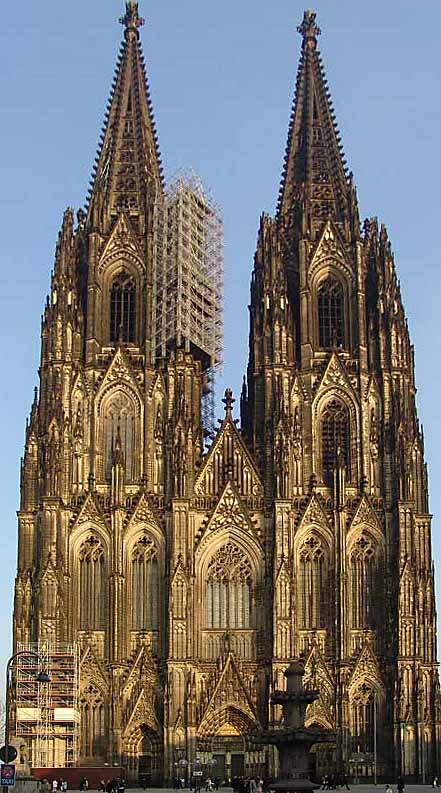 The Cathedral of Cologne (German: Kölner Dom, official name: Hohe Domkirche St. Peter und Maria)
THE ORDINARY OF THE MASS ACCORDING TO THE USE OF KÖLN, GERMANY, FROM THE 1525 MISSALE COLONIENSE
Ante medium Altaris signando se signo Sanctae Crucis:
In nomine Patris et Filii et Spiritus Sancti. Amen.
Celebrans: Adjutorium nostrum in nomine Domini.
Ministri: Qui fecit cœlum et terram.
Celebrans: Et introibo ad Altare Dei.
Ministri: Ad Deum qui laetificat juventútem meam.
Celebrans: Confitemini Domino quoniam bonus.
Ministri: Quoniam in saecula misericordia ejus.
Celebrans: Confíteor Deo coeli et beatae Mariae Virgini et omnibus Sanctis Dei et vobis, quia peccavi nimis in vita mea contra legem Dei mei cogitatione, locutione, concensu, visu, verbo et opere, mea culpa, mea culpa, mea maxima culpa. Ideo precor gloriosam Virginem Mariam et omnes Sanctos Dei et vos, orare pro me peccatore.
Ministri: Misereatur tui omnipotens Deus, et dimissis omnibus peccatis tuis, perducat te Jesus Christus sine macula cum gaudio in vitam aeternam.
Celebrans: Amen.
Ministri: Confíteor Deo coeli et beatae Mariae Virgini et omnibus Sanctis Dei et te, quia peccavi nimis in vita mea contra legem Dei mei; cogitatione, locutione, concensu, visu, verbo et opere; mea culpa, mea culpa, mea maxima culpa. Ideo precor gloriosam Virginem Mariam et omnes Sanctos Dei et te, orare pro me peccatore.
Celebrans: Misereatur vestri omnipotens Deus, et dimissis omnibus peccatis vestris, perducat te Jesus Christus sine macula cum gaudio in vitam aeternam.
Ministri: Amen.
Celebrans: Exaudi quaesumus Domine supplicum preces confitentium tibi parce peccatis, ut pariter nobis indulgentiam tribuas benignus et pacem. Per Dominum.
Ministri: Amen.
Accendens ad Altare: Aufer a nobis, quaesumus, Domine, cunctas iniquitates nostras: ut ad Sancta sanctorum puris mentibus introire mereamur. Per Dominum.
Osculando Altare: Da mihi, Domine, sensum rectum et vocem puram, ut placeant tibi verba mea; atque cunctis audientibus ea, propter nomen sanctum tuum proficiant in vitam aeternam.
Osculando Crucifixum: Tuam Crucem adoramus, Domine; et tuam sanctam recolimus passionem. Miserere nostri, qui passus est pro nobis.
Osculando Evangelium: Pax Christi et Ecclesiae quam nobis per sanctum Evangelium tradidit; confirmet et conservet corda et corpora nostra in vitam aeternam.
Ad Introitum Celebrans: Adjutorium nostrum in nomine Domini.
Ministri: Qui fecit coelum et terram.
C: Sit nomen Domini benedictum.
Ministri: Nunc et usque in saeculum.
Introitus legatur, deinde:
Kyrie Eleison. Kyrie Eleison. Kyrie Eleison.
Christe Eleison. Christe Eleison. Christe Eleison.
Kyrie Eleison. Kyrie Eleison. Kyrie Eleison.
========================
[The Celebrant] before the middle of the Altar, shall make the sign of the Holy Cross:
In the name of the Father and of the Son and of the Holy Spirit. Amen.
Celebrant: Our help is in the name of the Lord.
Minister: Who made Heaven and Earth.
Celebrant: And I shall go in to the Altar of God.
Minister: To God who grants joy to my youth.
Celebrant: O give thanks to the Lord, for He is good.
Minister: And His mercy endures forever.
Celebrant: I confess to God in Heaven, and to the Blessed Virgin Mary, and to all the Saints of God and to you; that I have exceedingly sinned in my life against the law of my God; in thought, speech, judgment, sight, word and deed; through my fault, through my fault, through my most grevious fault. Therefore I ask the Blessed Virgin Mary, and all the Saints of God and you, to pray for me, a sinner.
Minister: May almighty God have mercy on you, and forgiving you your sins, lead you to Jesus Christ without stain as well as joyful into life everlasting.
Celebrant: Amen.
Minister: I confess to God in Heaven, and to the Blessed Virgin Mary, and to all the Saints of God and to you; that I have exceedingly sinned in my life against the law of my God; in thought, speech, judgment, sight, word and deed; through my fault, through my fault, through my most grevious fault. Therefore I ask the Blessed Virgin Mary, and all the Saints of God and you, to pray for me, a sinner.
Celebrant: May almighty God have mercy on you, and forgiving you your sins, lead you to Jesus Christ without stain as well as joyful into life everlasting.
Minister: Amen.
Celebrant: Graciously hear, we beseech You, O Lord, the prayers of Your suppliants, pardon the sins of those who confess to You; that, in Your bounty, You may grant us both pardon and peace; through our Lord...
Celebrant: Amen.
Going up into the Altar, he shall say: Take away from us, we beseech You, O Lord, all our iniquities, that we may be worthy to enter with pure minds into the Holy of Holies; through our Lord...
He shall then kiss the Altar: Give me, O Lord, a right sense and a pure voice, that my words may be pleasing to You; and for the sake of Your Holy Name may it perfect all of them who hear it into everlasting life.
He shall then kiss the Crucifix: We adore Your Cross, O Lord; We contemplate Your Holy Passion. Have mercy on us, You who have suffered for us.
He shall then kiss the Gospel Book: May the peace of Christ and the Church, which He bequeathed us by the Holy Gospel conserve and confirm our soul and body unto everlasting life.
The Celebrant then begins: Our help is in the name of the Lord.
Minister: Who made Heaven and Earth.
Celebrant: Blessed be the name of the Lord.
Minister: From henceforth, now and forever.
The Introit is now said, then:
Kyrie Eleison. Kyrie Eleison. Kyrie Eleison.
Christe Eleison. Christe Eleison. Christe Eleison.
Kyrie Eleison. Kyrie Eleison. Kyrie Eleison.
Subscribe to:
Posts (Atom)