About six years ago (wow - seriously, I'm surprised at how time flies!) I wrote this blog post where I pretty much nitpicked some of the quotes which supposedly show how Catholics believe the Pope to be God in the flesh or something along those lines. It ain't really much, but I just added a little something to the post - specifically, to the quote attributed to Cardinal Sarto (Pope St. Pius X) about the pope "being Jesus Christ hidden under the veil of the flesh." Otherwise it's still the same old post, full of sharp nitpicking from a six-years-younger-me. Click on the link to find out.
(P.S. No, I can't really make any more promises to be active on this blog; the only thing I can say with certainty is, I'm not letting this blog die down. Yet. But who knows what tomorrow will bring?)
(P.P.S. So I'm advising readers, y'all better keep what you're reading here in whatever way you can - no need to ask me. Save it, print it, copy it, torrent it, whatever. Nothing is totally permanent, not even on the Internet. So if you feel something interests you - go ahead, feel free. This is probably one of the few instances where stealing is allowed - hey, maybe even a good thing. ;))

Showing posts with label Popular Misconceptions. Show all posts
Showing posts with label Popular Misconceptions. Show all posts
Saturday, August 23, 2014


Saturday, October 24, 2009
"The Lord pushed back the sea with a strong east wind": the Parting of the Red Sea in the movies, Part 1
 Anyone who has read their Bibles will surely be familiar with the following story:
And Pharaoh had drawn near, the sons of Yisrael lifted up their eyes, and look! The Mitzraim are marching after them, and they fear greatly. And the sons of Yisrael cry out to YHWH, and they say to Mosheh, "Is it because there are no graves in Mitzraim that you have taken us away to die in the wilderness? What is this you have done to us - to bring us out of Mitzraim? Is not this the word that we spoke to you in Mitzraim, saying, 'Let us alone that we may serve the Mitzraim?' because it is better for us to serve the Mitzraim than to die in the wilderness!" And Mosheh says to the people, "Do not fear! Stand firm and see the salvation of YHWH that He will do for you today; for the Mitzrim that you see today, you will no longer see again forever. YHWH will make war for you, and you can be still."YHWH says to Mosheh, "Why are you crying out to me? Speak to the sons of Israel that they might journey. And you - lift up your staff and stretch out your hand toward the sea and split it, and the sons of Yisrael will go into the midst of the sea on dry ground. And me - behold! I am about to harden the hearts of the Mitzraim and they will go in after them, and I will be honored over Pharaoh and over all his army, over his chariots, andover his horsemen. And Mitzraim will know I am YHWH when I have gained my honor over Pharaoh, his chariots, and his horsemen."In this post, we'll try to compare the Biblical account and its depictions in the movies. As everybody pretty much knows, the shadows of DeMille and Chuck Heston loom large over most depictions of Moses that came after the 1956 film was released. The influence is such that we are still subconsciously influenced by it; in many instances, we find that we are more familiar with Mr. DeMille than the Bible when reading the book of Exodus. Here, we will compare six Moses films in particular scene-by-scene:
The angel of Elohim, who is going in the face of the camp of Yisrael, moves and goes behind them; and the column of the cloud moves from their face and stands behind them, and comes between the camp of Mitzraim and the camp of Yisrael; and there is the cloud and the darkness, and he lights up the night, and one camp had not come near the other all night. And Mosheh stretches out his hand toward the sea; and YHWH drives the sea back by a strong east wind all night, and makes the sea into dry ground, and the waters are split, and the sons of Yisrael go into the midst of the sea on dry ground, and the waters are for them a wall on their right and on their left. And the Mitzraim pursue and go after them - all the horses of Pharaoh, his chariots, and his horsemen - into the midst of the sea.And it happen in the morning watch that YHWH looks down on the camp of Mitzraim through the column of fire and of the cloud, and throws the camp of Mitzraim into confusion, and turns aside the wheels of their chariots - and they drive them with difficulty. And the Mitzri say, "Let us flee from the face of Yisrael, for YHWH is fighting for them against Mitzraim!" And YHWH says to Mosheh, "Stretch out your hand toward the sea, and waters will return on the Mitzraim, on their chariots, and on their horsemen."
And Mosheh stretches out his hand toward the sea, and the sea returns, at the turning of the morning, to its perennial state; and the Mitzraim are fleeing into it, and YHWH shakes off the Mitzraim in the midst of the seam, and the waters return and cover the chariots and the horsemen and all the army of Pharaoh who are coming after them into the sea - not so much as one of them remain!
A: The Ten Commandments: a 1923 silent version by Cecil B. DeMille, with Theodore Roberts as Moses.
B: The Ten Commandments: the 1956 remake/extension of the 1923 silent film, also directed by DeMille, with Charlton Heston in the lead role.
C: Moses: a 1995 TV miniseries (a part of the so-called The Bible Collection) in two parts by Roger Young, starring Ben Kingsley.
D: The Prince of Egypt: a 1998 animated film produced and released by DreamWorks. Val Kilmer plays the title role.
E: The Ten Commandments (2006): Another TV series on the Exodus by Robert Dornhelm, with Dougray Scott portraying Moses.
F: The Ten Commandments (2007): A computer-animated film by John Stronach and Bill Boyce, starring Elliot Gould as the Lawgiver.
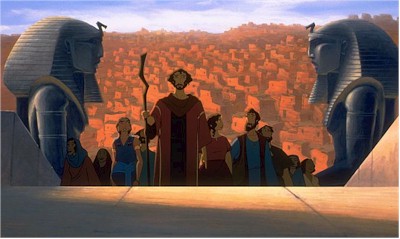 The aforementioned six films will henceforth be designated by their letters for purposes of convenience.
Without further ado, the step-by-step comparison.
1.) Egyptians Chasing (Exodus 14:6-9)
A: After a scene showing the Pharaoh and his soldiers riding on their chariots, we go back to the Israelites. Someone warns Joshua about the Egyptians, who then orders the Israelites to quickly disperse and run towards the sea. They do so, dismantling their tents in panic. The Egyptians follow after them, while we get to see some of the horses slipping on the sand dunes.All six films notably omit two things: specifically naming the place where the Israelites are camping (Pi-hahiroth between Migdol and the sea, in front of Baal-zephon; cf. Exodus 14:2, 9), and God commanding Moses and the sons of Israel to camp there (Exodus 14:1-2), though F does include Moses ordering the people. Only A, B, and F actually show the Israelites settling and having tents set up before the Egyptians arrive.
B: DeMille repeats very much the same formula for his 1956 version (minus the slipping horses) - only this time, the Israelites are apparently sitting quietly inside their tents. Here, Joshua spots the Egyptians himself and (with the help of sound!) sounds his horn as a warning signal.
C: The sons of Israel arrive at the seashore, when Moses receives a report that the Egyptians are half a day behind them. The 'settling' scene here is apparently merged with the parting of the sea (more on this later).
D: Moses and the people reach the shores, and we are shown some of the Israelites relaxing in some way, such as drinking water or sitting down. But all this is rather short-lived as the warning is sounded and the Egyptians appear, making the Hebrews run for their lives.
E: The Egyptian army spot the children of Israel in the middle of the desert and chase after them. The Israelites run away and eventually come by the shores of the sea, where Moses tells them to stop.
F: The people arrive at shore, where the pillar of cloud dissolves and Moses orders the people to camp. We then briefly cut to the Pharaoh, who regrets his decision to let the Israelites go and musters his army as a result, and then return to the Hebrews (the time now is around evening) who are now in panic because of the Egyptians.
The Bible does not specify how long the Israelites camped at Pi-hahiroth and how long the Egyptians took to reach them, therefore the filmmakers are very much at liberty here. C and D apparently show the Israelites arriving in the shore somewhere around late afternoon to early dusk. E and F show them arrive at daytime (with F showing time pass by more clearly), while A and B are rather ambiguous (although the lighting for A may indicate daytime).
2.) Complaining Israelites (Exodus 14:10-18)
A: The title cards quote Exodus 14:11a (from the King James Version). One Hebrew (called "Dathan, the discontented" in the introductions) apparently speaks for the whole people.Most of the films (with the notable exception of E) take the dialogue of the Israelites almost verbatim from Exodus - the element common in five out of the above six films excluding D is that a mouthpiece (either one man or a group of men) voices the worries and complaints of the sons of Israel, that this 'mouthpiece' is often antagonistic to Moses, and that the complainer/s would also later be instrumental in leading the Israelites to the sin of the Golden Calf!
B: Similar to A; the complainer is also called Dathan (though now an Egyptian collaborator than an ex-slave). Moses in addition speaks the words of verse 13a in reply (in comparison to A, where his line - via title card - is based on Exodus 15:16).
C: As in A and B, a spokesperson - here named Zerah - complains to Moses (the camera then shows reaction shots of the people, now driven to silence, looking uneasy), himself having a look of uncertainty on his face, who merely tells them that the Lord has shown the way to them and that they would be delivered if they follow Him.
D: Transposed after the pillar of fire blocks the Egyptians. There is no spoken complaint; here the Israelites merely stare at Moses.
E: As soon as the Israelites realize that Moses has led them into a dead-end, three Israelites berate Moses, exclaiming that he has led them into a trap and questioning his leadership. An already frustrated Moses silences them and goes to the shore, where God asks him whether he knows His voice, whether he knows who He is, and whether Moses trusts Him. To all this Moses says a yes.
F: The Israelites realize that the Egyptians are in pursuit, and three people, with short, stocky Dathan (clearly modelled after DeMille's character!) with them moans to Moses that "we can't fight Pharaoh". The army eventually arrives and stop at the ridge. Moses gets the people up and ready to go while Pharaoh finally orders his troops to charge ("Where's your God now, Moses?").
3.) The Angel of God and the Pillar of Fire (Exodus 14:19-20)

A: Moses raises up his hand, and a wall of fire pops up on screen, blocking the Egyptians' path while the title cards quote the appropriate passage. Dathan, now getting ready to stone Moses (he has a large rock in his hand!) relents when the others alert him to the miracle.In five out of the six films, some incarnation of the pillar of fire is shown (D is a notable exception because a fiery column would not really work in broad daylight). If we take the passage where the angel/pillar "moved and went behind them" literally, then only D and E follow this detail.
B: Here DeMille uses animation for the pillar of fire - which materializes before the Egyptians. Moses then gets the Israelites going while Dathan continues to grumble.
C: The equivalent scene here is transposed to after the sea was split open since it was only then that the Egyptians arrive at the shores, in contrast to the other films. Pharaoh orders his men to charge forward, during which the "fire" - interpreted here as bolts of lightning - strike down, frightening the horses and thus causing a few chariots to crash down.
D: When the Egyptians arrive on the scene, the sky immediately grows dark, clouds gather, and lightning strikes - very much like at the beginning of a storm. Then the gigantic pillar of fire comes out from within the sea, flies overhead above the clouds and swoops down before the Pharaoh's army, blocking their path in a zigzag motion (note that the pillar here is quite tornado-ish in its movements).
E: After Moses' "yes" to God, a tornado (the pillar of cloud) forms from the sea and goes to where the Egyptians are, scattering dust and sand and obscuring their view of the Israelites, confusing them.
F: This film attempts to combine elements in all the aforementioned five films. Here the pillar of fire does not form a barrier between the Egyptians and the Israelites as in A, B and D; rather, it just plunks itself in front of the Egyptians, and when Pharaoh orders his men to get around the almost-immobile pillar, the pillar then shoots out lightning!
As an aside, verse 20 contains an obscure statement: "there is the cloud and the darkness, and he lights up the night, and one camp had not come near the other all night." Some have taken this to mean that both the pillar of cloud and fire were present at this time, and that it was the column of cloud that diverted the Egyptians, perhaps by disorienting them with a fog-like condition ("the darkness"), while the column of fire lit up the Israelites' way - after all, the time was somewhere around evening/night. All six films had never taken consideration of this idea and only show one or the other, however (the only film that shows something closest to the idea is E with its dust-gathering tornado/pillar).
Friday, February 6, 2009
Popular (Mis)Depictions of Tolkien
On the same vein as the Popular (Mis)Depictions of Bible Stories series of posts, allow me to introduce the popular conception of Tolkien's Legendarium vs. the text itself.
 1.) Samwise Gamgee is fat.
It is a tradition among most film-makers and some illustrators to make Samwise Gamgee fat. In the film adaptation of The Two Towers, Gollum calls Sam "(stupid) fat hobbit", and indeed Sean Astin (Sam) was asked to put on weight to get the role or else the part would go to a fat guy in England, rumoured to be comedian Johnny Vegas.
Yet, the books never explicitly say anything about Sam's weight; Gollum calls Sam a variety of names, including cross, rude, nasty, suspicious, not nice, or silly. But never did he call Sam fat.
Stoutness is a very much a general trait among Hobbits. Tolkien mentioned often that the Hobbits enjoyed eating and drinking: in Letter 27, he describes them as being "fattish in the stomach, shortish in the leg", and like humans, they were inclined to expand as they got older - as shown in the books by Frodo himself, who was middle-aged for a Hobbit (he was around fifty when he set out to destroy the One Ring) and getting rather stout before losing much of his weight by walking and running a lot:
The popular idea that Hobbits have big feet seems to have begun with the Brothers Hildebrant, who did numerous popular Tolkien-related illustrations in the 1960s and 1970s. Apparently this was done to make Hobbits look more distinctive and unusual, as they also showed Dwarves with huge feet. Even so, Tolkien does not anywhere say that Hobbits have big feet for their size: the only Hobbit he describes as such is Mr. Proudfoot, and even then it would seem that his feet were exceptional:
3.) Sauron, by the end of the Third Age, is a mere eye atop Barad-dûr.
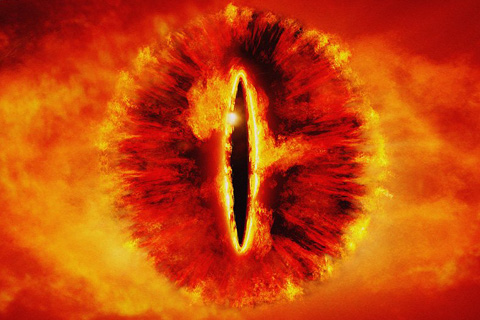 Throughout The Lord of the Rings, "the Eye" is the image most often associated with Sauron. Sauron's servants bore the symbol of the Eye on their helmets and shields and usually referred to him as the "Lidless/Red Eye". In the Mirror of Galadriel, Frodo had an actual vision of this Eye and much later, Tolkien writes as if Frodo and Sam really glimpse the Eye directly, not in any kind of vision. The mists surrounding Barad-dûr are briefly withdrawn, and:
The sum of the textual evidence does however allow for different interpretations: that the Eye is part of the physical body, or that the Eye is a mental or psychic manifestation (of Sauron's will, thought, power or presence), coexisting with the physical body. The Eye cannot be purely metaphorical, as Frodo's encounter with it in the Mirror shows.
The exact nature of the Eye, and its relationship to the never-seen body used by Sauron, remains a matter of debate among Tolkienists. Tolkien never elaborated further on these matters. Indeed he may intentionally have left many aspects of Sauron's character vague and mysterious.
1.) Samwise Gamgee is fat.It is a tradition among most film-makers and some illustrators to make Samwise Gamgee fat. In the film adaptation of The Two Towers, Gollum calls Sam "(stupid) fat hobbit", and indeed Sean Astin (Sam) was asked to put on weight to get the role or else the part would go to a fat guy in England, rumoured to be comedian Johnny Vegas.
Yet, the books never explicitly say anything about Sam's weight; Gollum calls Sam a variety of names, including cross, rude, nasty, suspicious, not nice, or silly. But never did he call Sam fat.
Stoutness is a very much a general trait among Hobbits. Tolkien mentioned often that the Hobbits enjoyed eating and drinking: in Letter 27, he describes them as being "fattish in the stomach, shortish in the leg", and like humans, they were inclined to expand as they got older - as shown in the books by Frodo himself, who was middle-aged for a Hobbit (he was around fifty when he set out to destroy the One Ring) and getting rather stout before losing much of his weight by walking and running a lot:
Looking in a mirror he was startled to see a much thinner reflection of himself than he remembered: it looked remarkably like the young nephew of Bilbo who used to go tramping with his uncle in the Shire; but the eyes looked at him thoughtfully.
And by Pippin's remark to Bergil son of Beregond in Minas Tirith:
My father farms the lands round Whitwell near Tuckborough in the Shire. I am nearly twenty-nine...though I am but four feet, and not likely to grow any more, save sideways.Even so, quite the opposite of what the movies would like to have one believe, Sam, being young and a hard worker, was probably fitter than Frodo, Pippin, or Merry (who are all upper-class Hobbits). Pauline Baynes's illustration of the Fellowship, done while Tolkien was alive, shows all four hobbits as being of very much the same proportions. Oddly enough, the movie shows Sam as more or less the same build when he leaves Hobbiton and when he reaches Mordor, even though he had some weeks of semi-starvation.

An insterestingly similar case happens in a number of adaptations of the Sherlock Holmes novels, where Holmes' sidekick Dr. John Watson is depicted as a fat, bumbling idiot - quite opposite from the novels, where the more competent Watson is, or was, apparently in pretty good shape (he is first described as "as thin as a lath and as brown as a nut" and later as "a middle-sized, strongly built man"; it was only in His Last Bow that he was described as "thickset").
2.) Hobbits, in general, have big feet.The popular idea that Hobbits have big feet seems to have begun with the Brothers Hildebrant, who did numerous popular Tolkien-related illustrations in the 1960s and 1970s. Apparently this was done to make Hobbits look more distinctive and unusual, as they also showed Dwarves with huge feet.
Even so, Tolkien does not anywhere say that Hobbits have big feet for their size: the only Hobbit he describes as such is Mr. Proudfoot, and even then it would seem that his feet were exceptional:My dear Bagginses and Boffins, he began again; and my dear Tooks and Brandybucks, and Grubbs, and Chubbs, and Burrowses, and Homblowers, and Bolgers, Bracegirdles, Goodbodies, Brockhouses and Proudfoots. 'ProudFEET!’ shouted an elderly hobbit from the back of the pavilion. His name, of course, was Proudfoot, and well merited; his feet were large, exceptionally furry. and both were on the table.Tolkien describes Hobbits in the Prologue (Concerning Hobbits) thus:
...They seldom wore shoes, since their feet had tough leathery soles and were clad in a thick curling hair, much like the hair of their heads, which was commonly brown. Thus, the only craft little practiced among them was shoe-making; but they had long and skilful fingers and could make many other useful and comely things.And further:
The Harfoots were browner of skin, smaller and shorter, and they were beardless and bootless; their hands and feet were neat and nimble...The Stoors were broader, heavier in build; their feet and hands were larger...The Fallohides were fairer of skin and also of hair, and they were taller and slimmer than the others...The Harfoots...were the most normal and representative variety of Hobbit, and far the most numerous.The four Hobbits of the Fellowship appear to have been Harfoots with (in the case of Merry, Pippin and Frodo at least) some Fallohide ancestry. Humans who go barefoot all their lives often develop wider and stronger feet, but not feet which are abnormally long or rubber-like. So why should we expect Hobbits to be any different (considering they were "fairly human" in appearance and are actually a branch or variety of the race of Men)?
3.) Sauron, by the end of the Third Age, is a mere eye atop Barad-dûr.
Throughout The Lord of the Rings, "the Eye" is the image most often associated with Sauron. Sauron's servants bore the symbol of the Eye on their helmets and shields and usually referred to him as the "Lidless/Red Eye". In the Mirror of Galadriel, Frodo had an actual vision of this Eye and much later, Tolkien writes as if Frodo and Sam really glimpse the Eye directly, not in any kind of vision. The mists surrounding Barad-dûr are briefly withdrawn, and:One moment only it stared out...as from some great window immeasurably high there stabbed northward a flame of red, the flicker of a piercing Eye... The Eye was not turned on them, it was gazing north...but Frodo at that dreadful glimpse fell as one stricken mortally.
Thus, many adaptations (such as the 1980 Rankin-Bass Return of the King and the Peter Jackson trilogy) Sauron is usually portrayed as a disembodied physical Eye high above the Dark Tower - a bit of a departure from the books, since it shows Sauron inside the tower, gazing out through "the Window of the Eye in [his] shadow-mantled fortress"; in addition, it is never clear in the books whether the Eye is disembodied or not.
Even so, from various quotes we can glean that Tolkien cannot have intended the Eye to be Sauron's complete or sole manifestation; his spirit did inhabit some kind of body. Gollum (who was tortured by Sauron in person) tells Frodo that Sauron has, at least, a "Black Hand" with four fingers. In the The Return of the King, the heralds call Sauron out before the Battle of the Morannon, telling him to "come forth", which would seem pointless if he did not have a body. Also, in one of his letters (Letter 246) Tolkien clarifies that Sauron did have a physical form in the Third Age:Sauron should be thought of as very terrible. The form that he took was that of a man of more than human stature, but not gigantic. In his earlier incarnation he was able to veil his power (as Gandalf did) and could appear as a commanding figure of great strength of body and supremely royal demeanour and countenance.J. R. R. Tolkien: Artist and Illustrator includes Tolkien's own drawing of Sauron, depicting him as a literally black humanoid.
The sum of the textual evidence does however allow for different interpretations: that the Eye is part of the physical body, or that the Eye is a mental or psychic manifestation (of Sauron's will, thought, power or presence), coexisting with the physical body. The Eye cannot be purely metaphorical, as Frodo's encounter with it in the Mirror shows.
The exact nature of the Eye, and its relationship to the never-seen body used by Sauron, remains a matter of debate among Tolkienists. Tolkien never elaborated further on these matters. Indeed he may intentionally have left many aspects of Sauron's character vague and mysterious.
Popular (Mis)Depictions of Bible stories, part 3
 1.) Jesus' name was Jesus H. Christ.
Jesus' real name was NOT Jesus H. Christ, despite what many swearers and popular culture might tell you. Christ was not a last name, but rather a title: a Greek translation of the Hebrew מֹשִׁיַּח, meshiakh or the Aramaic משיחא, meshiha, both meaning "the anointed" - this refers to an ancient Jewish ritual of anointing and consecrating someone or something with oil. This term was translated in Greek as χριστος, christos. Thus, Jesus Christ (Iesous Christos in Greek) actually stands for "Jesus the messiah", or, more literally, "Jesus the anointed".
The spelling Christ in English itself only became more common in the 17th century, when spellings of certain words were changed to reflect their Greek or Latin origins more. Prior to this, the word was usually spelled Crist in Old and Middle English, the i being pronounced either as /iː/ (as in fEEt or bEAn) or or as /ɪ/, which survives today in the modern pronunciation of Christmas.
As for the H, there are many varying theories about it, ranging from explaining the H as an abbreviation for a certain word (usually explained as being either 'holy', 'Hebrew', or even 'haploid' or 'hebe') to tracing it to the IHS-IHC abbreviation of Jesus' name commonly encountered in Christianity.
2.) The giving of the Commandments to Moses was a private event of sorts, unwitnessed by the Israelites.
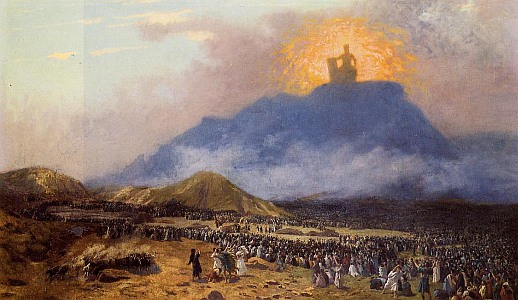 In The Ten Commandments (both the 1923 and 1956 DeMille versions), Moses climbs up the mountain of Sinai where - apparently - he alone hears God giving out the commandments while the people are busy creating the Golden Calf at the foot of the mountain, ignorant of the "Thou shalt not"s the Lord is talking about at the moment. However, Exodus 19:16-25 to 20:1-21 shows us that the giving of the commandments is a (semi-)public affair and that it was a separate event from the giving of the Tablets of the Law:
Some verses later, the text describes the peoples' reaction:And it was on the third day in the morning there was thunder and lightning and a heavy cloud on the mountain, and the sound of a strong horn so that all the people who were in the camp trembled. And Moses brought the people out of the camp to meet God, and they took their place at the foot of the mountain. Mount Sinai was completely in smoke, because the LORD descended upon it in fire, and its smoke went up like the smoke of a great furnace, and the whole mountain trembled violently. When the blast of the trumpet grew louder and louder, Moses was speaking and God was answering him with a voice. And the LORD came down upon Mount Sinai, on the top of the mountain, and the LORD called Moses to the top of the mountain, and Moses went up.
And the LORD said to Moses, "Go down and charge the people, lest they force their way through to the LORD to look, and many of them fall. Let the priests also, who approach the LORD, sanctify themselves, lest the LORD break out against them."
But Moses said to the LORD, "The people cannot come up to Mount Sinai; because you – you charged us, saying, ‘Set bounds around the mountain and sanctify it.’"
And the LORD said to him, "Go, get down, and come up, you and Aaron with you, but do not let the priests and the people break through to come up to the LORD, lest He break out against them." So Moses went down to the people and spoke to them. And God spoke all these words, saying: "I, the LORD, am your God, who brought you from the land of Egypt, from the house of slaves..."
...All the people were seeing the thundering and the lightning, and the sound of the horn, and the mountain smoking – and when the people saw it they trembled with fear and they stood from a distance. And they said to Moses, "You speak to us and we will listen, but do not let God speak with us or we will die." And Moses said to the people, "Do not fear, for God has come to test you, and that the fear of Him may be before you so that you may not sin." And they stood from a distance, but Moses drew near the thick darkness where God was.It was only after loads of instructions and commands - such as blueprints for building the Tabernacle and its necessary furnishings - and eleven chapters later (!!!) that God finally grants the tablets to Moses (31:18) and the Israelites decided to build the Golden Calf (32:1-35):
...And when He had finished speaking with him on Mount Sinai, He gave Moses two tablets of testimony, tablets of stone written by the finger of God. When the people saw that Moses delayed in coming down from the mountain, the people gathered around Aaron and said to him, "Get up, make us a god that will go before us. As for this Moses, the man who brought us up from the land of Egypt, we do not know what has become of him!"3.) Joseph wore a technicolor rainbow coat.
Notwithstanding the title of Andrew Lloyd Webber's musical, the actual meaning of the Hebrew phrase commonly translated as "coat of many colors" is ambiguous and unclear.
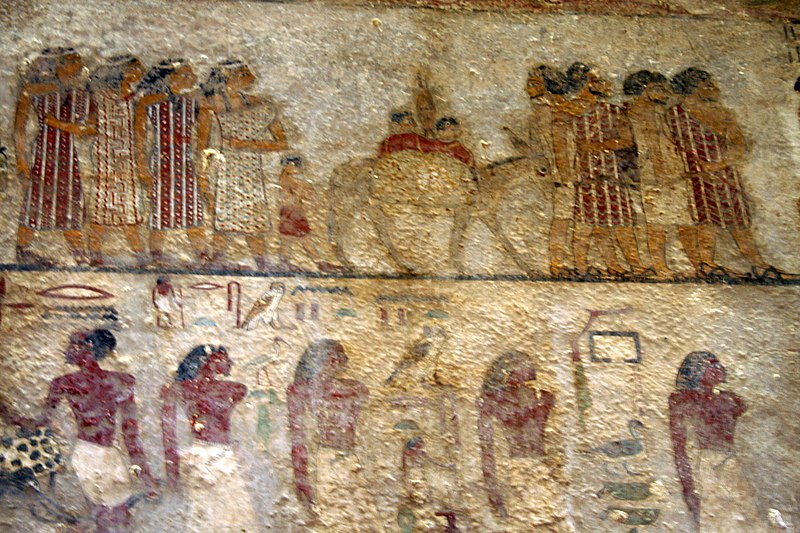 While the Hebrew term ketonet pasim (כתנת פסים) could mean "coat of many colors" since some of the possible meanings of pasim are "colorful," "embroidered" or "striped" - and indeed the translators of the Septuagint understood it thus and rendered the phrase as chitōna poikilon, meaning "garment of many kinds" or "multi[-colored] garment" - and since the use of clothing with differently-colored patterns or stripes is attested amongst Asiatic nomads in Canaan during the 2nd millenium BC (for example, see wall painting from the tomb of Khnumhotep II, located in Beni Hasan on the left [another detail here]; also see the detail of a mural fresco from the palace of Zimrilim at Mari in Syria, ca. 18th century BC), the word also allows for a long garment, coming down to the the hands and feet since another meaning of pasim is "the flat [palms] of the hands/the flat [soles] of the feet". Indeed, the 2nd-century Jewish proselyte Aquila of Sinope seems to have understood it thus and rendered pasim as astragalōn, "reaching to the ankles" in his translation of the Old Testament into Greek. Interestingly, the same phrase is used in 2 Samuel 13:18 to describe Tamar's clothing. In this case the Septuagint actually renders ketonet pasim as chitōn karpōtos, perhaps meaning "a garment reaching to the wrists".
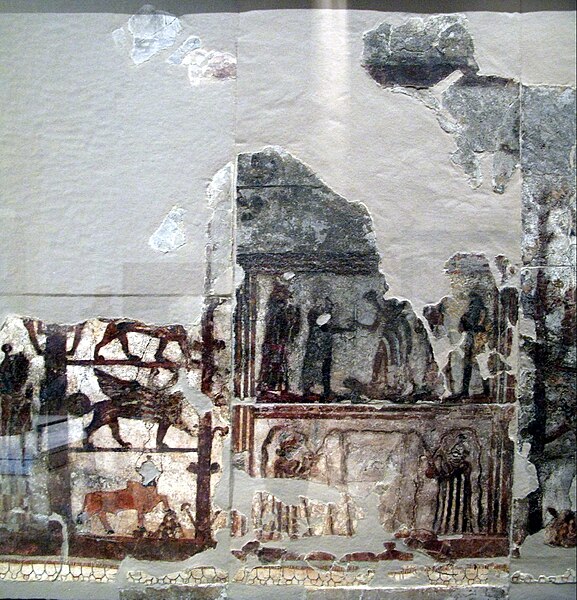
Yet another interpretation of ketonet pasim is a garment made of fine material, such as silk or fine wool: the rabbis of the Talmud, in fact, understood Joseph's coat to be a silken garment. Still others connect it with the Akkadian phrase kitu pishannu, a Babylonian ceremonial robe studded with gold ornaments (usually with figures of deities), the Phoenician ps "tablet, piece" (suggesting a garment made of patches of material sewn together), or even the Akkadian paspasu "brightly colored bird."
 Jerome, meanwhile, translates the instance of ketonet pasim in Genesis 37 as tunicam polymitam, which could mean "garment woven with many threads", "garment made of fine fabric" or "garment woven with different colored threads", and the one in 2 Samuel 13 as talari tunica, "garment reaching to the ankles".
If we'll look into early artworks, such as those depicting the brothers showing the (bloodstained) coat to Jacob, a number of them usually depict Joseph's coat as being of one color (such as here, here, here, here, here, here, here, and here), or apparently made of fine material.
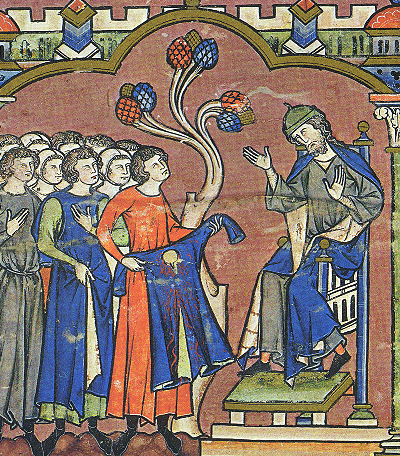

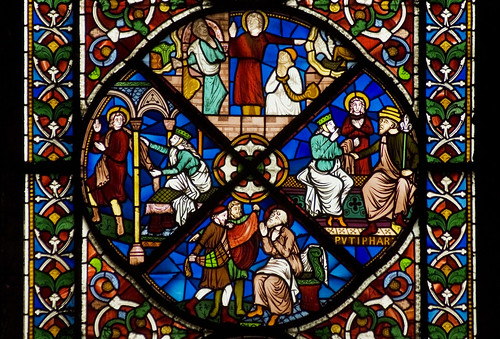


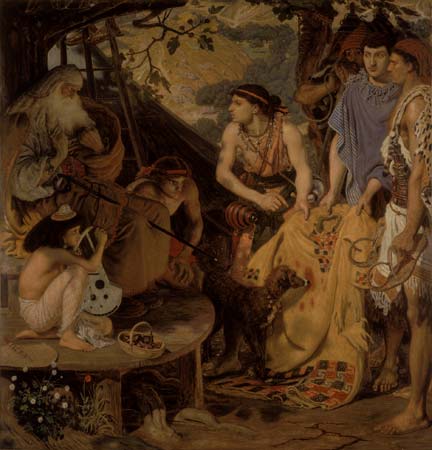
Rendering the coat with all seven colors of the rainbow only became in vogue recently, perhaps somewhere around the 19th-20th century (see Horace Vernet's 1853 painting); on the other hand, this depiction, made in 1867, still depicts the coat as being of one color, yet adds multicolored designs at the lower hem and at the sleeves (personally, I actually find this depiction closer to reality than the full-fledged "rainbow coat" we so commonly see today).
So how did we come by with the "coat of many colors"?
Translating ketonet pasim as "coat of many colors" is an old tradition in the art of translating Bibles into English - John Wycliff and his associates, one of the first (but not exactly THE first) people to translate the Bible into English, already used the term in the late 14th century even before the King James Version of 1611, and its subsequent revisions, used it. Because the KJV was very influential - and because for some people it served as the Bible - many translations have followed the King James in understanding ketonet pasim as "coat of many colors".
One of the first translations to break this long-standing custom was the Revised Standard Version (1952), which translated the phrase as "long robe with sleeves"; since then many English Bibles have opted follow suit and to either render the phrase somewhere along the lines of "a richly ornamented robe" (New International Version) or "a long tunic" (New American Bible) or, in cases where the traditional rendering is used, have started to include footnotes which give either background detail on the phrase in question in the original Hebrew or alternate possible renderings.
Even if we can't know for certain what the word actually meant - whether the coat was actually colorful or made of fine material or was very long, we can still conclude that this piece of clothing is a very special gift, as Joseph was given the coat by his father Jacob (who favored him); as a result, he was envied by his brothers, who saw it as indicating that Joseph would assume family leadership (Genesis 37:3-4):
Now Israel (Jacob) loved Joseph more than all his sons, because he was a son of old age to him, and he had made him a ketonet pasim. When his brothers saw that their father loved him more than any of his brothers, they hated him and could not speak peaceably to him.
Friday, January 9, 2009
Popular (Mis)Depictions of Bible stories, part 2 (1)
 1.) The Tablets of the Law are semi-flat rounded off rectangles.
While it had become common to depict the Tablets of the Law as rounded off rectangles, this is actually a recent innovation in Western art, becoming prevalent only from the late Medieval period. A majority of earlier depictions of the Tablets depict them as being rectangular slabs (see image at left, and here, here, here, here, and here for some more examples).
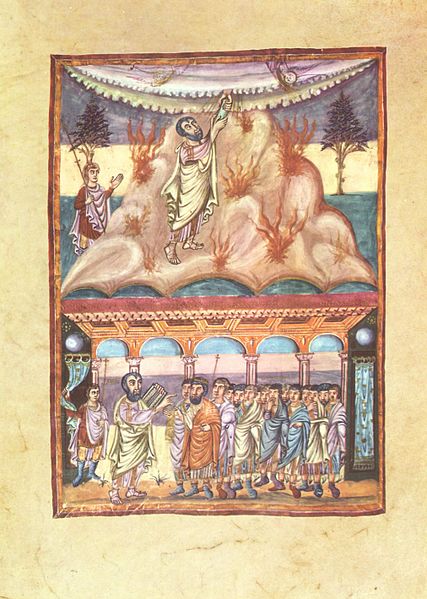


Rabbinic tradition, meanwhile, has it that the Tablets were either shaped like perfect cubes or sharp-cornered rectangles, six tefachim - a tefach ("handbreath") is approximately equal to 8 centimeters or 3.2 inches - in length and three tefachim thick (Baba Batra 14a).
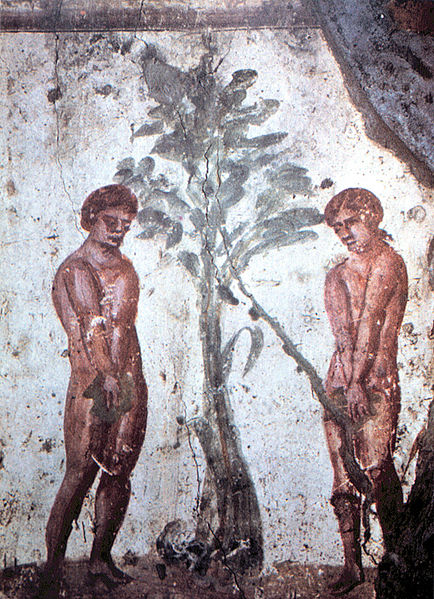 2.) Adam and Eve ate an apple.
There is nothing in the Bible that expressly mentions or suggests that the Tree of Knowledge of Good and Evil (Etz ha-Daat tov V'ra) is an apple tree. Even early authorities disagreed on the species of the tree and its fruit. The apocryphal Book of Enoch (32:4) suggests that the tree looked like a species of tamarind that bore fruit which resembled extremely fine grapes.
In the Talmud (Berachot 40b), Rabbi Meir said that Man and Woman debased themselves by drinking wine made out of the grape(s) which grew from the tree, "since the thing that most causes wailing to a man is wine" (as it did to Noah, who drank to the point of intoxication). Meanwhile, Rabbi Nehemiah suggested that the fruit may have been figs (cf. Genesis 3:7, where Adam and Eve sew fig leaves to hide their nakedness) while Rabbi Yehuda said that it was a sort of wheat (Hebrew khitah, a pun on khet, "sin"), "since a child does not know how to call 'father' and 'mother' until it has had a taste of corn."
The citron (Hebrew etrog, which resembles the Aramaic m'ragag, "desirable"; cf. Genesis 3:6) and the carob (since its Hebrew name charuv puns on cherev "sword", and churban "destruction") have also been suggested. Islamic tradition, meanwhile, commonly represents the fruit as a fig or olive.
Around the 12th century, Christian art in France and Germany started to depict the apple as the forbidden fruit, while Byzantine and Italian artists stuck with the belief that the Fruit of Knowledge was a fig. It was not until the later Renaissance that the "forbidden fruit=apple" belief was universal.
There are varying hypotheses on why the apple was chosen to represent this fruit, but one possible theory is that because the Latin word for evil, "malus", is homonymous with the word for apple: Adam and Eve contracted malus (evil) by eating a malus (apple).
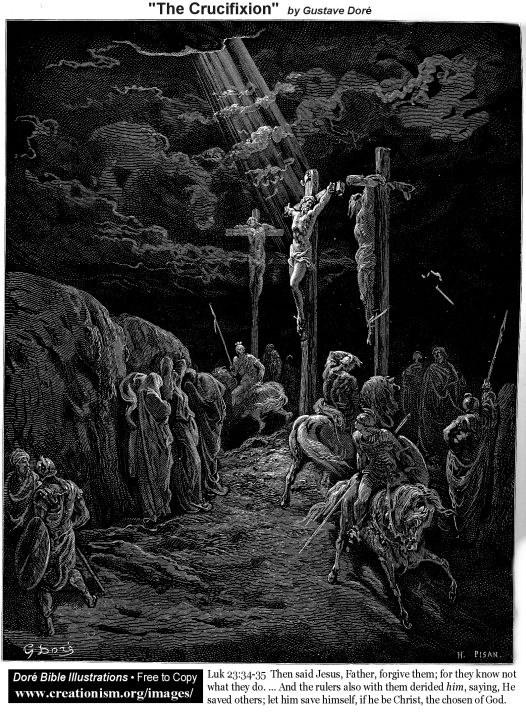
3.) Golgotha was a skull-shaped hill with three tall crosses in it.
 While the word Golgotha does mean "the place of the skull," the place's appearance needn't necessarily have looked like a skull; indeed this belief that Golgotha is named so because of its appearance is only recent, dating only from the 19th century.
The general belief from early Christian times onwards is that the reason why it is called such is either because of its function as a place of execution, i.e. there were bones and skulls of victims strewn about all over the place, or the belief held by many Church Fathers that Adam was buried on that spot (Origen in the 2nd century, who himself have lived in Jerusalem for 20 years, is our earliest witness to this tradition).
No early Christian writer explicitly suggested that Calvary was a skull-shaped hill, and the Gospels themselves are silent as to whether Jesus' crucifixion occurred on a raised place at all. It is true that the tradition embodied in the name "Mount Calvary" appears as early as the 4th century, but that the hill was skull-like in form is quite a modern idea. In fact, St. Epiphanius of Salamis in the 4th century expressly said that "There is nothing to be seen on the place resembling this name; for it is not situated upon a height that it should be called (the place) of a skull, answering to the place of the head in the human body."
Gordon's Calvary (named after Major-General Charles George Gordon, who had popularized the site in 1882-83, after Otto Thenius of Dresden proposed this hill as the true location of Golgotha in 1842) does resemble a skull and is popular among some Christians as the location of Jesus' crucifixion. Even so, the features of the hill that make it look like a skull were most likely not present in the 1st century. Archaeologists believe it to be a quarry or mine developed only in the past two or three centuries; its skull-like appearance is thus due to modern mining or quarrying operations in the area.
Also, many works of art and even a number of films show only three crosses on Golgotha; sometimes shown as very tall ones.
However, it is more historically plausible that Golgotha was literally dotted with upright beams (stipes) on which the crossbeam (patibulum) was placed to make a cross - it was, after all, an execution site, and crucifixions by the tens or hundreds were most likely held there daily. It might be even possible that there were other crucified victims, dead or dying, in Golgotha when Jesus and the two criminals arrived.
Also, crosses were not that high; in fact, they were most probably only a feet or so from the ground, so as to facilitate wild animals consuming the corpses of the victims hanging thereon (victims of crucifixion were often left to hang on their crosses to rot or, at worst, were dumped in the garbage heap; giving a crucifixion victim a proper burial was rare and was the exception to the rule).
Early artworks (once again, examples are here, here, here, here, here, here, and here) quite uniformly depict the crosses as only a few measures tall than the victim. It was not until later that a number of artists gradually started increasing the heights of the crosses in their art. The end results of this were the popular images of three crosses which at most are somewhere around seven to ten-feet tall, standing on a hill very much devoid of anything else.


Friday, January 2, 2009
Popular (Mis)Depictions of Bible stories, part 1
Sometimes, popular belief and iconography can influence our minds on how we read the Bible (admittedly one of the least descriptive ancient texts), sometimes to such an extent that we are so used to it that when someone tries depict a particular event in a different manner - usually closer to what the Bible says, we often get fidgety and uncomfortable.
Here let's do a simple listing of popular depictions vs. the Biblical account.
1.) The Red Sea started to part from Israelites' side.
Cecil B. DeMille's 1923 and 1956 films, both entitled The Ten Commandments, and just about a majority of Moses films after it depicts the parting of the Red Sea in a very dramatic manner: as Moses raises his staff/hands over the sea, the sea starts to open from the shore where the Israelites are. (footage from DeMille's 1923 version)
The Bible (Exodus 14:21-22), however, paints a quite different picture:
 While the exact route that the Israelites took is still a matter of debate (see map to the right for various possible routes), the results would have been pretty much the same. The Israelites were going eastward towards Canaan, as any good map could tell you. If the parting of the sea happened like films show it (opening dramatically), the sea would have started to part from the other shore, as the sea was driven back by "a strong east wind", rather opposite to what the movies are depicting - since an east wind comes from the east and blows west.
2.) Jonah was swallowed by a whale.
There's really no indication that Jonah was swallowed by a whale, at least from the book of Jonah (2:1):
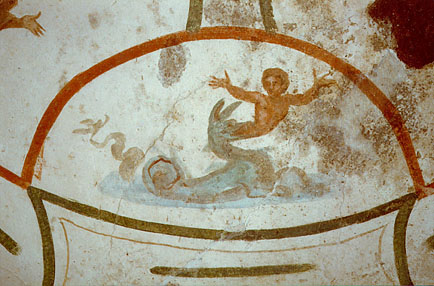 The Greek Septuagint, meanwhile, renders the phrase hadag gadol as kētei megalō meaning "a large great fish" or "a large whale" or even "a large sea monster/sea serpent." Since in Greek mythology the word kētos, while meaning "great fish", is closely associated with sea monsters (e.g., Cetus (Kētos) of Greek mythology), early Christians seem to have understood and depicted the 'fish' as being a hideous serpentine creature like in the image at left; see here, here, and here for other examples.
Jerome later translated this phrase as piscis granda (great fish) in his Latin Vulgate. He translated kētos, however, as cetus in Matthew 12:40. At some point cetus became synonymous with "whale" (for instance, the study of whales is now called cetology).
In his late 14th century translation, John Wycliff rendered piscis granda as "greet fisch" (great fish) in Jonah 2:1, while translating cetus as "whal" (whale) in Matthew 12:40. William Tyndale followed suit, translating the phrase as "greate fyshe" in his 1534 translation of the Bible, while translating the word kētos or cetus as "whale". Tyndale's translation was later incorporated into the Authorized Version of 1611 (aka the King James Version). Since then, the "great fish" in Jonah 2 has been most often interpreted as a whale.
3.) Moses turned his rod into a serpent and called forth all ten plagues of Egypt.
In the 1998 film The Prince of Egypt, it was Moses who call forth all the plagues to the Egyptians. However, the Bible has Moses commanding Aaron to throw down his staff and to summon the first three plagues:
As to the reason why Aaron is commanded to do the things that would call the three plagues, Jewish belief explains it as Moses being obliged to appreciate the help he received earlier from the Nile (Exodus 2:1-10), and the dust (Exodus 2:11-12) and was therefore unable to smite either of these, necessitating Aaron to do it in his stead.
 4.) The Tablets of the Law are only written on one side.
Exodus 32:15-16 tells us that:
As for how any commandments are written on one tablet, while arrangements such as "five commandments on each tablet" or the "three commandments on one with seven on the other" (first suggested by St. Thomas Aquinas, for theological reasons) are common, some are of the idea that that each tablet contained all ten commandments in imitation of ancient treaties, in which each party receives a copy of the treaty - usually written in stone - while the subordinate party places his copy of the pact inside the main temple of his deity, which would be parallel to the keeping of the tablets within the Ark of the Covenant, which in turn was kept in the Mishkan (Tabernacle) and later in the Temple of Jerusalem.
Apparently, this was also a debated point among early Jewish rabbis: some held that there were five on each tablet, but it was also admitted that "the Sages say ten on one tablet and ten on the other".
Here let's do a simple listing of popular depictions vs. the Biblical account.
1.) The Red Sea started to part from Israelites' side.
Cecil B. DeMille's 1923 and 1956 films, both entitled The Ten Commandments, and just about a majority of Moses films after it depicts the parting of the Red Sea in a very dramatic manner: as Moses raises his staff/hands over the sea, the sea starts to open from the shore where the Israelites are. (footage from DeMille's 1923 version)
The Bible (Exodus 14:21-22), however, paints a quite different picture:
Then Moses stretched out his hand toward the sea, and the LORD drove the sea back by a strong east wind (v'ruach qadim 'azah) all that night and He made the sea into dry ground, and the waters were divided. The sons of Israel went into the midst of the sea on the dry ground, and the waters were for them a wall on their right and on their left.
While the exact route that the Israelites took is still a matter of debate (see map to the right for various possible routes), the results would have been pretty much the same. The Israelites were going eastward towards Canaan, as any good map could tell you. If the parting of the sea happened like films show it (opening dramatically), the sea would have started to part from the other shore, as the sea was driven back by "a strong east wind", rather opposite to what the movies are depicting - since an east wind comes from the east and blows west.2.) Jonah was swallowed by a whale.
There's really no indication that Jonah was swallowed by a whale, at least from the book of Jonah (2:1):
The LORD appointed a great fish (hadag gadol) to swallow Jonah; and Jonah was in the stomach of the fish three days and three nights.Now the phrase "great fish" is ambiguous. While there is a possibility that it is indeed a species of whale, it could also have been another aquatic animal, or even a special one-time creature that God made for the purpose of rescuing Jonah.
The Greek Septuagint, meanwhile, renders the phrase hadag gadol as kētei megalō meaning "a large great fish" or "a large whale" or even "a large sea monster/sea serpent." Since in Greek mythology the word kētos, while meaning "great fish", is closely associated with sea monsters (e.g., Cetus (Kētos) of Greek mythology), early Christians seem to have understood and depicted the 'fish' as being a hideous serpentine creature like in the image at left; see here, here, and here for other examples.


Jerome later translated this phrase as piscis granda (great fish) in his Latin Vulgate. He translated kētos, however, as cetus in Matthew 12:40. At some point cetus became synonymous with "whale" (for instance, the study of whales is now called cetology).
In his late 14th century translation, John Wycliff rendered piscis granda as "greet fisch" (great fish) in Jonah 2:1, while translating cetus as "whal" (whale) in Matthew 12:40. William Tyndale followed suit, translating the phrase as "greate fyshe" in his 1534 translation of the Bible, while translating the word kētos or cetus as "whale". Tyndale's translation was later incorporated into the Authorized Version of 1611 (aka the King James Version). Since then, the "great fish" in Jonah 2 has been most often interpreted as a whale.
3.) Moses turned his rod into a serpent and called forth all ten plagues of Egypt.
In the 1998 film The Prince of Egypt, it was Moses who call forth all the plagues to the Egyptians. However, the Bible has Moses commanding Aaron to throw down his staff and to summon the first three plagues:
Exodus 7:10: When Moses and Aaron went to Pharaoh, they did so, just as the Lord had commanded them – and Aaron threw down his staff before Pharaoh and his servants and it became a snake.However, that piece of artistic license within the context of the film is understandable (the film has Moses' wife Tzipporah accompanying him to Egypt in place of Aaron, who seems rather bitter at Moses by this point).
Exodus 7:19: And the LORD spoke to Moses, "Say to Aaron, ‘Take your staff and stretch out your hand over the waters of Egypt, over their streams, over their rivers, over their ponds, and over all their pools of water, that they may become blood. And there will be blood throughout all the land of Egypt, both in wood and stone containers.’"
Exodus 8:5: And the LORD spoke to Moses, "Say to Aaron, ‘Stretch out your hand with your rod over the streams, over the rivers, and over the ponds, and cause frogs to come up on the land of Egypt.’"
Exodus 8:16: And the LORD spoke to Moses, "Say to Aaron, ‘Extend your staff and strike the dust of the ground, and it will become gnats throughout all the land of Egypt.’"
As to the reason why Aaron is commanded to do the things that would call the three plagues, Jewish belief explains it as Moses being obliged to appreciate the help he received earlier from the Nile (Exodus 2:1-10), and the dust (Exodus 2:11-12) and was therefore unable to smite either of these, necessitating Aaron to do it in his stead.
4.) The Tablets of the Law are only written on one side.Exodus 32:15-16 tells us that:
And Moses turned and went down from the mountain with the two tablets of the testimony in his hands. The tablets were written on both sides – they were written on one side and the other. And the the tablets were the work of God, and the writing was the writing of God, engraved on the tablets.There was in fact a Jewish tradition which states that the letters were not merely engraved on the surface of the tablets; they were fully bored through it. In fact, while one would expect the reverse side to bear a mirror image since the letters were bored fully, both sides appeared normally; i.e. the back appeared identical to the front. Another is that the inner part of some Hebrew letters (either ayin, which in paleo-Hebrew looked like an 'O', or samekh or the final mem in modern-day Hebrew script) 'hovered' in place, despite the letters being graven fully.
As for how any commandments are written on one tablet, while arrangements such as "five commandments on each tablet" or the "three commandments on one with seven on the other" (first suggested by St. Thomas Aquinas, for theological reasons) are common, some are of the idea that that each tablet contained all ten commandments in imitation of ancient treaties, in which each party receives a copy of the treaty - usually written in stone - while the subordinate party places his copy of the pact inside the main temple of his deity, which would be parallel to the keeping of the tablets within the Ark of the Covenant, which in turn was kept in the Mishkan (Tabernacle) and later in the Temple of Jerusalem.
Apparently, this was also a debated point among early Jewish rabbis: some held that there were five on each tablet, but it was also admitted that "the Sages say ten on one tablet and ten on the other".
Subscribe to:
Posts (Atom)