Saturday, September 20, 2008

On Crucifixion: An Essay: part 2

D. DEATH

Blood loss from the scourging helped determine the time the victim survived. In any case, victims suffered a long time (at most, days) before falling into prolonged unconsciousness and death. Soldiers typically did not hasten things along because a long and painful death was the point of the execution method. Usually the victim was left on the cross until birds and wild beasts consumed the body.

Death could result from a variety of causes, including blood loss and hypovolemic shock, or infection and sepsis, caused by the scourging that preceded the crucifixion or by the nailing itself, and eventual dehydration. A theory attributed to French surgeon Dr. Pierre Barbet (author of A Doctor at Calvary: The Passion of Our Lord Jesus Christ As Described by a Surgeon) holds that, when the whole body weight was supported by the stretched arms, the typical cause of death was asphyxiation. He conjectured that the condemned would have severe difficulty inhaling, due to hyper-expansion of the chest muscles and lungs.

The condemned would therefore have to draw himself up by his arms, leading to exhaustion, or have his feet supported by tying or by a wood block. Indeed, the executioners were sometimes asked that the legs of the victim were broken or shattered, an act called crucifragium which was also frequently applied without crucifixion to slaves.

This act speeded up the death of the person but was also meant to deter those who observed the crucifixion from committing offenses. Once deprived of support and unable to lift himself, the victim would die within a few minutes.

Experiments by Dr. Frederick Zugibe, former chief medical examiner of Rockland County, New York have revealed that, when suspended with arms at 60° to 70° from the vertical, test subjects had no difficulty breathing, only rapidly-increasing discomfort and pain. This would correspond to the Roman use of crucifixion as a prolonged, agonizing, humiliating death. Zugibe claims that the breaking of the crucified condemned's legs to hasten death was administered as a coup de grâce, causing severe traumatic shock or hastening death by fat embolism. Crucifixion on a single pole with no transom, with hands affixed over one's head, would precipitate rapid asphyxiation if no block was provided to stand on, or once the legs were broken.

It is possible to survive crucifixion, if not prolonged, and there are records of people who did. The historian Josephus, a Judean who defected to the Roman side during the Jewish uprising of 66-72 AD, describes finding two of his friends crucified. He begged for and was granted their reprieve; one died, while the other recovered. Josephus gives no details of the method or duration of their crucifixion before their reprieve.

E. WERE VICTIMS CRUCIFIED NAKED?

It is still a matter of debate whether victims were crucified in the nude or with their loincloths left on. There is no doubt that many (if not most) crucifixion victims were stripped naked, either with or without a loincloth, as it would have humiliated the victim further. This is one of the elements which made crucifixion notorious: due to the physical, mental and emotional pain it caused.

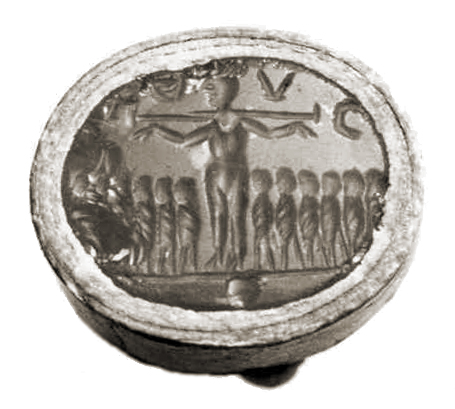
While traditionally Jesus and the two criminals are depicted as having a sort of loincloth for modesty (in a few depictions, Jesus even wears a full-length robe, called a colobium), a few very early depictions depict the victim as either being stark naked on the cross or with some loincloth on (also see illustration at left and below right, one of which is a graffito found in Puzzuoli, with the other being a gem found in Syria, dating from the late 2nd-3rd century). As a general rule of thumb, most of these early representations are not depictions made by Christians, who still didn't depict the Crucifixion overtly during this time period, but were usually created by non-Christians and/or Gnostics.

While some take the position that Jesus was not spared even a loincloth when He was crucified, some believe that due to Jewish sensibilities, loincloths were left on or provided (it would be fitting to remind here that many people in ancient times did not even wear loincloths; for them, their tunics served as their undergarment). So, before we could have any conclusive evidence, it would seem that the best answer here for the moment is that it depended on the situation and the location.

F. THE SHAPE OF THE CROSS

The gibbet on which crucifixion was carried out could be of many shapes. Josephus records multiple tortures and positions of crucifixion during the Siege of Jerusalem as Titus crucified the rebels; and the Roman historian Seneca the Younger recounts ("To Marcia, On Consolation", 6.20.3):

"Video istic cruces non unius quidem generis sed aliter ab aliis fabricatas: capite quidam conversos in terram suspendere, alii per obscena stipitem egerunt, alii brachia patibulo explicuerunt. Video fidiculas, video verbera, et membris singulis articulis singula docuerunt machinamenta: sed video et mortem..."

I see there crosses, not merely of one kind but fashioned differently by others: a certain one suspends with head down towards the ground, others drive stakes through their private parts; others stretch the arms out on the gibbet; I see cords, I see whips, and contraptions designed to torture every joint and limb, but I see death as well...
At times the gibbet was only one vertical stake, called in Latin crux simplex or palus. This was the simplest available construction for torturing and killing the criminals. Frequently, however, there was a cross-piece attached either at the top to give the shape of a T (crux commissa) or just below the top, as in the form most familiar in Christian symbolism (crux immissa). Other forms were in the shape of the letters X and Y.

While the view that Jesus died on a stake has thus been propounded by writers of the nineteenth and twentieth century (and is still popular among Jehovah's Witnesses), second-century writers, such as Justin Martyr and Irenaeus, who were much closer to the event, speak of him only as dying on a two-beam cross.

In the same century, the author of the Epistle of Barnabas and Clement of Alexandria saw a two-beam shape of the cross of Jesus as foreshadowed in a numerological interpretation of Genesis 4:14, and the first of these, as well as Justin Martyr, saw the same shape prefigured in Moses keeping his arms stretched out in prayer in the battle against Amalek. At the end of the same century, Tertullian speaks of Christians as accustomed to mark themselves repeatedly with the sign of the cross, and the phrase "the Lord's sign" (τὸ κυριακὸν σημεῖον, to Kyriakon simeion) was used with reference to a cross composed of an upright and a crossbeam. Crosses of † or Τ shape were in use, even in Palestine, at the time of Jesus.

See here for more in-depth discussion on the shape of Jesus' cross.

G. LOCATION OF THE NAILS

In popular depictions of crucifixion, the condemned is shown with nails in the palm of their hands. Although historical documents refer to the nails being in the hands, the word usually translated as hand, "χείρ" (cheir) in Greek, referred to arm and hand together, so that, words are added to denote the hand as distinct from the arm, as "ἄκρην οὔτασε χεῖρα" (Akrin outase cheira, "he wounded the end of the 'cheir'", i.e. he wounded her hand).

A possibility that does not require tying is that the nails were inserted just above the wrist, between the two bones of the forearm (the radius and the ulna). The nails could also be driven through the wrist, in a space between four carpal bones. The word χείρ, translated as "hand", can include everything below the mid-forearm: Acts 12:7 uses this word to report chains falling off from Peter's 'hands', although the chains would be around what we would call wrists. This shows that the semantic range of χείρ is wider than the English hand, and can be used of nails through the wrist.

An experiment that was the subject of National Geographic Channel's documentary entitled Quest For Truth: The Crucifixion, and of a brief news article, showed that a person can be suspended by the palm of their hand. Nailing the feet (or the ankles) to the side of the cross relieves strain on the wrists by placing most of the weight on the lower body.

Another possibility, suggested by Frederick Zugibe, is that the nails may have been driven in at an angle, entering in the palm in the crease that delineates the bulky region at the base of the thumb, and exiting in the wrist, passing through the carpal tunnel.

A footrest attached to the cross, perhaps for the purpose of taking the man's weight off the wrists, is sometimes included in representations of the crucifixion of Jesus, but is not mentioned in ancient sources. These, however, do mention the sedile (a small piece or block of wood attached to the front of the cross, about halfway down, where the victim could rest) which could have served that purpose.

H. THE NUMBER OF THE NAILS USED IN JESUS' CRUCIFIXION

The question has long been debated whether Jesus was crucified with three or with four nails.

The treatment of the Crucifixion in art during the earlier Middle Ages strongly supports the tradition of four nails, and the language of certain historical writers (none, however, earlier than Gregory of Tours, "De Gloria Martyrum", vi), favors the same view. The earliest depictions of the subject (see links to pictures in Section E above) might also favor this view, as they generally depict the feet of the victim as being separate from each other.

On the other hand, in the thirteenth century, most of Western art (with a few exceptions; see the image to the right, painted by Diego Velázquez in 1632) began to represent the feet of Jesus as placed one over the other and pierced with a single nail. This accords with the language of Nonnus and Socrates and with the poem "Christus Patiens" attributed to St. Gregory Nazianzus, which speaks of three nails.

This depiction of three nails had actually caused some controversy when it was first introduced. For example, in the latter part of the 13th century the bishop of Tuy in Iberia wrote in horror about the 'heretics' who carve 'ill-shapen' images of the crucified Jesus 'with one foot laid over the other, so that both are pierced by a single nail, thus striving to annul or render doubtful men's faith in the Holy Cross and the traditions of the sainted Fathers.'

Archaeological criticism has pointed out however not only that two of the earliest representations of the Crucifixion (the Palatine graffito does not here come into account), viz., the carved door of the Santa Sabina in Rome, and the ivory panel of the British Museum, show no signs of nails in the feet, but that St. Ambrose ("De obitu Theodosii" in P.L., XVI, 1402) and other early writers distinctly imply that there were only two nails. However, this does not answer why in Luke 24:39-40 Jesus is said to have shown 'his hands and his feet' to his disciples, unless there was some distinguishing mark located there.

St. Ambrose informs us that Empress Helena had one nail converted into a bridle for Constantine's horse (early commentators quote Zechariah 14:20, in this connection), and that an imperial diadem was made out of the other nail. Gregory of Tours speaks of a nail being thrown (deponi), or possibly dipped into the Adriatic Sea to calm a storm. It is impossible to discuss these problems adequately in brief space, but the information derivable from the general archaeology of the punishment of crucifixion as known to the Romans does not in any way contradict the early Christian tradition of four nails.

On Crucifixion: An Essay: part 1


I. INTRODUCTION

Crucifixion (from Latin crucifixio, perfect passive participle crucifixus, fixed to a cross, from prefix cruci-, cross, + verb ficere, fix or do, variant form of facere, do or make ) is an ancient method of execution, whereby the condemned person is tied or nailed to a large wooden cross (of various shapes) and left to hang until dead.

German scholar of religion Martin Hengel, the author of the work entitled Crucifixion (full title Crucifixion in the Ancient World and the Folly of the Message of the Cross), originally published in 1977, writes that while authors commonly regard the origins of crucifixion as coming from Persia due to the writings of the Greek historian Herodotus, the practice of impaling or nailing someone to a post or something similar to it, was also found among the Indians, Assyrians, Scythians, Taurians, Celts, Greeks, Seleucids, Romans, Britanni, Numidians and Carthaginians. The Carthaginians is commonly thought to have passed the knowledge to Romans, who then perfected the method.

II. HISTORY

While the origins of this method of execution are quite obscure, it is clear that the form of capital punishment lasted for over nearly 900 years, starting with the Persian king Darius’ (reigned 550-485 BC) crucifixion of 3000 Babylonian slaves in 519 BC and ending with Constantine in 337 AD; thus tens if not hundreds of thousands of individuals have been subjected to this cruel and humiliating form of punishment. There are records of mass executions in which hundreds of thousands of persons have died due to this practice.

It is common belief that crucifixion was only reserved for criminals, as a result of Plutarch’s passage that “each criminal condemned to death bears his cross on his back”, however literature clearly shows that this class were not the only individuals who were subjected to crucifixion. For example, Alexander the Great crucified 2000 survivors from the siege of Tyre on the shores of the Mediterranean Sea. Condemned Roman citizens were usually exempt from crucifixion (like feudal nobles from hanging, dying more honorably by decapitation) except for major crimes against the state, such as high treason.

The goal of Roman crucifixion was not just to kill the criminal, but also to mutilate and dishonour the body of the condemned. In ancient tradition, an honourable death required burial; leaving a body on the cross, so as to mutilate it and prevent its burial, was a grave dishonour.

Under ancient Roman penal practice, crucifixion was also a means of exhibiting the criminal’s low social status. It was the most dishonourable death imaginable, originally reserved for slaves, hence still called "supplicium servile" by Seneca, later extended to provincial freedmen of obscure station ('humiles'). The citizen class of Roman society were almost never subject to capital punishments; instead, they were fined or exiled. The Jewish-Roman historian Josephus mentions Jews of high rank who were crucified, but this was to point out that their status had been taken away from them.

Control of one’s own body was vital in the ancient world. Capital punishment took away control over one’s own body, thereby implying a loss of status and honor. The Romans often broke the prisoner's legs to hasten death and usually (with a few known exceptions) forbade burial.

III. METHODS OF CRUCIFIXION

Crucifixion was literally a death that was ‘excruciating’ (from the Latin word ‘ex cruces’, “out of crucifying”), gruesome (hence dissuading against the crimes punishable by it), and public (hence the expression “to nail to the cross”), using whatever means expedient for that goal. The methods varied considerably with location and with time period.

The Greek and Latin words corresponding to “crucifixion” covered a wide range of meaning, from impaling on a stake to affixing on a tree, to a mere upright pole (a ‘crux simplex’) or to a combination of an upright stake (‘stipes’ in Latin) and a crossbeam (‘patibulum’).

If a crossbeam is used, the victim was forced to carry it on his shoulders, which would have been torn open by a brutal scourging, to the place of execution. The Roman historian Tacitus records that the city of Rome had a specific place for carrying out executions, situated outside the Esquiline Gate, and a specific area reserved for the execution of slaves by crucifixion.

A. SCOURGING
Scourging the victim was a legal preliminary to every Roman execution, and only women and Roman senators or soldiers (except in eases of desertion) were exempt. The usual instrument was a short whip (known as a flagellum or flagrum, seen at right) with several single or braided leather thongs of variable lengths, in which small iron or lead balls or sharp pieces of sheep bones were tied at intervals.

For scourging, the man was first stripped of his clothing, and his hands were tied to an upright post.

The poet Horace refers to the horribile flagellum (horrible whip) in his Satires, calling for the end of its use. Typically, the one to be punished was stripped naked and bound to a low pillar so that he could bend over it, or chained to an upright pillar as to be stretched out.

The back, buttocks, and legs were flogged either by two Roman officials known as lictors (from the Latin verb ligare, which means "to bind", said to refer to the fasces that they carried) or by one who alternated positions (some reports even indicate scourgings with four or six lictores). The severity of the scourging depended on the disposition of the lictores and was intended to weaken the victim to a state just short of collapse or death.

There was no limit to the number of blows inflicted — this was left to the lictores to decide, though they were normally not supposed to kill the victim. Nonetheless, Livy, Suetonius and Josephus report cases of flagellation where victims died while still bound to the post. Josephus also states that, at the Siege of Jerusalem at 70 AD (Jewish War 5.11), Jews who were captured by Titus' forces "were first whipped, and then tormented with all sorts of tortures, before they died, and were then crucified before the wall of the city. This miserable procedure made Titus greatly to pity them, while they caught every day five hundred Jews; nay, some days they caught more; yet it did not appear to be safe for him to let those that were taken by force go their way, and to set a guard over so many he saw would be to make such as great deal them useless to him. "

Flagellation was so severe that it was referred to as "half death" by some authors and apparently, many died shortly thereafter (some survivors were even reported to have gone mad due to the intensity of the scourging). Cicero reports in In Verrem (II.5), "pro mortuo sublatus, perbrevi postea est mortuus" ("taken away for a dead man, shortly thereafter he was dead"). Often the victim was turned over to allow flagellation on the chest, though this proceeded with more caution, as the possibility of inflicting a fatal blow was much greater.

As Pontius Pilate was only the Prefect/Equestrian Procurator of Iudeaea Region (from 26-36 A.D.), he might have had no true lictor of his own, hence regular soldiers might have administered the scourging in place of lictores.

After the scourging, the soldiers often taunted their victim. In Jesus' situation, this took the form of plaiting thorns (several prickly or thorny shrubs found in Palestine, especially the Paliurus aculeatus, Zizyphus Spina-Christi, and Zizyphus vulgaris may have served for the purpose) into a sort of 'crown' (the Gospels use the Greek word stephanon, which usually implies a wreath or garland of some sort; however some think that it is likely that the crown was a sort of 'cap' that covered the whole head, as in the illustration at right), dressing him in a purple (so say Mark and John) or scarlet (Matthew) cloak (Matthew and Mark used the Greek word chlamys, which was originally a sort of cloak worn by Greek soldiers made from a rectangle of woollen material about the size of a blanket, typically bordered, and was usually pinned at the right shoulder while John used the word himation, which was a type of cloak worn over the tunic or chiton), in order to mock him as King of the Jews. In addition, he was also provided a reed (kalamos) for a sceptre, which was later used to beat him (Matt. 27:30). However, once the soldiers got tired of this sport, they took off the robe, "dressed him in his own clothes, and led him off to crucify him."

B. TO THE PLACE OF EXECUTION

It was customary for the condemned man to carry his own cross from the flogging post to the site of crucifixion outside the city walls. He was usually naked, unless this was prohibited by local customs. Since the weight of the entire cross was probably well over 300 pounds (136 kilograms), only the crossbar was carried. The patibulum, weighing 75-125 pounds (35-60 kg). was placed across the nape of the victim’s neck and balanced along both shoulders. Usually, the outstretched arms then were tied to the crossbar.

The processional to the site of crucifixion was led by execution teams composed of four soldiers, headed by a centurion, with the condemned man placed in the middle of the hollow square of the four soldiers.

A herald carried a sign (titulus, epigraphe) on which the condemned man’s name and crime were displayed; alternatively, it would have been hung around the victim's neck. The board was said to be whitened with gypsum while the lettering was in black; alternatively, the lettering was done with gypsum. The description of guilt written thereon was usually made to be as brief and as concise as possible; the Gospel's record that Jesus' titulus merely contained his name and his crime ("the King of the Jews"). Eusebius (Ecclesiastical History 5.1) recorded a Christian martyr named Attalus who was led to the ampitheatre to be killed, with a placard being carried before him which said simply: "This is Attalus the Christian."

At the site of execution, the victim stripped of his clothing (if any) and, at least in Palestine, was given a bitter drink of wine mixed with myrrh (gall) as a mild analgesic to help deaden the pain. The criminal was then thrown to the ground on his back, with his arms outstretched along the patibulum. Any article of clothing belonging to the victim became the property of the party of soldiers in charge of the execution, as per the law; thus, the soldiers drew lots for Jesus' clothes.

There was no 'set' posture for someone being crucified; soldiers usually crucified victims in various postures and positions (Josephus mentions that during the Siege of Jerusalem, soldiers crucified those they caught "one after one way, and another after another" to amuse themselves).

Upright posts would have presumably been erected and fixed permanently in such places, and the crossbeam, with the condemned man perhaps already nailed to it, would then be attached to the post. To prolong the crucifixion process, a horizontal wooden block or plank serving as a crude seat (known as a sedile or sedulum), was often attached midway down the stipes.

C. TYING OR NAILING TO THE CROSS?

The condemned man may sometimes have been attached to the cross by tying him securely there (some scholars have, in fact, argued that crucifixion was actually a bloodless form of death and that tying the victim was the rule), but nails are mentioned by Josephus, who states that, again during the Siege of Jerusalem, “the soldiers, out of the wrath and hatred they bore the Jews, nailed those they caught, one after one way, and another after another, to the crosses, by way of jest, when their multitude was so great, that room was wanting for the crosses, and crosses wanting for the bodies.”

Therefore, other scholars such as Hengel, who here takes along with Hewitt (1932) have argued that nailing the victim by his hands and feet was the rule and tying him to the cross was the exception.

In Roman times iron was expensive; thus, nails from a crucifixion were usually removed from the dead body and reused over and over to cut the costs. Also, objects used in the execution of criminals, such as nails or ropes from a crucifixion were frequently sought as amulets by many people, and was thus removed from the victim following their death.

This is attested to by a passage in the Mishna (Tractate Sabbath 6.10) which states that both Jews and Amorites (a sort of 'codeword' for non-Jews) may carry a nail from a crucifixion, a tooth from a jackal and an egg from a locust as a means of healing:

MISHNA IX: It is permitted to go out with eggs of grasshoppers or with the tooth of a fox or a nail from the gallows where a man was hanged, as medical remedies. Such is the decision of R. Meir, but the sages prohibit the using of these things even on week days, for fear of imitating the Amorites.

GEMARA: The eggs of grasshoppers as a remedy for toothache; the tooth of a fox as a remedy for sleep, viz., the tooth of a live fox to prevent sleep and of a dead one to cause sleep; the nail from the gallows where a man was hanged as a remedy for swelling.

"As medical remedies," such is the decision of R. Meir. Abayi and Rabha both said: "Anything (intended) for a medical remedy, there is no apprehension of imitating the Amorites; hence, if not intended as a remedy there is apprehension of imitating the Amorites? But were we not taught that a tree which throws off its fruit, it is permitted to paint it and lay stones around it? It is right only to lay stones around it in order to weaken its strength, but what remedy is painting it? Is it not imitating the Amorites? (Nay) it is only that people may see it and pray for mercy. We have learned in a Boraitha: It is written: "Unclean, unclean, shall he call out [Leviticus, 13:45]." (To what purpose?) That one must make his troubles known to his fellow-men, that they may pray for his relief."

As this Mishnaic passage mentions both Jews and non-Jews carrying these objects one can infer the power of these amulets and their scarcity in the archaeological record. Not only Jewish sources attest to the power of these objects; Pliny in Naturalis Historia (28.11) wrote that:

...So, too, in cases of quartan fever, they take a fragment of a nail from a cross, or else a piece of a halter that has been used for crucifixion, and, after wrapping it in wool, attach it to the patient's neck; taking care, the moment he has recovered, to conceal it in some hole to which the light of the sun cannot penetrate...

Perhaps, however, the number of the individuals crucified may determine the manner in which the execution took form. For example, during the Third Servile War (led by the slave Spartacus), which happened in 73-71 BC, 6600 prisoners of war were crucified along the Via Appia between the cities of Rome and Capua, it would seem plausible that the most quick and efficient manner of death was employed; namely, to simply tie the victim to the tree or cross with his hands suspended directly over his head, causing death within a few minutes, or perhaps an hour if the victims’ feet were not nailed or tied down.

Saturday, September 13, 2008

September 14-The Exaltation of the Holy Cross

(The Gospel Reading in the Extraordinary Form)

JOHN 12:31-36

At that time, Jesus said to the crowds of the Jews: "Now is the judgment of this world; now the ruler of this world will be cast out; and I, if I am lifted up from the earth, will draw all men to myself (But he said this, indicating by what kind of death by which he was to die)."

So the crowd answered him, "We have heard out of the Law that the Christ remains forever; and how can you say, 'The Son of Man must be lifted up?' Who is this Son of Man?"

Therefore Jesus said to them, "For a little while longer, the light is among you. Walk while you have the light, so that darkness may not overtake you; and he that walks in the darkness does not know where he is going. While you have the light, believe in the light, that you may become sons of light."

====================================

CRUX FIDELIS, the second part of the PANGE LINGUA
(by Venantius Fortunatus)
Used on Good Friday during the Adoration of the Cross and in the Liturgy of the Hours during Holy Week and on feasts of the Cross

Faithful Cross!
above all other,
one and only noble Tree!
None in foliage, none in blossom,
none in fruit thy peers may be;
sweetest wood and sweetest iron!
Sweetest Weight is hung on thee!

Lofty tree, bend down thy branches,
to embrace thy sacred load;
oh, relax the native tension
of that all too rigid wood;
gently, gently bear the members
of thy dying King and God.

Tree, which solely wast found worthy
the world's Victim to sustain.
harbor from the raging tempest!
ark, that saved the world again!
Tree, with sacred blood anointed
of the Lamb for sinners slain.

Tuesday, September 9, 2008

"Our Lord God the Pope"...not: Part 1

NOTA BENE: I might get a bit emotional and sharp-tongued in in the following article, so excuse me in advance if my words become too acerbic.

If there is one thing, one argument that some anti-Catholics use that would irk me, it's their trying to prove the "Pope is God" by showing various quotes from (supposedly) Catholic works which show a Pope or a Cleric proclaiming that the Pope is equivalent to and is God Himself under the flesh.I know a few will say, "Come on, these guys have their proof and even provide citations for them! How can you refute these?"

I answer that: While these people may have done a commendable job of trying to provide citations for a statement (a plus point in my book), providing citations is not enough in many cases. I believe that one must also show the statement in question in context (cherry-picking one phrase and interpreting it removed from its context is just intolerable, IMHO), show other related works (if possible) that corroborate the statement, and always provide correct citations.If the Church teaches that the Pope is God in human form, then why doesn't a statement similar to that one appear in the Catechism, where just about all things that Catholics believe in are written? And be better sure that if there is any evidence to the contrary, that it is published in the official Catechism and not in local ones.

Now, let's first adress three of these supposed 'quotes', shall we?


1.) These words are written in the Roman Canon Law 1685: "To believethat our Lord God the Pope has not the power to decree as he is decreed, is tobe deemed heretical."Father A. Pereira says: "It is quite certain that Popes have neverapproved or rejected this title 'Lord God the Pope,' for the passage in thegloss referred to appears in the edition of the Canon Law published in Rome in1580 by Gregory XIII."
Quite believable, this one, isn't it? Yet the problem with this quote is:

1.) Pope Gregory XIII's Canon Law was published in 1582, not 1580 (though this is just a minor quibble).

2.) António Pereira de Figueiredo (1761-1797) was a priest in Lisbon who published many works, including a translation of the Bible and a work entitled Tentativa Theologica (first published in 1766; it is in this work where this quote supposedly appears), in which he attacked the Papal predominancy in Portugal. The work was then translated in Latin, Spanish and Italian and sparked a controversy; eventually because of this, Pereira was excommunicated.

There is some information about Pereira in this (Spanish) work entitled Historia de los Heterodoxos Españoles (History of heterodox Spaniards?) VII, chapter 2. If someone knows Spanish and can translate this chapter for me, please contact me or post in the comment box.

3.) All that Fr. Pereira he says is that the passage in the gloss referred to (in other words, the passage that is referred to in the gloss) appears in the Canon Law edition. He does not say that the gloss itself appears in this edition of the Canon Law (and it doesn't). So, suppose someone were to write a false statement in relation to another written work anywhere, would that affect the truth or otherwise the referenced written work itself?

Now, let's move on:

2.) "The Pope is not only the representative of Jesus Christ, he is Jesus Christ himself, hidden under the veil of flesh."-Catholic National, July 1895
Frs. Leslie Rumble and Charles M. Carty already answered this question in volume 2 of their Radio Replies (which were actually transcripts of a 1930's radio program hosted by them), so I would defer to them here:

2-310. Pope Pius X made the blasphemous claim that he was "Jesus Christ hidden under the veil of the flesh. Does the Pope speak? It is Jesus Christ who speaks."
REPLY: A Protestant paper, the "Church Review," in England, October 3, 1895, charges Cardinal Sarto, Archbishop of Venice, with having uttered those words at Venice. Cardinal Sarto was elected Pope in 1903. But as soon as the charge was made in 1895 that Cardinal Sarto had said those words, inquiries were sent from England to Venice, and Cardinal Sarto produced the manuscript of his discourse. And this is what he actually did say:"The Pope REPRESENTS Jesus Christ Himself, and therefore is a loving father. The life of the Pope is a holocaust of love for the human family. His word is love; love, his weapon; love, the answer he gives to all who hate him; love, his flag, that is, the Cross, which signed the greatest triumph on Earth and in Heaven."
1.) The quote is said to have appeared from an English Protestant publication (October 3, 1895), not a Catholic one. As an aside, that quote had also appeared earlier from another Protestant magazine entitled Evangelical Christendom in January 1 of that year.

2.) The actual words of Cardinal Sarto (later Pope Pius X; he only became Pope in 1903) says that the Pope represents Jesus Christ, not that he is Jesus Christ, as this misquote (and those who use them) loves to say.

3.) I haven't been able to find anything about Catholic National. There is however, a Catholic publication which have the names National Catholic Register which is the oldest Catholic newspaper in the United States; however, this publication was begun in 1927.
Can someone at least show me proof that there was a 19th-century publication entitled Catholic National, and that the quote appeared in there?

UPDATE (2014/08/24): I just found a rather interesting link that may be pertinent to the discussion. (Oh, and this one.) Given how ephemeral Internet pages can be I'll just quote the thing in full. This by the way is from the British Catholic paper The Tablet (nowadays rather infamous for its liberal stance), back when it was not so infamous (January 18th, 1896; p. 20) ;):

"THE CHURCH REVIEW" AND THE PATRIARCH OF VENICE. 

SIR,—I have received to-day the enclosed letter from a priest in Venice, with reference to the correspondence published in your paper of November 30 last; which was called forth by a statement in The Church Review to the effect that the Cardinal Patriarch of Venice had taught "the transubstantiation of the Pope into the Person of the Eternal Son of God." The letter speaks for itself. I have sent a copy to The Church Review; but, after recent experience, I am by no means certain that the editor of that journal will publish it, and I should therefore be obliged if you would find a place for the enclosed in your columns.

 I am, Sir, your obedient servant, S. ANDREWS.

Copy of letter of Don Marino to the Rev. S. Andrews:
"Rev. F. S. Andrews,—A lady who lives with the [. . .] family here in Venice, came to me and interested me about a misrepresentation of a sermon made by the Patriarch of Venice in his own Cathedral.
"I went to the Patriarch to know the truth. He flatly denies the words and the interpretation attributed to him by the Catholique National and The Church Review. Nay, he wrote to me a letter, which I faithfully translate for you:
" 'Dear Don Marino,—I have read all the Homilies I have made since my coming here in Venice, and only in the sermon for the Anniversary of the election of the Holy Father I said these exact words:
" "The Pope represents Jesus Christ Himself, and therefore is a loving father. The life of the Pope is a holocaust of love for the human family. His word is love. Love, his weapons; love, the answer he gives to all those who hate him; love, his flag—i.e., the Cross, which signed the greatest triumph on earth and in heaven ... &c."
" 'A father of the Company of Jesus also wrote me interesting me to state the very words I have read for refuting the Protestant newspaper, and I could not but give him the answer I give you, whilst I sign myself, with esteem and affection,
" 'Yours obligedly and affectionately in Jesus Christ, "
+ JOSEPH, Cardinal Sarto, Patriarch.' " 

"This is the faithful translation of the letter. As you see, there is nothing, absolutely nothing, of the 'transubstantiation of the Pope into the Person of the Eternal Son of God,' as The Church Review says.
"Please forgive my bad English, and, with best regards,
"I remain, yours sincerely,
"MARINO TOMMATES.
"Venice, January 10, 1896."
This is most likely where Radio Replies got the quote. This meanwhile is from the earlier, November 30th, 1895 issue of The Tablet (pp. 25-26). Again, I'll quote the thing in full just in case, but since the letter also talks about other stuff (this is actually a very lengthy letter) I'll just bold the relevant parts. I think this might at least be a further key to unlocking the mystery.
The Rev. T. Andrews, of St. Mary-of-the-Angels, Bayswater, sends us the following correspondence:
To the Editor of The Tablet.
Sir,—I am venturing to send you the enclosed correspondence in the hope that you may think it worth while to give it publicity, as a specimen of Ritualist fairness and candour in regard to Roman matters. I must explain that my first letter (the only one which the Editor allowed to appear) was called forth by three statements in The Church Review. Of those statements, the first related to a passage in the Durandus in regard to Communion in one kind, of which one clause only of a sentence had been quoted apart from the rest; the whole drift of the passage being in an exactly opposite direction to that which was alleged, as I pointed out. No reply having been offered to that portion of my letter, I need not trouble you with the subject, but will call your attention only to the second and third statements, which are dealt with in the enclosed extract which I append:
In a letter published on October 3 and signed W. G. B.,' I find two marvellous statements. (1) It is said that there is a large and powerful section of the Roman body which holds and teaches that the accidents as well as the substance of the consecrated elements are changed into the Body and Blood of Christ—in other words, that there is a transubstantiation of the accidents! Surely this is absolute nonsense—a contradiction in terms. It is inconceivable that any reasonable and educated persons could hold such an absurd theory, and I know of no one who does hold it, or ever has held it. If it were not a subject of such solemnity, one could hardly refrain from laughter at its absurdity, and I defy your correspondent to bring forward any justification of his statement. (2) But there is a yet greater depth of absurdity —and not merely absurdity, but blasphemy—in another statement attributed, not to a section of Catholics, but to the Archbishop (i.e., the Cardinal Patriarch) of Venice. It is said by the same writer that the Patriarch "is reported to have taught from his cathedral pulpit the transubstantiation (!) of the person of the Pope into the Person of the Eternal Son of God." Your correspondent may well term such teaching the most horrible blasphemy, unmatched in the history of the Christian Church.' But, let me ask, how is it possible that he could have believed a Christian Bishop to have been capable of proclaiming such blasphemy? Such a statement seems, indeed, too contemptible and too monstrous to contradict or to notice in any way. But, appearing as it does in a journal of respectable and accredited position, and professing to represent a large and influential section of the Church of England, it may, I fear, gain some credence amongst weak-minded readers. I, therefore—in common, as I am quite sure, with all my co-religionists—indignantly and emphatically deny the possibility of its truth, and I challenge your correspondent to state when and where this report originated, by what channel it reached his ears, and to declare plainly whether he himself attaches any credibility to it. I cannot refrain from asking also, in conclusion, whether the circulation of such a horrible report—such a speaking-evil of dignities' in another 'branch' of the Church—is the way to promote the cause of the reunion of Christendom and to advance the kingdom of Christ.
S. ANDREWS.
To that letter I found the enclosed reply, printed in the next issue of The Church Review.
To the Editor of The Church Review.
Sir,—In reply to your various discontented correspondents, I wish to say that my letter on the difficulties (constantly accruing) of Reunion neither contained nor was meant to contain any accusation against our Roman Catholic brethren. In that letter I simply referred to the development of individual ideas into pious opinions, which in course of time eventuate in positive dogma. In mentioning two examples which might so develop, I was careful not to mention them as being facts, and therefore wrote, it is said; "it was recently reported.' No one believes for a moment that the Roman Church can be held responsible for the utterances of its individual members, however eminent. It is always considered unwise for one who, like myself, is not learned in Roman casuistry to cross swords with any one who is a specialist in such learning. Therefore I decline to be drawn into a controversy about 'substance' and accidents,' especially since to suit emergencies these terms are sometimes treated as distinct theological ideas, and sometimes are confused together, or are considered as a contradiction in terms.' What makes the task more difficult to one who is not a casuist is the fact that he is unable to avail himself of the so-called moral philosophy of Liguori, saint and doctor, the most authoritative teacher of morals in the Roman Church, who lays down that equivocation is certainly lawful at all times for a just cause, while mental reservation, so long as it is not pure, is always lawful too, for a just cause.' No argument is of any use where the two parties to a discussion do not define their logical terms before starting, and settle them in a univocal sense and not in an equivocal. For myself I can only say that I have not only heard the question of Transaccidentalism discussed as an existing belief, but have also seen controversial letters in the press on the subject. But as Father Andrews contradicts the whole thing in toto why should I appear to dogmatize on the matter. As to the extract from the Cardinal Patriarch's sermon, it was taken from a rather long report inserted by one of the many papers which I take in, and purported, I believe, to be a copy from an Italian paper, and was unaccompanied by any hostile comment, as far as I remember. I am sorry that it should have been destroyed, but I think I can get a fresh copy from London, when I will send it to you, so that you may print any portion of it you think fit, and substantiate my good faith.
I am pointedly asked whether or not I believe that any Christian Bishop would make such statements. I do not wish to believe it, and cling to the hope that his Eminence has been misunderstood, and so misreported. I only made a passing allusion to the case as expressive of a fear that if the report were true, and such teaching generally accepted, it would discourage hopes of Reunion. I may also add, that even Popes have been declared heretics-at least eight-so that it is not difficult to conceive it quite possible that Cardinal Patriarchs and ordinary priests may hold heretical opinions.
I had not the least intention of stirring up any unkindly feelings, or of 'misleading ignorant persons;' at the same time, I cannot forget the wicked forgery of the Nag's Head, which even Christian priests are not ashamed to retail among the unlearned over whom they have influence. I beg to thank 'A.B.' for his most opposite remarks on this case, and so anticipating what I should have liked to say.

W.G.B.

I answered the above by a protest against the false issues which 'W.G.B.' had (as I considered) raised in regard to consistency, equivocation, &c., and declined on my part to discuss such questions. I called upon him to give references (or any single reference) as to the published letters on 'Transaccidentalism,' which he professed to have read. I remarked on the impossibility of proving a negative, and insisted on the obligation, which rested on him, of substantiating the statements he had made.
This letter was not inserted in The Church Review; but in the 'Answers to correspondents' I found the following:
"S. Andrews. - We fear we must ask you to wait till 'W.G.B.' has verified his quotation."
I waited accordingly; and on November 14 appeared the following paragraph in the front page of the paper:

"W.G.B." sends us the following, in corroboration of his statement about the transubstantiation of the Pope:
"The Catholique National for July 13 quotes the following words recently uttered by the Archbishop of Venice: 'The Pope is not only the representative of Jesus Christ, but he is Jesus Christ Himself, hidden under the veil of the flesh. Does the Pope speak? It is Jesus Christ who speaks. Does the Pope accord a favour or pronounce an anathema? It is Jesus Christ who pronounces the anathema or accords the favour. So that when the Pope speaks, we have no business to examine. We have only to obey. We have no right to criticize his decisions or discuss his commands. Therefore, everyone who would wear the crown ought to submit himself to Divine Right.'"

To this I replied in a letter, which received the same treatment as my former one: i.e., it was suppressed. I am sending you a copy of it, and also append the Editor's excuse for not publishing it-an excuse, of the honesty and truthfulness of which I leave your readers to judge. Comment on my part appears to me quite unnecessary.


To the Editor of The Church Review.
Sir,-Your correspondent "W.G.B." has certainly lost no time in endeavouring to corroborate his statement in regard to the Patriarch of Venice. That he has succeeded in his attempt I cannot admit. For the sake of clearness, let me give the two statements side by side.
"W.G.B." says: "It is reported that the Archbishop of Venice, preaching in his own Cathedral, taught the transubstantiation of the Pope (a man born in sin) into the Person of the Eternal Son of God."
In corroboration of this, he has now written to you: The Catholique National, for July 13, quotes the following words recently uttered by the Archbishop of Venice:
"The Pope is not only the representative of Jesus Christ, but he is Jesus Christ Himself hidden under the veil of the flesh. Does the Pope speak? It is Jesus Christ who speaks. Does the Pope accord a favour or pronounce an anathema? It is Jesus Christ who pronounces the anathema or accords the favour, so that when the Pope speaks, we have no business to examine. We have only to obey."
Let me say that in the first instance that I have quite allow the language as quoted to have been somewhat hyperbolical, and perhaps liable to miscontruction by the ignorant. But, though I have assumed the Patriarch to have been accurately quoted, I must point out, by way of protest, that the words cited by "W.G.B." are a translation of a translation, and given in a French paper (the name of which I have never heard of before, and cannot find anyone who has ever heard of it), and thus coming to us third-hand, I cannot therefore allow that their accuracy is by any means fully established. I cannot always accept as necessarily true anything that may appear in print. But waiving for the present this question, and supposing that the report is correct, I protest against "W.G.B.'s" perversion of the words, and maintain that they are capable of conveying, and were intended to convey, a meaning quite innocuous and in keeping with expressions in Holy Scripture itself.
The word "transubstantiation," which was the chief and most prominent point of "W.G.B.'s" accusation, does not once occur in the passage as here given. What does transubstantiation mean? Or at least what would it have meant in the utterance of a Roman Catholic Bishop? In the words of the Council of Trent it would mean "the conversion of the whole substance" of the one "into the whole substance" of the other, i.e., that the whole substance of the Pope was actually-"truly and really"- changed into the whole substance of our Blessed Lord-"so that he was no longer Leo XIII., but truly and really Christ Himself-"Body and Blood, Soul, and Divinity." Do the words given in the report of the Catholique National signify-or at any rate were they intended to convey-anything so monstrous and so blasphemous? Most assuredly not. To say that the Pope is Jesus Christ and that when the Pope speaks etc., Christ is speaking-may at first sight and to uninstructed people (I admit) appear a startling (if not a blasphemous) utterance. But to those who are acquainted with the language of the New Testament-nay, with the words of Our Lord Himself-there could be no danger of any such perversion of the meaning as your correspondent has made. When Christ says to His Apostles "He that heareth you heareth Me," does He mean that they would transubstantiated (sic) into His own substance or Person? When he declares that at the last day He will say to those who have relieved his poor "Inasmuch as ye have done it to one of the least of my brethren ye have done it unto Me," does He mean that those to whom they ministered had been "transubstantiated" into Himself? Or when He says to the Apostles, that when brought before rulers or kings "It is not you that speak but the Spirit of My Father etc.," does he mean that they would be actually transubstantiated into the Person of God the Holy Ghost?
The like question would apply to other similar expressions relating not to the Apostles only but to all the members of Christ's Church, as when He says to St. Paul "Why persecutest thou me?" Or indeed to the very title of the Church as the Body of Christ. "Ye are," says St. Paul, "the Body of Christ:" and again "We are members of His Body, of His Flesh and of His Bones." And again, when he says that we are "transformed into the same image-i.e. the image of the Lord-from glory to glory," he does not surely mean that our whole substance is being changed into His Person. Or when he says "To whom I forgave anything I forgave it in the person of Christ" does he use any stronger language than the Archbishop here uses of the Pope, to signify the authority conferred upon him by Christ?

Once more, let me cite St. Augustine, in a passage read in the Breviary on the Octave Day of the Epiphany. Referring to the Baptist's words Hic est qui baptizat and maintaining that the grace of baptism may be conferred through the agency of secondary ministers, he declares that Christ is in fact all such cases the true minister of the Sacrament. "Petrus baptizet, hic (i.e., Christus) est qui baptizat: Paulus baptizet, hic est qui baptizat; Judas baptizet, hic est qui baptizat." [Tractates on John, 6 (John 1:32-33) "What then did he [John] learn from the dove, that he may not afterwards be found a liar (which God forbid we should think), if it be not this, that there was to be a certain peculiarity in Christ, such that, although many ministers, be they righteous or unrighteous, should baptize, the virtue of baptism would be attributed to Him alone on whom the dove descended, and of whom it was said, "This is He that baptizes with the Holy Ghost"? Peter may baptize, but this is He that baptizes; Paul may baptize, yet this is He that baptizes; Judas may baptize, still this is He that baptizes."]

As my reply to "W.G.B.'s" last letter did not appear in your columns, I trust you will allow me this opportunity of recording my protest (as I then attempted to do) against that letter as raising entirely false issues in regard to "casuistry" and "equivocation" as weapons, which (with scant courtesy and without any relevance to the subject) he assumes that I am likely to employ. Let me also repeat that I never attempted to "draw" him into any controversy, and that his tone and method is not of a kind which would make me anxious to do so on my subject.
Your obedient servant,
S. ANDREWS.

St. Mary's, Bayswater, November 17, 1895.

From Church Review, November 21.

St. Andrews.- Your letter involves the discussion of first principles, and if we admitted it we should find ourselves involded in a huge correspondence dealing with the whole question of England v. Rome.
Such a discussion we cannot admit.
A correction.- Major-General Barnett asks us a matter of fairness to let him say in answer to the Rev. N. Green Armytage, that "'S. Andrews, a Romish priest 'was not called in to help me. He wrote to you of his own accord." The rest of General Barnett's letter is so pro-Roman that we cannot accept it. We have no sympathy with those who are always girding at Rome, but at the same time we have little short of contempt for the conduct of those whose one object seems to be that of depreciating the Church of England on every occasion, while at the same time making out that the Church of Rome is perfect.
The Internet sure has made digging up this stuff much easier, didn't it?

So a few things have become clear here: someone going under the initials 'W.G.E.'  in a letter dated 3rd October, 1895 and published in the CofE publication The Church Review referred in passing to a purported statement of the Patriarch of Venice concerning "the transubstantiation of the Pope into the Person of the Eternal Son of God." When 'W.G.E.' was criticized by Fr. S. Andrews (of St. Mary of the Angels in Bayswater) concerning the quote's authenticity and asked to provide a source for it, he provided the bit about the 'Pope ... not only [being] the representative of Jesus Christ' but being himself Jesus Christ, which was in turn attributed to an elusive French paper named Catholique National - the quote supposedly appeared there in 13th July (with the purport that the words were 'recently uttered by the Archbishop of Venice'). By 17th November, Fr. Andrews wrote a reply to The Church Review but his letter apparently never got published in that paper (the excuse being that it might spark a whole debate on the issue of England vs. Rome), so he instead sent it to The Tablet. (The rejection letter also referred in passing to a letter by a Major-General H.B.B. Barnett which was never published for being too 'pro-Roman' - Barnett also wrote to The Tablet the following month to complain about this treatment.)

Fr. Andrews then got a letter from a priest in Venice named Marino Tommates who sent him the Patriarch's (Cardinal Sarto, future Pope Pius X) answer to the accusation. Cardinal Sarto claims that only in the sermon delivered "for the Anniversary of the election of the Holy Father " (Pope Leo XIII) does he find saying something that somewhat resembles the supposed quote from Catholique National. Note here: neither the supposed Catholique National quote nor the text of Cardinal Sarto's sermon are close to "W.G.E.'s" original claim that the Patriarch of Venice spoke about "the transubstantiation of the Pope into the Person of the Eternal Son of God." The Tablet would once again refer to this in a future issue (5th September 1903), after Cardinal Sarto had become pope himself:
Now that Cardinal Sarto is sitting in the Chair of Peter it may not be uninteresting to reprint a letter from him written in January 1896, which appeared in our columns and in which he gave his idea of the Papacy. The letter was evoked by a statement made by The Church Review asserting that the Cardinal Patriarch of Venice had taught "the transubstantiation of the Pope into the Person of the Eternal Son of God." A Venetian priest, Don Marino Tommates, was asked concerning this astounding misrepresentation, and Don Marino went to Cardinal Sarto, who not only denied ever having used the words attributed to him or any words which could be so interpreted, but gave the priest a letter, of which Don Marino sent us the following translation ...
===

3.) "We hold upon this earth the place of God Almighty"-Pope Leo XIII Encyclical Letter of June 20, 1894
This one is a classic case of "cherry-picking a quote out of context." The Encyclical mentioned here is Praeclara Gratulationis Publicae, which called for the reunion of Eastern and Western churches into the "Unity of the Faith". What then, does the actual Encyclical say?

...A great deal, however, has been wanting to the entire fulness of that consolation. Amidst these very manifestations of public joy and reverence Our thoughts went out towards the immense multitude of those who are strangers to the gladness that filled all Catholic hearts: some because they lie in absolute ignorance of the Gospel; others because they dissent from the Catholic belief, though they bear the same name of Christians. This thought has been, and is, a source of deep concern to Us; for it is impossible to think of such a large portion of mankind deviating, as it were, from the right path, as they move away from Us, and not experience a sentiment of innermost grief.But since We hold upon this earth the place of God Almighty, who will have all men to be saved and to come to the knowledge of the truth, and now that Our advanced age and the bitterness of anxious cares urge Us on towards the end common to every mortal, We feel drawn to follow the example of Our Redeemer and Master, Jesus Christ, who when about to return to Heaven, implored of God, His Father, in earnest prayer, that His disciples and followers should be of one mind and of one heart: "I pray...that they all may be one, as thou Father in Me, and I in Thee: that they also may be one in Us."And as this divine prayer and supplication does not include only the souls who then believed in Jesus Christ, but also every one of those who were henceforth to believe in Him, this prayer holds out to Us no indifferent reason for confidently expressing Our hopes, and for making all possible endeavors in order that the men of every race and clime should be called and moved to embrace the unity of divine faith.
Pressed on to Our intent by charity, that hastens fastest there where the need is greatest, We direct Our first thoughts to those most unfortunate of all nations who have never received the light of the Gospel, or who, after having possessed it, have lost it through neglect or the vicissitudes of time: hence do they ignore God, and live in the depths of error. Now, as all salvation comes from Jesus Christ--for there is no other name under Heaven given to men whereby we must be saved--Our ardent desire is that the most holy name of Jesus should rapidly pervade and fill every land.
1.) If the Pope identifies himself as God, then why does he refer to the Lord Jesus as "Our Redeemer and Master?" Surely God cannot have a master as that would imply that there is someone superior to him.

2.) The phrase is interpreted in the wrong sense by many here. In the Catholic point of view, "we hold upon this Earth the place of God" makes perfect sense, as Catholics believe that the Pope is the Vicar (i.e. Representative) of Christ. What does a representative do? He "holds the place" of the person he represents! Far from claiming that he is God in the flesh, Pope Leo is just reaffirming his position as Christ's representative (like a Prime Minister) on Earth.

4.) Pope Nicholas I declared that "the appellation of God had been confirmed by Constantine on the Pope, who being God, cannot be judged by man." (Labb IX Dist.: 96 Can 7 Satis Evidentur Decret Gratian Primer Para)
This is quite similar to an argument Frs. Rumble and Carty answered:

2-311. Pope Nicholas I said that the Pope, being God, is judged by no man.
REPLY: Never did Pope Nicholas I. say that the Pope is God. What he does say is this:"Since those in higher authority are not judged by inferiors, it is evident that the Apostolic See, than which no earthly authority is higher, is judged by none."And that is perfectly sound reasoning. Even in civil law, the king is "above the law," and not subject to his own laws. Hence the legal axiom, "The king can do no wrong." Italy itself has acknowledged the justice of the Pope's claim to be independent of all civil jurisdiction, and subject to no earthly authorities.
If I might add, the citation "Labb IX Dist.: 96 Can 7 Satis Evidentur Decret Gratian Primer Para" is obscure. I checked his opera omnia (whole works) here (based on Migne's Patrologia Latina) and found no document similar to the one above.

UPDATE (2010/10/03): After a bit of research, it now seems to me that the "Gratian Primer Para" refers to the Decretum Gratiani; for those curious about Gratian, see this page; a full text of his Decretum is available here. Lo and behold, after a bit of tweaking I finally found the source of our little quote (courtesy of the Internet ;)): it's from his Decretum, pars prima (Part One), Distinctio XCVI, Canon 7.

Satis euidenter ostenditur, a seculari potestate nec solui prorsus, nec ligari Pontificem, quem constat a pio principe Constantino (quem longe superius memorauimus) Deum appellatum, cum nec posse Deum ab hominibus iudicari manifestum sit. Sed et Theodosius minor sanctae sinodo scribens dixit Ephesinae primae. "Deputatus est igitur Candidianus, magnificentissimus comes strenuorum domesticorum, transire usque ad sanctissimam sinodum uestram, et in nullo quidem, quem faciendae sunt de piis dogmatibus questiones seu potius expositiones, communicare. Illicitum namque est eum, qui non sit in ordine sanctissimorum episcoporum, ecclesiasticis intermisceri tractatibus." (Et post pauca:) §. 1.
His itaque manifestis repertis aparet conministrum Ignatium per inperialem tantummodo sententiam nullo modo potuisse prorsus expelli. In cuius dampnatione quia presulum quoque assensus est subsecutus, aparet fuisse patratum id causa adulationis, non legitimae sanctionis.
EDIT: Continue on, brave reader, to part 2!

Saturday, August 23, 2008

The Mass in Köln (the Use of Köln, Germany), part 3

The High Altar of the Cathedral of Köln. The golden Reliquary is the Shrine of the Three Kings (Dreikönigenschrein), begun by the goldsmith Nicholas of Verdun in 1180 or 1181 and completed after his death circa 1225. The reliquary is believed to contain the bones of the Three Magi.

Sequitur Offertorium. Deinde Praeparatio accessoria ad Canonem: Lavabo inter innocentes manus meas: et circumdabo altare tuum, Domine.
Deinde fac Signum Crucis super Calicem: In nomine Patris + et Filii et Spiritus Sancti. Quid retribuam Domino pro omnibus quae retribuit mihi. Calicem salutaris accipiam et nomen Domini invocabo.
Tenens Calicem in medio Altaris dic: In spiritu humilitatis, et in animo contrito suscipiamur, Domine, a te: sic fiat sacrificium hodie et placeat tibi, Domine Deus.
Accipe Patenam: Acceptabile fiat omnipotenti Deo sacrificium istud in odorem suavitatis.
Benedic utriumque: Veni, invisibilis Sanctificator, omnipotens aeterne Deus: benedic + et sanctifica hoc sacrificum nomini tuo praeparatum. Per Christum Dominum nostrum.

Inclina et dic: Suscipe sancta Trinitas, hanc oblationem, quam tibi offerimus in memoriam passionis, resurrectionis, ascensionis Domini nostri Jesu Christi: et in honorem sanctissimae Dei Genitricis Virginis Mariae: et Sanctorum quorum hodie festivitas celebratur: et quorum hic nomina et reliquiae habentur: nec non et Sanctorum tuorum qui tibi placuerunt ab initio mundi. Ut proficiat ad honorem: nobis autem et omnibus fidelibus vivis et defunctis ad salutem et ad remissionem omnium peccatorum: et ut omnes pro nobis dignentur interdecere in coelis, quorum memoriam agimus in terris. Per eundem Christum Dominum nostrum. Amen.

Verte te ad populum: Orate pro me peccatore, fratres et sorores: ut meum pariter et vostrum sacrificium acceptum sit omnipotenti Deo.

<Domini, exaudi orationem meam.> Et clamor meus ad te veniat.
Oremus. Deinde legatur Secreta, cujus finis est initium Praefationis.

<Per omnia saecula saeculorum.> Amen.

<Dominus vobiscum.> Et cum spiritu tuo.
<Sursum corda.> Habemus ad Dominum.
<Gratias agamus Domino Deo nostro.> Dignum et justum est.
Vere dignum et justum est, aequum et salutare etc. etc.

Sanctus, Sanctus, Sanctus, Dominus Deus Sabaoth. Pleni sunt coeli et terra gloria tua. Hosanna in excelsis. Benedictus qui venit in nomine Domini. Hosanna in excelsis.

=====================

The Offertory shall then follow. Then the assessory preparation up to the Canon: I wash my hands among the innocent, and go around Your altar, O Lord.

Then he shall make the Sign of the Cross over the Chalice: In the name of the Father, + and of the Son and of the Holy Spirit. What return shall I make to the Lord for all He has given me? I will take the Chalice of salvation and call upon the Name of the Lord.
He shall hold the Chalice at the middle of the Altar, saying: In a humble spirit and with a contrite heart, may we be accepted by You, O Lord; may our sacrifice be so offered this day and please You, O Lord God.
He shall then take the Paten: May this Sacrifice be acceptable to the Almighty God, in the odor of sweetness.
He shall then bless both: Come, O invisible Sanctifier, Almighty and Eternal God; bless + and sanctify this sacrifice prepared for the glory of Your Name, through Christ our Lord.

He shall bow and say: Receive, O Holy Trinity, this oblation which we offer to You in memory of the Passion, Resurrection and Ascension of our Lord Jesus Christ: and in honor of the most-Holy Mother of God, the Virgin Mary; and those Saints whose feast we now celebrate, whose names and relics we have, and also Your Saints who make this request of You from the beginning of the world. To them let it bring honor, and to us salvation, and all the faithful living and dead, and the remission of all sins; and may they intercede for us in Heaven, whose memory we honor here on Earth. Through the same Christ our Lord. Amen.

He shall face the people: Brothers and sisters, pray for me, a sinner; that my Sacrifice and equally yours may be accepted by the Almighty God.

<O Lord, hear my prayer.> And let my cry come to You.
Let us pray He shall then recite the Secret; and at its end begin the Preface
<Forever and ever.> Amen.

<The Lord be with you.> And with your spirit.
<Lift up your hearts.> We have lifted them up to the Lord.
<Let us give thanks to the Lord our God.> It is meet and just.
It is truly meet and just, right and profitable etc. etc.

Holy, Holy, Holy, Lord God of Hosts. Heaven and Earth are filled with your glory; Hosanna in the highest. Blessed is He Who comes in the Name of the Lord. Hosanna in the highest.

Friday, August 22, 2008

The Mass in Köln (the Use of Köln, Germany), part 2

Archbishop Gero of Cologne (900-976) placing a Host in the wooden (oak) head of the monumental Gero Crucifix (which he donated to the Cathedral of Cologne; the crucifix itself will be featured in later post). According to a popular story (also mentioned in the Chronicon of Thietmar of Merseburg), when the Archbishop noticed that the head of Christ had developed a crack, he placed a Host and a relic of the True Cross on it, which resulted in the crack being miraculously healed. This particular depiction of the miracle is in an 11th century Altarpiece in the Cathedral.

Quando non de B.M.V.
Gloria in excelsis Deo. Et in terra pax hominibus bonae voluntatis. Laudamus te. Benedicimus te. Adoramus te. Glorificamus te. Gratias agimus tibi propter magnam gloriam tuam. Domine Deus, Rex coelestis, Deus Pater omnipotens.
Domine Fili unigenite, Jesu Christe. Domine Deus, Agnus Dei, Filius Patris. Qui tollis peccata mundi, miserere nobis. Qui tollis peccata mundi, suscipe deprecationem nostram. Qui sedes ad dexteram Patris, miserere nobis.
Quoniam tu solus Sanctus. Tu solus Dominus, Tu solus Altissimus, Jesu Christe, cum Sancto Spiritu in gloria Dei Patris. Amen.

Quando de B.M.V.
Gloria in excelsis Deo. Et in terra pax hominibus bonae voluntatis. Laudamus te. Benedicimus te. Adoramus te. Glorificamus te. Gratias agimus tibi propter magnam gloriam tuam, Domine Deus, Rex coelestis, Deus Pater omnipotens.
Domine Fili unigenite, Jesu Christe. Spiritus et alme orphanorum Paraclite. Domine Deus, Agnus Dei, Filius Patris, Primogenitus Mariae Virginis Matris.
Qui tollis peccata mundi, miserere nobis. Qui tollis peccata mundi, suscipe deprecationem nostram, ad Mariae gloriam. Qui sedes ad dexteram Patris, miserere nobis.
Quoniam tu solus Sanctus, Mariam sanctificans. Tu solus Dominus, Mariam gubernans. Tu solus Altissimus, Maria coronans, Jesu Christe, cum Sancto Spiritu in gloria Dei Patris. Amen.

<Dominus vobiscum.> Et cum spiritu tuo.
Oremus. Collecta, ad collectam respondetur: Amen. Deinde Lectio, Graduale, Alleluia, Sequentia, Tractus. Preparando Calicem dicat: In nomine Patris et Filii et Spiritus Sancti. Sanguis exivit de latere Domini nostri Jesu Christi.
Intendo aquam dicit: Et aqua in remissionem peccatorum. Fiat haec commixtio vini et aquae in nomine Patris et Filii et Spiritus Sancti. Amen.
Deinde: Deus, qui humanae substantiae dignitatem mirabiliter condidisti, et mirabilius reformasti: da nobis per hujus aquae et vini mysterium, ejus divinitatis esse consortes, qui humanitatis nostrae fieri dignatus est particeps, Jesus Christus, Filius tuus, Dominus noster: Qui tecum vivit et regnat in unitate Spiritus Sancti, Deus; per omnia saecula saeculorum. Amen.

Ante Evangelium: Jube, Domine benedicere. Dominus sit in corde meo et in labiis meis: ut digne et competenter annuntiem Evangelium pacis. In nomine Patris et Filii et Spiritus Sancti. Amen.
<Dominus vobiscum.> Et cum spiritu tuo.
<Sequentia sancti Evangelii secundum hic nominatur nomen Evangelistae cujus Evangelium pronunciandum.> Gloria tibi Domini.
Post Evangelium: Per haec sancta Evangelica dicta deleantur universa crimina nostra et delicta. Amen.

Deinde se dicendum: Credo in unum Deum, Patrem omnipotentem, factorem coeli et terrae, visibilium omnium, et invisibilium. Et in unum Dominum Jesum Christum, Filium Dei unigenitum. Et ex Patre natum ante omnia saecula. Deum de Deo, lumen de lumine, Deum verum de Deo vero. Genitum, not factum, consubstantialem Patri: per quem omnia facta sunt. Qui propter nos homines, et propter nostram salutem descendit de coelis. Et incarnatus est de Spiritu Sancto ex Maria Virgine; et Homo factus est. Crucifixus etiam pro nobis: sub Pontio Pilato passus, et sepultus est. Et resurrexit tertia die, secundum Scripturas. Et ascendit in coelum: sedet ad dexteram Patris: Et iterum venturus est com gloria, iudicare vivos et mortuos: cujus regni non erit finis. Et in Spiritum Sanctum, Dominum et vivificantem: qui ex Patre Filioque procedit. Qui cum Patre et Filio simul adoratur et conglorificatur: qui locutus est per prophetas. Et unam, sanctam, catholicam et apostolicam Ecclesiam. Confiteor unum baptisma in remissionem peccatorum. Et exspecto resurrectionem mortuorum. Et vitam venturi saeculi. Amen.
Deinde clara voce: <Dominus vobiscum.> Et cum spiritu tuo.
Oremus.


=====================================

On days other than feasts of the B.V.M.

Glory to God in the highest. And on earth peace to men of good will. We praise You. We bless You. We adore You. We glorify You. We give You thanks for Your great Glory.
Lord God, heavenly King, God the Father Almighty. Lord the only-begotten Son, Jesus Christ. Lord God, Lamb of God, Son of the Father.
You who take away the sins of the world, have mercy on us. You who take away the sins of the world, receive our prayer. You who sit at the right hand of the Father, have mercy on us.
For You alone are the Holy One. You alone are the Lord. You alone are the Most High, Jesus Christ, with the Holy Spirit, in the glory of God the Father. Amen.

On feasts of the B.V.M.

Glory to God in the highest. And on earth peace to men of good will. We praise You. We bless You. We adore You. We glorify You. We give You thanks for Your great Glory. Lord God, heavenly King, God the Father almighty. Lord Jesus Christ, the only-begotten Son. O Spirit, the nurturer of orphans, the Paraclete. Lord God, Lamb of God, Son of the Father, First-Born of Mary the Virgin Mother.
You who take away the sins of the world, have mercy on us. You who take away the sins of the world, receive our prayer, to the glory of Mary. You who sit at the right hand of the Father, have mercy on us.
For You alone are the Holy One, who sanctified Mary. You alone are the Lord, who guided Mary. You alone are the Most High, who crowned Mary, Jesus Christ. With the Holy Spirit, in the glory of God the Father. Amen.
<The Lord be with you.> And with your spirit.

Let us pray. The Collect is said here; at its end: Amen. Then follows the Lesson, Gradual, Alleluia, Sequence and Tract.

When he prepares the Chalice, he shall say: In the name of the Father, and of the Son, and of the Holy Spirit. From the side of Our Lord Jesus Christ came forth blood.
He then holds out the water: And water for the remission of sins. May this mingling of wine and water be made in the name of the Father, and of the Son, and of the Holy Spirit. Amen.
Then, he continues: O God, who established the nature of man in wondrous dignity, and still more admirably restored it, grant that by the mystery of this water and wine, may we come to share in His Divinity, who humbled himself to share in our humanity, Jesus Christ, Your Son, our Lord. Who lives and reigns with You in the unity of the holy Spirit; God, forever and ever. Amen.

Before the Gospel: Grant, O Lord, to bless. May the Lord be in my heart and upon my lips that I may worthily and fittingly proclaim the Gospel of Peace. In the name of the Father, and of the Son, and of the Holy Spirit. Amen.
<The Lord be with you.> And with your spirit.
<The continuation of the Holy Gospel according to Here he shall name the name of the Evangelist with the Gospel that will be proclaimed.> Glory be to You, O Lord.
After the Gospel: May the words of this Holy Gospel wipe away our entire sins and offenses. Amen.

Then he shall say: I believe in one God, the Father Almighty, Maker of Heaven and Earth, and of all things visible and invisible. And in one Lord, Jesus Christ, the Only-begotten Son of God, born of the Father before all ages. God of God, Light of Light, true God of true God. Begotten, not made, of one substance with the Father; through whom all things were made. Who for us men and for our salvation came down from Heaven, and became incarnate by the Holy Spirit of the Virgin Mary, and was made man. Who was also crucified for us, suffered under Pontius Pilate, and was buried; and on the third day rose again according to the Scriptures, and ascended into Heaven and is seated at the right hand of the Father. And He will come again in glory to judge the living and the dead, and His kingdom will have no end. And in the Holy Spirit, the Lord and Giver of life, who proceeds from the Father and the Son; who together with the Father and the Son is adored and glorified, and who spoke through the prophets. And one holy, Catholic and Apostolic Church. I confess one baptism for the forgiveness of sins. And I await the resurrection of the dead, and the life of the world to come. Amen.
Then he shall say in a clear voice: <The Lord be with you.> And with your spirit.

Let us pray.