In my humble opinion, one of the miracles of Jesus' birth that many people often overlook nowadays is a rather 'mundane' one: the fact that both Jesus and Mary survived.

Showing posts with label Nativity of Our Lord. Show all posts
Showing posts with label Nativity of Our Lord. Show all posts
Thursday, December 23, 2010


The Minor, Trivial Biblical Stuff, Part 8: The Birth of the Messiah, Part 1: Katalyma, Pandocheia, House and Cave
(Admittedly, part of this would be a rehash of something I wrote a while ago)
I'm sure many of our readers know of the manifold inspirational stories, poems, songs and sermons that have been made through the ages on the innkeeper who either gave Mary and Joseph room or shooed them away. This rude man has been pretty much a mainstay of our Christmas pageants and Nativity scene and is usually made as a prime example of the cruel world that would not accept its Creator. However, did Luke really refer to an 'inn' (in the sense we often understand the word) in Luke 2:7?And it came to pass, that in those days there went out a decree from Caesar Augustus, that the whole world should be enrolled. This enrolling was first made by Cyrinus, the governor of Syria. And all went to be enrolled, every one into his own city. And Joseph also went up from Galilee, out of the city of Nazareth into Judea, to the city of David, which is called Bethlehem: because he was of the house and family of David, to be enrolled with Mary his espoused wife, who was with child.
And it came to pass, that when they were there, her days were accomplished, that she should be delivered. And she brought forth her firstborn son, and wrapped him up in swaddling clothes, and laid him in a manger; because there was no room for them in the inn.
-Luke 2:1-7 (Douay-Rheims Challoner)
Thursday, December 24, 2009
December 25 - The Nativity of Our Lord and Savior Jesus Christ
 From lands that see the sun arise,
to earth's remotest boundaries,
the Virgin-born today we sing,
the Son of Mary, Christ the King.
Blest Author of this earthly frame,
to take a servant's form He came,
that liberating flesh by flesh,
whom He had made might live afresh.
In that chaste parent's holy womb,
celestial grace hath found its home:
and she, as earthly bride unknown,
yet call that Offspring blest her own.
A Merry Christ's-Mass to all readers!
Wednesday, December 24, 2008
The Eucharistic Significance of the Manger
We often read it, but very often we neglect its significance.
 One thing we need to see is that the Infant was placed in a feeding trough for animals (see, for example, the illustration at left depicting a stone manger from Israel, which would have been similar to the one in which Jesus was laid on).
Early iconographers seem to be aware of a sort of connection between the Nativity and the Eucharist (John 6:51-58), as in many of these representations the animals push their muzzles into the manger as if to eat from it (or nibbling at the Child's hand). The manger itself was depicted as something similar to a bread-basket or even as a raised structure somewhat similar to an Altar. In fact, in some of the above depictions architectural elements block the view of and segregate the beasts, shepherds and angels from the inner sanctum like a rood screen, who are looking on the Infant in quiet reverence like worshippers in a medieval Church.
In these images Christ is presented not as the cute baby of our Christmas cards but as the spotless Lamb of God destined for a sacrifice on the cross that will be revisited in the Eucharist. El Greco makes the emphasis on sacrifice rather explicit in his depiction of the Adoration of the Shepherds where the inclusion of a trussed lamb identifies the child as the sacrificial Lamb "who will take away the sins of the world."
 In Eastern iconography, there came a type of image depicting the infant Christ either lying on the altar or within a paten covered by the asterisk, with his midsection covered by a liturgical cloth (see left portion of the icon at right). This was known as the melismos ("breaking"), with the name coming from the action of breaking the consecrated bread, known as Amnos in Greek or Amnets in Slavonic, both meaning "Lamb", with a scalpel called a "spear" (in reference to the spear that pierced the side of Jesus; John 19:33-37) that the priest performs just before distributing Holy Communion.
The connection between the manger and the cross is also evident in another element of Eastern icons of the Nativity: in it the infant Jesus is bound, mummy-like, by strips of cloth (which is similar to the depiction of the Lord's grave clothes in burial) and rests in a raised structure, which in addition to its (vague) resemblance to an altar, also looks like a stone coffin.
The final connection between the Eucharist and Christmas we can make is the name of Bethlehem itself. Beit Lehem (בית לחם) is Hebrew for "House of Bread" (the Arabic name بيت لحم Bayt Laḥm is also interesting, as it literally means "House of Lamb" or "House of Meat"!); how fitting it is that the One who said He was the bread of life (John 6:35) was born in the House of Bread!
And she brought forth her firstborn son, and wrapped Him up in swaddling clothes, and laid Him in a manger; because there was no room for them in the lodgings.Many people usually think that the Christ child was placed inside a manger because it resembled a cradle. While this may be true to an extent, newborn babies don't really need a crib yet as they could not move much. Even in our time, we only transfer babies from bassinets into infant beds when they are three or four months of age (as they could tip themselves out). Mary could have chosen to place the child beside her, but instead she chose a feeding-trough for her Child.
-Luke 2:7
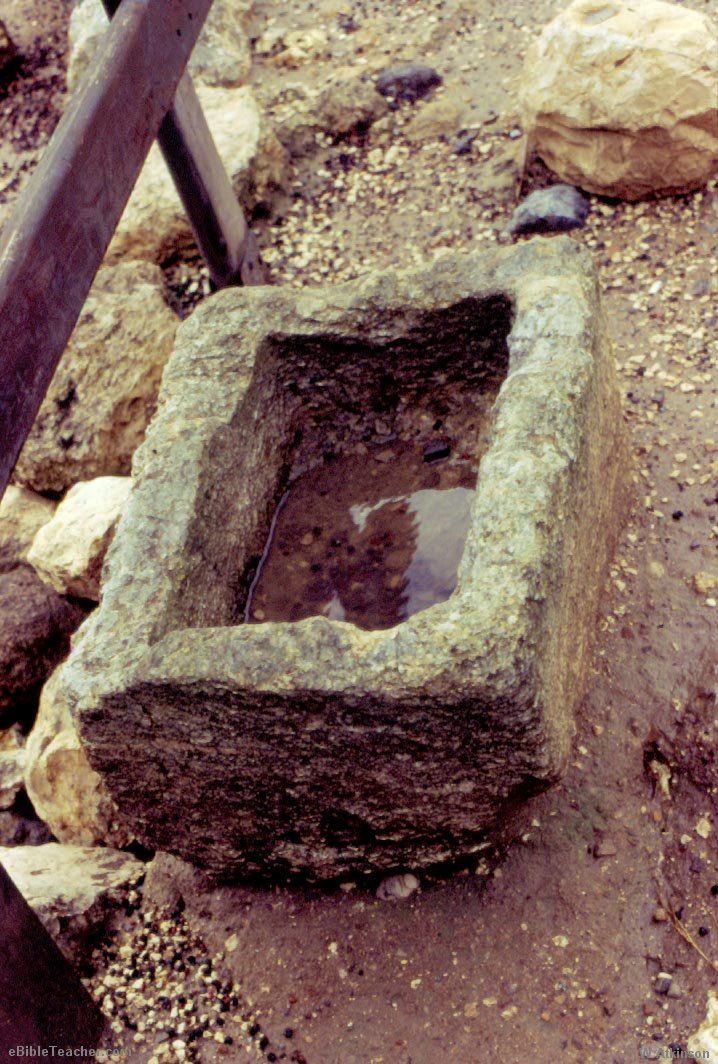 One thing we need to see is that the Infant was placed in a feeding trough for animals (see, for example, the illustration at left depicting a stone manger from Israel, which would have been similar to the one in which Jesus was laid on).
Early iconographers seem to be aware of a sort of connection between the Nativity and the Eucharist (John 6:51-58), as in many of these representations the animals push their muzzles into the manger as if to eat from it (or nibbling at the Child's hand). The manger itself was depicted as something similar to a bread-basket or even as a raised structure somewhat similar to an Altar. In fact, in some of the above depictions architectural elements block the view of and segregate the beasts, shepherds and angels from the inner sanctum like a rood screen, who are looking on the Infant in quiet reverence like worshippers in a medieval Church.
In these images Christ is presented not as the cute baby of our Christmas cards but as the spotless Lamb of God destined for a sacrifice on the cross that will be revisited in the Eucharist. El Greco makes the emphasis on sacrifice rather explicit in his depiction of the Adoration of the Shepherds where the inclusion of a trussed lamb identifies the child as the sacrificial Lamb "who will take away the sins of the world."
 In Eastern iconography, there came a type of image depicting the infant Christ either lying on the altar or within a paten covered by the asterisk, with his midsection covered by a liturgical cloth (see left portion of the icon at right). This was known as the melismos ("breaking"), with the name coming from the action of breaking the consecrated bread, known as Amnos in Greek or Amnets in Slavonic, both meaning "Lamb", with a scalpel called a "spear" (in reference to the spear that pierced the side of Jesus; John 19:33-37) that the priest performs just before distributing Holy Communion.
"Broken and distributed is the Lamb of God; broken yet not divided, ever eaten yet is never consumed, but sanctifies those who partake of Him."The diskos itself (which answers to the paten of the Western Church), on which the Lamb is laid, is taken to be representative either of the manger or Mary, who bore Christ in her womb, and at the same time, the tomb on which Jesus was laid. The asteriskos meanwhile represents the star of Bethlehem (Matthew 2:9 is even quoted as the asteriskos is placed over the Lamb before the start of the Divine Liturgy), while the veil called aër (vózdukh), which covers both the diskos and the chalice, represents both the swaddling-clothes and the shroud which covered the Lord during burial.
The connection between the manger and the cross is also evident in another element of Eastern icons of the Nativity: in it the infant Jesus is bound, mummy-like, by strips of cloth (which is similar to the depiction of the Lord's grave clothes in burial) and rests in a raised structure, which in addition to its (vague) resemblance to an altar, also looks like a stone coffin.


The final connection between the Eucharist and Christmas we can make is the name of Bethlehem itself. Beit Lehem (בית לחם) is Hebrew for "House of Bread" (the Arabic name بيت لحم Bayt Laḥm is also interesting, as it literally means "House of Lamb" or "House of Meat"!); how fitting it is that the One who said He was the bread of life (John 6:35) was born in the House of Bread!
December 25 - The Nativity of Our Lord and Savior Jesus Christ
(Hebrews 1:1-12)
God, who at various times and in various ways spoke formerly to the fathers by the prophets, has in these last days spoken to us in a Son, whom He appointed heir of all things, and by whom He created the ages, who being the brightness of His glory and the representation of His substance, and sustaining all things by the word of His power, when He had made purification of sins, sat down at the right hand of the Majesty on high, having become so much better than the angels, as He has inherited a name superior to theirs.
For to which of the angels did He say at any time, "You are my Son, today I have begotten you"? And again, "I will be to Him a Father and He will be to me a Son." And again when He brings the Firstborn into the world, He says: "And let all the angels of God worship him.”
And of the angels He says, "He who makes His messengers winds, and His ministers a flame of fire," but of the Son, "Your throne, O God, is forever and ever, and a righteous scepter is the scepter of your kingdom. You have loved righteousness and hated iniquity; therefore God, your God, has anointed you with the oil of gladness over your companions."
And, "Lord, in the beginning you founded the earth, and the heavens are the works of your hands. They will perish, but you continue; and they will all grow old like a garment; and like a cloak you will fold them up and they will be changed, but you are the same, and your years will not fail.”
(John 1:1-14)
In the beginning was the Word, and the Word was with God, and the Word was God. He was in the beginning with God. All things came into being through Him, and apart from Him nothing came into being that has come into being.
 In Him was life, and the life was the light of men. And the light shines on in the darkness, and the darkness did not overcome it.
There came a man sent from God, whose name was John. This man came for a testimony, to bear witness of the Light, so that all through Him might believe. He was not the Light, but he came to bear witness about the Light. The true Light which gives light to every man was coming into the world.
He was in the world, and the world came into being through Him, and the world did not know Him. He came to His own, and His own received Him not. But as many as received Him, to them He gave power to become children of God, to those who believe in His Name: who were born, not of bloods nor of the will of the flesh nor a man's decision but of God.
And the Word became flesh and tabernacled among us, (and we saw His glory, the glory as of the only-begotten of the Father,) full of grace and truth.
God, who at various times and in various ways spoke formerly to the fathers by the prophets, has in these last days spoken to us in a Son, whom He appointed heir of all things, and by whom He created the ages, who being the brightness of His glory and the representation of His substance, and sustaining all things by the word of His power, when He had made purification of sins, sat down at the right hand of the Majesty on high, having become so much better than the angels, as He has inherited a name superior to theirs.
For to which of the angels did He say at any time, "You are my Son, today I have begotten you"? And again, "I will be to Him a Father and He will be to me a Son." And again when He brings the Firstborn into the world, He says: "And let all the angels of God worship him.”
And of the angels He says, "He who makes His messengers winds, and His ministers a flame of fire," but of the Son, "Your throne, O God, is forever and ever, and a righteous scepter is the scepter of your kingdom. You have loved righteousness and hated iniquity; therefore God, your God, has anointed you with the oil of gladness over your companions."
And, "Lord, in the beginning you founded the earth, and the heavens are the works of your hands. They will perish, but you continue; and they will all grow old like a garment; and like a cloak you will fold them up and they will be changed, but you are the same, and your years will not fail.”
(John 1:1-14)
In the beginning was the Word, and the Word was with God, and the Word was God. He was in the beginning with God. All things came into being through Him, and apart from Him nothing came into being that has come into being.
 In Him was life, and the life was the light of men. And the light shines on in the darkness, and the darkness did not overcome it.
There came a man sent from God, whose name was John. This man came for a testimony, to bear witness of the Light, so that all through Him might believe. He was not the Light, but he came to bear witness about the Light. The true Light which gives light to every man was coming into the world.
He was in the world, and the world came into being through Him, and the world did not know Him. He came to His own, and His own received Him not. But as many as received Him, to them He gave power to become children of God, to those who believe in His Name: who were born, not of bloods nor of the will of the flesh nor a man's decision but of God.
And the Word became flesh and tabernacled among us, (and we saw His glory, the glory as of the only-begotten of the Father,) full of grace and truth.
Subscribe to:
Posts (Atom)